The right capture card can turn a laptop into a flexible streaming, recording, or video-conferencing workstation. These 10 options cover everything from DSLR connectivity to console gameplay and portable USB-C setups.
Before choosing, check your laptop ports, target resolution, frame rate, passthrough needs, and whether you need features such as loop-out, game audio support, or USB-C power delivery.
Best 10 Capture Card for Laptop Picks for 2026
Best Camera-to-Computer Pick

- 1080p60 and 4K capture support
- Ultra-low latency for synced video and audio
- Works with cameras, OBS, Zoom, Mac, PC, and iPad
Best For: Creators turning a camera into a webcam or streaming source
Best Flexible USB Interface
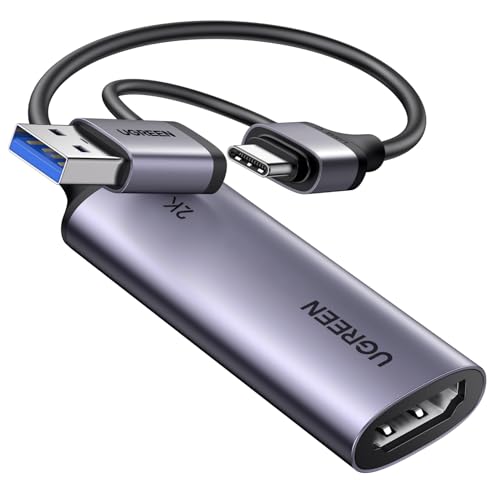
- Captures up to 2K30 and 1080p60
- Offers USB-A and USB-C connectivity
- Supports Windows, macOS, Linux, phones, and tablets
Best For: Multi-device streaming and recording across laptop and tablet setups
Best High-Frame-Rate Gaming Pick

- Captures gameplay at 4K60
- Supports 1440p120 and 1080p240 passthrough
- Adds HDR10 support and analog audio input
Best For: Console gamers using PS5, Xbox Series X/S, or Switch 2
Best Loop-Out Value
UGREEN 2K HDMI Capture Card with Loop-Out

- Captures up to 2K30 or 1080p60
- Includes 4K30 HDMI input and loop-out
- Provides USB-A and USB-C connectivity
Best For: Streamers who want direct-monitoring gameplay capture
USB 2.0 Starter Pick
Audio Express AXHDCAP 4K HDMI Capture Card

- 4K HDMI input; captures up to 1080p at 30Hz
- Plug-and-play across Windows, macOS, and Linux
- USB 2.0 design is not intended for 60fps capture
Best For: Basic streaming, recording, teaching, and video conferencing
Flexible 60fps Choice
XIIXMASK USB 3.0 HDMI Capture Card

- 1080p60 or 1440p30 capture over USB 3.0
- 4K60 HDMI input and loop-out
- Mic-in and USB-A/USB-C compatibility
Best For: Gaming, streaming, and commentary from a laptop
Complete Streaming Kit
Portta 1080p60 HDMI Capture Card

- 1080p60 USB 3.0 capture with 4K60 loop-out
- Includes HDMI cable, USB cable, and USB-C adapter
- Two-year warranty and lifetime technical support
Best For: Console streaming and content creation with a laptop
Versatile 4K Preview Capture
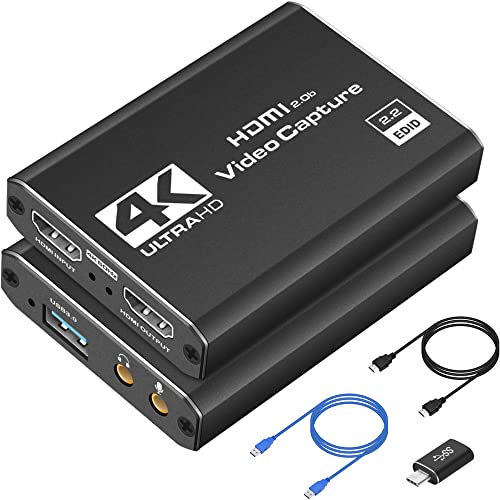
- 1080p 60fps recording with 4K HDMI preview
- Plug-and-play support for Windows and Mac
- Works with consoles, PCs, and cameras
Best For: Gamers and creators needing portable USB 3.0 capture
USB-C Flexible Capture
Papeaso 1080P60 HDMI Capture Card

- 1080p 60fps HDMI recording
- USB-C connection with included adapter
- Works with Windows, Mac, Linux, and Android
Best For: USB-C laptop users recording games, cameras, or meetings
Charging Capture Hub
Hagibis 100W PD USB 3.0 Capture Card

- 1080p 60fps recording from 4K 60Hz input
- USB-A and USB-C dual-interface design
- Supports up to 100W PD charging
Best For: Laptop and mobile setups needing capture plus charging
Best Camera-to-Computer Pick – Elgato Cam Link 4K
If you want a dependable capture card for laptop use with a DSLR, mirrorless camera, camcorder, or action camera, the Elgato Cam Link 4K is a compact option designed for high-quality live video. It connects over USB 3.0 and supports 1080p60 or 4K capture with compatible equipment.
Best For: Creators who want to use a camera as a webcam for streaming, video calls, or recording on a PC, Mac, or compatible iPad.
Pros:
- Supports 1080p60 and 4K capture
- Ultra-low latency helps keep video and audio in sync
- Works with cameras, camcorders, action cameras, and iPhone sources
- Compatible with OBS, Zoom, Discord, PC, Mac, and iPad
Cons:
- Requires a compatible camera and HDMI source
- Maximum capabilities depend on the specific Cam Link 4K model and connected equipment
- Its focus is camera capture rather than console-specific features
The Cam Link 4K is a strong fit when camera quality matters more than gaming extras. Its compact design, broad software compatibility, and low-latency USB 3.0 connection make it practical for a laptop-based streaming setup.
Best Flexible USB Interface – UGREEN 2K HDMI Capture Card
This UGREEN capture card for laptop setups combines HDMI input with both USB-A and USB-C connectivity. It supports up to 2K at 30fps, 1080p at 60fps, and 4K input, making it a versatile choice for recording or streaming console, camera, and mobile-device content.
Best For: Users who need broad device and operating-system compatibility, including Windows, macOS, Linux, phones, tablets, and USB-C iPads running iPadOS 17 or later.
Pros:
- Supports 2K30 and 1080p60 capture with 4K input
- Includes both USB-A and USB-C interfaces
- Works with OBS, XSplit, PotPlayer, VLC, and QuickTime Player
- Aluminum housing and 5 Gbps USB 3.0 transfer help support stable operation
Cons:
- Only accepts HDMI input and sends the signal out over USB
- Console capture may require HDCP to be disabled
- USB-C iPad use requires iPadOS 17 or later
With dual USB connectors and driver-free support across several platforms, this model is a practical all-purpose choice. It is especially useful when the same capture card needs to move between laptops, desktops, tablets, and phones.
Best High-Frame-Rate Gaming Pick – Elgato 4K S
For console players looking for a high-performance capture card for laptop gaming, the Elgato 4K S supports 4K60 capture and high-frame-rate passthrough. It is built for systems such as the PS5, Xbox Series X/S, and Switch 2, while also adding HDR10 support and an analog audio input.
Best For: Gamers who want to capture console gameplay while preserving high-refresh-rate play at 1440p120 or 1080p240.
Pros:
- Captures video in 4K60
- Supports 1440p120 and 1080p240 passthrough
- HDR10 support with tone mapping on Windows
- Includes a 3.5mm analog audio input for chat or commentary
Cons:
- Requires a USB 3.0 Type-C port
- System requirements include Windows 11 or macOS 13 and newer, depending on platform
- More specialized for console gaming than general camera capture
The 4K S stands out for gamers who do not want capture hardware to limit their display settings. Its high-frame-rate passthrough, 4K60 recording, and audio input make it a capable centerpiece for a modern laptop streaming setup.
Best Loop-Out Value – UGREEN 2K HDMI Capture Card with Loop-Out
This UGREEN capture card for laptop streaming adds HDMI loop-out for real-time monitoring while recording up to 2K at 30fps or 1080p at 60fps. Its USB-A and USB-C connectivity, plug-and-play setup, and support for common streaming platforms make it suitable for gaming and general video capture.
Best For: Streamers who want to monitor HDMI gameplay on a display with minimal delay while sending the recording feed to a laptop or PC.
Pros:
- Supports 2K30 and 1080p60 capture
- Provides 4K30 input and HDMI loop-out
- Offers USB-A and USB-C recording interfaces
- Works with Windows, macOS, Linux, Android, OBS, and XSplit
Cons:
- Does not support 4K capture
- PS4 and PS5 use requires HDCP to be turned off
- Not compatible with Fire TV Stick; iPhone cannot serve as a data acquisition device
The loop-out connection is the main advantage here, letting you play or preview on a separate display without relying solely on the laptop feed. Choose it over a basic capture card when direct monitoring and flexible USB connectivity are priorities.
USB 2.0 Starter Pick – Audio Express AXHDCAP 4K HDMI Capture Card
If you need a straightforward capture card for laptop use, the Audio Express AXHDCAP is a plug-and-play option for recording HDMI video through USB 2.0. It accepts HDMI input up to 4K at 30Hz and captures up to 1080p at 30Hz with stereo sound.
Best For: Basic streaming, online teaching, video conferences, and recording footage from cameras or other HDMI sources.
Pros:
- Supports HDMI input up to 3840×2160 at 30Hz.
- Captures video up to 1920×1080 at 30Hz with stereo audio.
- Plug-and-play design works with Windows, macOS, and Linux without external power.
Cons:
- USB 2.0 limits capture output to 1080p at 30Hz.
- It cannot add HDMI output to a laptop or computer that lacks HDMI out.
The AXHDCAP is best suited to users who value simple setup over high-frame-rate capture. Consider a USB 3.0 model if smooth 60fps gameplay is a priority.
Flexible 60fps Choice – XIIXMASK USB 3.0 HDMI Capture Card
For a capture card for laptop setups that need smoother video, the XIIXMASK combines USB 3.0 connectivity with 1080p at 60fps capture and 4K at 60Hz loop-out. Its dual USB-A/USB-C compatibility and mic-in port make it adaptable for gaming and live commentary.
Best For: Console gaming, live streaming, online meetings, and creators who want 1080p60 capture with external voice input.
Pros:
- Captures up to 1080p at 60fps or 1440p at 30fps.
- Supports 4K at 60Hz HDMI input and loop-out.
- Includes mic-in support and a USB-A/USB-C connection cable.
- Works with OBS, Twitch, YouTube, Zoom, Windows, macOS, Linux, and other listed platforms.
Cons:
- The mic-in feature does not record party chats.
- OBS may need to be restarted after audio setup.
This is a versatile midrange pick for laptop users who want smooth 1080p gameplay capture and convenient connectivity. Its loop-out is useful when you want to pass the signal to a display while recording.
Complete Streaming Kit – Portta 1080p60 HDMI Capture Card
The Portta is a practical capture card for laptop streaming when you want 1080p at 60fps recording plus 4K HDMI loop-out. It includes the main connection cables and adapter, supports OBS and UVC/UAC applications, and comes with a two-year warranty and lifetime technical support.
Best For: Console streamers, content creators, and laptop users who want a ready-to-connect 4K pass-through and 1080p60 capture setup.
Pros:
- Captures 1080p at 60fps through USB 3.0.
- Supports 4K at 60Hz HDMI input and loop-out, plus 3.5mm audio out and mic-in.
- Includes an HDMI cable, USB-A cable, and USB-C adapter.
- Offers plug-and-play compatibility with Windows, macOS, and Linux.
Cons:
- Does not support HDR or CEC.
- Requires a relatively capable computer, with the manufacturer recommending a quad-core i5/Ryzen 5 or better and 8GB RAM.
- Microphone audio is not passed to the HDMI output or TRS headphones/speakers.
The Portta stands out when you want a more complete package rather than just the capture device. Its included accessories and warranty add convenience, while the 1080p60 capture suits smooth gameplay and live production.
Versatile 4K Preview Capture – 1080P60 USB Capture Card
This capture card for laptop use is a practical choice for recording or streaming HDMI video at up to 1080p 60fps. Its USB 3.0 connection, plug-and-play setup, and broad console and camera compatibility make it suitable for creators who want a straightforward setup with low-latency performance.
Best For: Gamers and content creators using a Windows PC, Mac, laptop, or MacBook with a USB 3.0 port.
Pros:
- Captures or records up to 1080p at 60fps with 4K HDMI real-time preview.
- Works without drivers and supports OBS Studio, Streamlabs, and XSplit.
- Compatible with PS5, PS4, Xbox, Nintendo Switch, PCs, and cameras.
- Includes USB and USB-C connection accessories for flexible setup.
Cons:
- Requires a USB 3.0 port for use.
- Its maximum recorded output is 1080p at 60fps rather than 4K recording.
Choose this model if you want a compact, portable capture card for laptop streaming with 1080p60 recording and 4K passthrough-style preview. It is especially useful for moving between gaming setups or recording locations.
USB-C Flexible Capture – Papeaso 1080P60 HDMI Capture Card
This capture card for laptop setups connects through USB-C and is designed for 1080p 60fps recording from HDMI sources. It supports Windows, macOS, and Linux without requiring drivers, making it a flexible option for streaming, online meetings, game capture, and video recording.
Best For: Laptop, Mac, or Linux users who prefer USB-C connectivity and need compatibility with consoles, cameras, or other HDMI devices.
Pros:
- Records video at up to 1080p 60fps from HDMI sources.
- USB-C connectivity works with Windows, Android, Mac OS X, and Linux systems.
- Supports streaming and recording software including OBS, PotPlayer, and VLC.
- Includes a USB-C converter adapter for connecting to USB devices.
Cons:
- Uses USB 2.0 technology rather than USB 3.0.
- The listed capture resolution is limited to 1080p.
The Papeaso is a sensible pick when USB-C compatibility matters more than advanced passthrough features. Its driver-free operation and wide device support simplify laptop-based streaming and recording.
Charging Capture Hub – Hagibis 100W PD USB 3.0 Capture Card
This capture card for laptop use combines HDMI video capture with USB-A and USB-C connectivity and 100W Power Delivery charging. It records at up to 1080p 60fps from 4K 60Hz input, making it useful for laptop, tablet, phone, and VR streaming setups that need charging while capturing.
Best For: Users who want dual USB connectivity and pass-through charging while capturing console or HDMI video.
Pros:
- Supports up to 4K 60Hz input and 1080p 60fps recording.
- Offers both USB-A and USB-C interfaces for broader device compatibility.
- Supports up to 100W PD charging while in use.
- Works with Windows, macOS, Linux, phones, tablets, and software such as OBS and XSplit.
Cons:
- Only accepts HDMI input sources.
- iPadOS devices require iPadOS 17 or later.
- Console use may require HDCP to be disabled.
The Hagibis stands out for setups where charging and capture need to happen together. Its dual-interface design and 100W PD support add flexibility, while its 1080p60 output fits typical laptop streaming workflows.
How We Picked the Best Capture Card for Laptop Use
We focused on compatibility, supported input and capture resolutions, connection type, latency, passthrough functionality, and practical setup requirements. The selection includes simple USB capture devices, higher-bandwidth USB 3.0 models, console-focused cards, camera adapters, and options with USB-C or power-delivery support.
Input resolution and captured resolution are not always the same. Several cards accept a 4K HDMI signal but record at 1080p, while others offer 2K or 4K capture under specific frame-rate conditions. Always verify the manufacturer’s specifications for your exact source device and software.
Quick Comparison
| Feature | What to Look For | Best Fit |
|---|---|---|
| Capture resolution | 1080p at 60 fps for smooth mainstream streaming; higher resolutions for detailed recording | Gaming, tutorials, and live video |
| Input support | 4K input or HDMI compatibility matched to your camera or console | Modern consoles and mirrorless cameras |
| Connection | USB 3.0 or USB-C for higher bandwidth and broad laptop compatibility | Windows laptops and newer ultraportables |
| Passthrough | HDMI loop-out when you want to play on a monitor while recording | Low-latency console streaming |
| Power features | USB-C power delivery where a connected device needs charging | Portable setups and compatible headsets |
Key Buying Factors for a Capture Card for Laptop
Resolution and Frame Rate
For most streaming, 1080p at 60 fps is the practical target. It produces fluid gameplay and clear camera footage without placing excessive demands on the laptop. A 4K-input card can be useful when your source outputs 4K, but confirm whether it captures 4K or only passes it through.
USB Bandwidth and Compatibility
USB 3.0 is generally preferable for 1080p60 and higher-bandwidth workflows. USB 2.0 models can be suitable for basic recording, but they may impose lower frame rates or compression. Check whether your laptop has USB-A, USB-C, or requires an adapter, and connect the card directly when possible.
Latency, Loop-Out, and Audio
Low latency matters for interactive gaming and live production. HDMI loop-out lets you send the original signal to a monitor or television while the laptop handles capture. If you plan to use console or camera audio, confirm that the card supports the required HDMI audio format and that your streaming software recognizes it correctly.
Software and Setup
Many capture cards work as plug-and-play UVC devices with applications such as OBS Studio, Zoom, Teams, and camera software. You may still need to select the capture card as both a video and audio source, adjust resolution settings, and install manufacturer software for advanced controls.
Who Should Buy Which Capture Card for Laptop?
- Camera users: Choose a camera-oriented HDMI-to-USB option such as the Elgato Cam Link 4K.
- Console streamers: Prioritize 1080p60 capture, low latency, and HDMI loop-out; the Elgato, UGREEN, Portta, and similar USB 3.0 models are worth comparing.
- Budget buyers: A basic 1080p USB capture card can handle occasional streaming, presentations, and recording.
- USB-C laptop owners: Look for native USB-C connectivity or include a reliable adapter in your setup.
- Portable or headset-based setups: Consider the Hagibis model if its USB-C and power-delivery features match your equipment.
For the best overall balance, prioritize a USB 3.0 connection, 1080p60 capture, broad HDMI compatibility, and clear audio handling. Choose 4K support only when it serves a specific camera, console, or passthrough requirement.