Choosing the right SDI streaming encoder can simplify live production while preserving the video quality, connectivity, and protocol support your workflow demands. The products in this roundup range from compact HD units to professional 4K encoders with recording, NDI, PoE, and multi-input capabilities.
Use the guide below to compare essential features, understand compatibility requirements, and narrow the selection based on resolution, streaming platform, portability, and production complexity.
Best 10 Streaming Encoders with Sdi Picks for 2026
Best Multi-Platform 4K Pick
URayCoder 4K SDI-to-IP Encoder

- 4K input at up to 30fps
- Four simultaneous protocol outputs
- Lifetime support and customization options
Best For: Multi-platform 4K livestreaming and advanced SDI workflows
Best Compact Broadcast Option
Blackmagic Streaming Encoder HD

- 12G-SDI input and loop output
- 1080p60 encoding
- H.264 and H.265 support
Best For: Straightforward 1080p60 broadcast streaming
Best Value SDI IP Encoder
URayCoder HD-SDI Stream Encoder

- Four simultaneous video streams
- Broad protocol compatibility
- Lifetime support and customization
Best For: Flexible HD-SDI and IPTV distribution
Best Encoder and Recorder Combo

- HDMI and 3G-SDI support
- 1080p60 streaming and recording
- USB-C capture and OLED controls
Best For: Portable events and stream-plus-record workflows
Best Professional 4K SDI Encoder
Magewell Ultra Encode SDI Plus

- 4K SDI encoding up to 4096×2160p30
- Multi-protocol, multi-destination streaming
- Simultaneous recording with PoE and Wi-Fi
Best For: Professional SDI production and contribution workflows
Best Budget 1080p SDI Encoder
AVMATRIX SE2017 HDMI/SDI Encoder

- HDMI and SDI support up to 1080p60
- Records to USB or SD card
- Includes USB-C capture and PoE
Best For: Affordable HD events, conferences, and church streaming
Best Dual-Input 4K SDI Encoder

- HDMI and SDI 4K encoding in one unit
- Mixes inputs with PiP or side-by-side layouts
- Streams to up to six destinations
Best For: Flexible multi-source live production and 4K streaming
Flexible SDI Gateway
ZowieBox 3G SDI Encoder Decoder
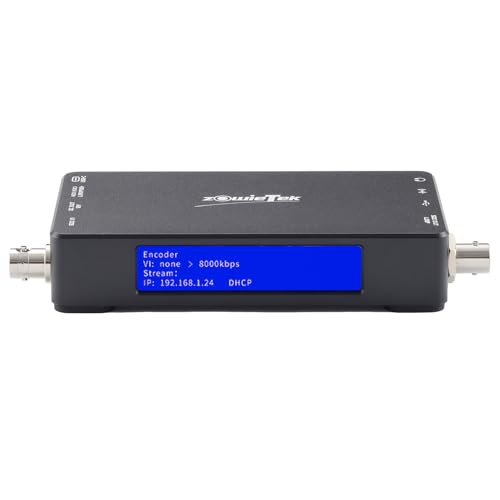
- Encodes SDI to SRT, RTMP(S), or RTSP
- Bridges SDI and UVC workflows
- Supports PoE, loopout, and H.264/H.265
Best For: Mixed SDI, IP video, and UVC production setups
4K Broadcast Powerhouse
Blackmagic Streaming Encoder 4K
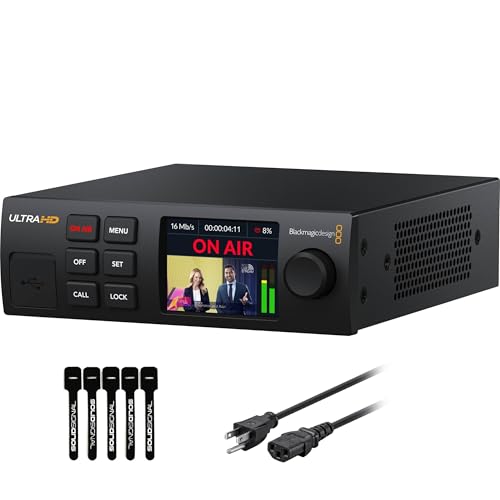
- Encodes up to 2160p60 in H.264 or H.265
- Includes 12G-SDI input and standards conversion
- Supports Ethernet, mobile failover, and webcam output
Best For: Professional 4K broadcast and redundant streaming
Multi-Platform HD Streamer

- Streams up to 1080p60
- Outputs up to three video streams simultaneously
- Supports broad protocols and graphic overlays
Best For: HD SDI broadcasts targeting multiple platforms
Best Multi-Platform 4K Pick – URayCoder 4K SDI-to-IP Encoder
For buyers comparing streaming encoders with SDI, this URayCoder model stands out for 4K input support, flexible protocol choices, and multi-platform distribution. It can encode up to 3840×2160 at 30fps, while lower resolutions can reach up to 120fps.
Best For: Multi-platform livestreaming, 4K SDI workflows, and users who need customizable overlays and stream settings.
Pros:
- Supports 4K UHD input and H.264/H.265 encoding.
- Can output up to four streams using different protocols.
- Offers overlays, captions, logos, timestamps, and video adjustments.
- Includes lifetime warranty and technical support.
Cons:
- Its extensive settings may be more than basic users need.
- 4K operation is limited to 30fps.
This is a feature-rich choice for production teams and advanced streamers who want SDI connectivity alongside broad protocol and customization support.
Best Compact Broadcast Option – Blackmagic Streaming Encoder HD
The Blackmagic Design Streaming Encoder HD is a focused option for streaming encoders with SDI, supporting 12G-SDI input and loop output. It handles 1080p at 60fps and supports both H.264 and H.265 codecs.
Best For: Broadcast-oriented users who need a straightforward 1080p60 encoder with 12G-SDI connectivity.
Pros:
- Supports 12G-SDI input and loop output.
- Encodes 1080p video at 60fps.
- Offers both H.264 and H.265 codec support.
- Includes a two-year manufacturer guarantee.
Cons:
- Maximum listed resolution is 1080p rather than 4K.
- The supplied specifications provide fewer protocol and workflow details than some competing models.
Choose this model when dependable SDI integration and 1080p60 performance matter more than extensive built-in stream customization.
Best Value SDI IP Encoder – URayCoder HD-SDI Stream Encoder
This URayCoder unit is a practical choice among streaming encoders with SDI for HD broadcast and IPTV applications. It supports H.264/H.265 encoding, multiple streaming protocols, and simultaneous delivery to different servers.
Best For: HD-SDI livestreaming, IPTV distribution, and custom streaming setups that need several output protocols.
Pros:
- Supports HTTP, RTSP, RTMP(S), SRT, HLS, UDP, multicast, and other protocols.
- Can output four video streams simultaneously.
- Allows text, logos, timestamps, cropping, rotation, and mirroring.
- Includes lifetime technical support and warranty.
Cons:
- Designed for HD/3G-SDI rather than 4K input.
- Only one SDI port is listed in the specifications.
Its combination of protocol flexibility, multi-stream output, and customization makes it well suited to operators building adaptable HD streaming systems.
Best Encoder and Recorder Combo – AVMATRIX SE2017
The AVMATRIX SE2017 combines SDI and HDMI encoding with local recording, making it a versatile option among streaming encoders with SDI. It supports up to 1080p60, records to SD cards or USB disks, and can send streams to multiple platforms.
Best For: Portable production, event streaming, webcam capture, and workflows that need both live output and local recording.
Pros:
- Accepts HDMI and 3G-SDI inputs with loop outputs.
- Supports streaming and recording up to 1080p60.
- Records to SD card or USB storage.
- Provides USB-C capture, PoE networking, OLED status display, and onboard controls.
Cons:
- Maximum listed resolution is 1080p.
- Some setup details, including software update support, are unspecified.
For creators who want a compact device that can stream, record, and function as a USB capture source, the SE2017 offers broader production utility than a basic encoder.
Best Professional 4K SDI Encoder – Magewell Ultra Encode SDI Plus
For production teams seeking streaming encoders with SDI, the Magewell Ultra Encode SDI Plus is a compact standalone option built around 6G-SDI input. It supports 4K encoding, multiple streaming protocols, onboard recording, overlays, and flexible network connectivity for professional live workflows.
Best For: Professional live production, remote contribution, corporate AV, education, houses of worship, and hybrid NDI|HX workflows.
Pros:
- Encodes SDI video up to 4096×2160p30 using H.264 or H.265.
- Supports RTMP, RTMPS, SRT, NDI|HX, HLS, and TS over UDP/RTP.
- Streams and records simultaneously to internal, USB, or network storage.
- Includes overlays, web/API control, Wi-Fi, Gigabit Ethernet, and PoE.
Cons:
- SDI-focused design does not list HDMI input support.
- 4K SDI encoding is limited to 30 frames per second.
- 4G/5G modem support requires a separate USB modem.
The Ultra Encode SDI Plus is a strong fit when dependable SDI connectivity and advanced workflow support matter more than a basic plug-and-stream setup. Its recording, protocol, and control options make it suitable for installations that may expand over time.
Best Budget 1080p SDI Encoder – AVMATRIX SE2017 HDMI/SDI Encoder
The AVMATRIX SE2017 is a practical choice among streaming encoders with SDI for HD productions, conferences, and events. It combines HDMI and SDI video handling with recording, USB-C capture, loopout, PoE, and common network streaming protocols in one compact unit.
Best For: 1080p60 broadcasting, conferences, churches, classrooms, and straightforward HDMI/SDI streaming setups.
Pros:
- Supports HDMI and SDI inputs with loopout functionality.
- Streams using RTSP, RTMP/RTMPS, SRT, HTTP-FLV, unicast, and multicast.
- Records MP4 or TS files to USB or SD card at up to 1080p60.
- Offers USB-C capture, up to 32 Mbps encoding, and PoE power.
Cons:
- Maximum listed resolution is 1080p rather than 4K.
- The line audio input does not support a microphone input.
- Supplied details list a one-year warranty.
Choose the SE2017 when you need broad HD connectivity without the added complexity of a 4K production encoder. Its combination of capture, recording, streaming, and PoE makes it especially useful for fixed conference or house-of-worship installations.
Best Dual-Input 4K SDI Encoder – Magewell Ultra Encode AIO
For buyers comparing streaming encoders with SDI that also need HDMI flexibility, the Magewell Ultra Encode AIO offers both inputs in one production-oriented device. It supports 4K encoding, dual-input mixing, up to six simultaneous destinations, recording, overlays, and NDI|HX3 workflows.
Best For: Live producers needing HDMI/SDI flexibility, picture-in-picture or side-by-side layouts, and advanced 4K streaming workflows.
Pros:
- Accepts HDMI up to 4096×2160p60 and SDI up to 4096×2160p30.
- Combines HDMI and SDI using picture-in-picture or side-by-side layouts.
- Streams to up to six destinations with RTMP, SRT, NDI|HX2/HX3, HLS, and more.
- Records while streaming and supports overlays, PoE, Wi-Fi, and API control.
Cons:
- SDI input is limited to 4K at 30 frames per second.
- Its rack-mountable production form factor may be more than simple setups require.
- The supplied details do not specify a built-in storage capacity.
The Ultra Encode AIO is the most versatile option here for mixed-source productions. Its dual-input layouts and six-destination capability are particularly valuable when a workflow must combine cameras, computers, or other HDMI and SDI sources.
Flexible SDI Gateway – ZowieBox 3G SDI Encoder Decoder
For creators and production teams comparing streaming encoders with SDI, the ZowieBox stands out as a versatile bidirectional converter. It can encode SDI to SRT, RTMP(S), or RTSP, decode those streams back to SDI, and bridge SDI or UVC sources into computer-based workflows.
Best For: Live events, conferences, sports, webinars, and productions needing SDI, IP video, and UVC flexibility.
Pros:
- Supports SDI-to-SRT, RTMP(S), and RTSP encoding plus reverse decoding.
- Converts SDI equipment to a UVC webcam and UVC H.264 sources to SDI.
- Includes SRT support, SDI loopout, H.264/H.265 encoding, PoE, and standalone operation.
Cons:
- Designed for SDI workflows rather than HDMI input.
- Its 3G-SDI positioning is less suited to 4K production.
The ZowieBox is a strong choice when one compact unit needs to handle multiple signal-conversion tasks. Its broad protocol support and flexible power options are especially useful for portable or mixed-format setups.
4K Broadcast Powerhouse – Blackmagic Streaming Encoder 4K
For buyers seeking streaming encoders with SDI and Ultra HD capability, the Blackmagic Design Streaming Encoder 4K is a self-contained option with a 12G-SDI input, up to 2160p60 support, and H.264 or H.265 streaming over SRT or RTMP.
Best For: Professional 4K live production, broadcast workflows, and streams that need connection redundancy or advanced control.
Pros:
- Supports DCI 4K60 input and H.264/H.265 encoding without an encoding PC.
- Provides 12G-SDI loop output, HDMI and SDI monitor outputs, and standards conversion.
- Offers Gigabit Ethernet, USB-C mobile failover, webcam output, captions, timecode, and REST API control.
Cons:
- Its advanced feature set may be more than a basic streaming setup requires.
- Remote camera control, tally, and talkback depend on compatible Blackmagic cameras and equipment.
This is the most capable option of the group for high-resolution production and broadcast integration. Automatic standards conversion and network failover add practical resilience, while the front-panel controls and monitor outputs help reduce dependence on a computer.
Multi-Platform HD Streamer – AVMATRIX SE1117 SDI Encoder
The AVMATRIX SE1117 is a practical pick among streaming encoders with SDI for HD-focused productions. It supports encoding up to 1080p60, multiple streaming protocols, simultaneous output to as many as three streams, and custom graphic overlays.
Best For: HD event streaming and creators who want to send one SDI production to multiple platforms.
Pros:
- Supports up to three simultaneous video streams for multi-platform distribution.
- Handles HTTP, RTSP, RTMP, RTMPS, SRT, UDP, RTP, multicast, and unicast protocols.
- Provides HDMI loopout along with image and text overlay features.
Cons:
- Resolution is limited to 1080p60 rather than 4K.
- The supplied details identify HDMI loopout, but do not specify an SDI loop output.
The SE1117 makes sense for straightforward HD workflows where protocol choice and multi-platform publishing matter more than Ultra HD resolution. Its overlays and loopout add useful monitoring and branding options for live broadcasts.
How We Picked the Best Streaming Encoders with Sdi
We focused on encoder features that have the greatest effect on real-world live production: SDI format support, maximum resolution and frame rate, streaming protocols, audio handling, network connectivity, recording options, and setup flexibility. The selection includes dedicated SDI models as well as units that add HDMI, USB capture, NDI|HX, PoE, or dual-input production features.
Protocol support matters because platforms and workflows vary. RTMP and RTMPS are common for online services, while SRT is useful when a more resilient contribution link is needed. RTSP, UDP, HLS, and NDI can be valuable for IPTV, internal networks, monitoring, and studio distribution.
Quick Comparison
- HD-focused options: Best for 1080p broadcasts, classrooms, houses of worship, conferences, and smaller production systems.
- 4K-capable options: Better for UHD capture, premium event work, higher-resolution archives, and future-proofing.
- Standalone encoders: Designed to convert an SDI source directly into network video without requiring a computer.
- Encoder-recorders: Add local recording for backup copies, editing, or delayed publishing.
- Hybrid models: Combine SDI with HDMI, USB capture, NDI, or input mixing for more flexible setups.
Key Buying Factors for Streaming Encoders with Sdi
SDI Format and Resolution
Confirm whether your cameras or switchers output SD, HD-SDI, 3G-SDI, 6G-SDI, or another standard. A 1080p60 workflow generally needs 3G-SDI support, while 4K production may require 6G-SDI or a higher-bandwidth connection. Also check whether the encoder accepts your exact frame rate and progressive or interlaced format.
Protocols and Platform Compatibility
Choose an encoder that supports the destinations you actually use. RTMPS is important for many cloud platforms, SRT is suited to unstable networks and remote contribution, and NDI|HX can integrate with compatible production software and hardware. Multiple protocol options provide more flexibility but may increase setup complexity.
Network, Audio, and Recording Features
Wired Ethernet is usually the most dependable choice for continuous streaming. Some models add Wi-Fi or mobile connectivity for field use, while PoE can simplify installation. Check embedded SDI audio support, external audio inputs, channel configuration, and whether recording uses removable storage or network storage.
Ease of Operation
A web interface, front-panel controls, presets, status monitoring, and reliable firmware support can matter as much as headline specifications. For unattended installations, prioritize stable operation and clear recovery behavior after a network interruption.
Who Should Buy Which Streaming Encoders with Sdi?
Event, church, and conference teams should favor dependable HD encoders with RTMP, RTMPS, SRT, and simple Ethernet setup. Broadcasters and live-production professionals may benefit from 4K support, recording, NDI, PoE, and broader SDI compatibility. Mobile crews should look for compact hardware, flexible power options, and wireless or cellular-friendly workflows. Studios and integrators should prioritize protocol breadth, redundant workflow options, remote management, and compatibility with existing SDI infrastructure.
Before buying, verify the encoder’s input standard, required output protocol, network speed, audio workflow, and destination platform. Matching those details to your production is more important than choosing the model with the longest feature list.