A dependable driveway alarm can give you early notice when a vehicle, visitor, or animal approaches your property. Solar-powered models reduce battery maintenance while wireless receivers make installation more flexible.
We compare 10 solar driveway alarms across detection range, sensor capacity, receiver design, charging convenience, and coverage needs so you can choose the right setup for your home, driveway, or rural property.
Best 10 Solar Driveway Alarms Picks for 2026
Long-Range Pick

- Up to 2,640-foot wireless range
- Solar-powered, adjustable sensor
- Expandable to 64 sensors
Best For: Long driveways and large properties
Most Flexible Setup

- Includes two solar motion sensors
- Portable rechargeable receiver
- Expandable to 84 sensors
Best For: Multi-zone monitoring and portable alerts
Best Alert Variety

- Four selectable alert modes
- IP65 weather-resistant sensor
- Solar and USB-C charging
Best For: Flexible audible and visual alerts
Best Visual Alerts

- RGB flashing receiver alerts
- 36 melodies and five volumes
- Pre-paired, adjustable sensor
Best For: Color-coded driveway and zone alerts
Best Long-Range Coverage
1/2-Mile Wireless Alarm with 2 Sensors

- Up to 1/2-mile wireless range
- Two sensors included; supports up to 32
- 35–50-foot adjustable detection range
Best For: Large properties needing expandable wireless coverage
Best Solar Alert Options
Solar 1/2-Mile Alarm with 120dB Alerts

- Solar charging with USB-C backup
- Four selectable alert modes
- IP65 outdoor sensors and 1/2-mile range
Best For: Flexible solar monitoring with audible and visual alerts
Best Simple Solar Setup
1/2-Mile Alarm with Adjustable Sensitivity

- Solar-powered sensors with rechargeable batteries
- 20- or 30-foot sensitivity settings
- No Wi-Fi, Bluetooth, or app required
Best For: Simple local alerts for driveways, farms, and garages
Long-Range Solar Coverage
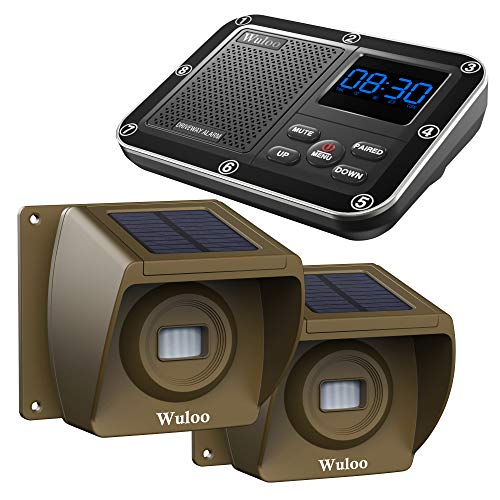
- 1,760-foot tested wireless range
- Two solar-charged motion sensors
- Expandable to eight additional sensors
Best For: Large properties needing customizable, expandable alerts
Wide Detection Zone

- Detection range adjusts up to 70 feet
- 1/2-mile wireless range in open areas
- 35 melodies and five volume levels
Best For: Large driveways needing adjustable motion coverage
Multi-Alert Property Security

- Four IP65-rated solar motion sensors
- Expandable to 16 sensors per receiver
- Four selectable alert modes
Best For: Multi-entry properties needing flexible alerts
Long-Range Pick – 1/2-Mile Solar Driveway Alarm
This solar driveway alarm is designed for homeowners who need dependable alerts across a long driveway or large property. Its 1/2-mile wireless range, adjustable motion sensitivity, and solar-powered outdoor sensor provide broad coverage without trenching or complex wiring.
Best For: Long driveways, large properties, detached garages, barns, and multiple entry points.
Pros:
- Wireless range reaches up to 2,640 feet in suitable conditions.
- Solar-powered sensor reduces the need for frequent battery replacement.
- Supports up to 64 sensors and unlimited receivers for expandable coverage.
- Adjustable detection settings help tailor coverage and reduce false alerts.
Cons:
- This package includes only one sensor and one receiver.
- Detection distance is limited to about 20 to 30 feet at the sensor.
Choose this model when wireless reach and future expandability matter most. It is a practical fit for larger properties that need a straightforward, non-app monitoring system.
Most Flexible Setup – 3000FT Solar Driveway Alarm
This solar driveway alarm combines two outdoor sensors with a portable rechargeable receiver. With a claimed 3,000-foot open-area transmission range, adjustable detection distances, and multiple alert options, it suits properties where alerts need to follow you from room to room.
Best For: Long driveways, farms, gates, barns, garages, and users who want a portable receiver.
Pros:
- Includes two sensors for monitoring separate areas out of the box.
- Portable receiver offers up to 30 days of use under the stated alert conditions.
- Provides 37 chimes, 10 volume levels, flashing LEDs, and mute control.
- Supports up to 84 compatible sensors with separate zone chimes.
Cons:
- The 3,000-foot range is specified for open, unobstructed conditions.
- Low-sensitivity detection reaches up to 32 feet, while high sensitivity reaches up to 55 feet.
This is a strong choice for buyers who value coverage flexibility and a receiver that does not have to remain plugged in. The two-sensor bundle also makes it easier to monitor more than one approach immediately.
Best Alert Variety – 1/2-Mile Solar Wireless Alarm
This solar driveway alarm offers a 1/2-mile open-area wireless range, an IP65 outdoor sensor, and four alert modes. The sensor can operate with the receiver or independently, giving buyers several ways to monitor a driveway, gate, or other property entrance.
Best For: Homeowners wanting audible, visual, or combined alerts from a weather-resistant sensor.
Pros:
- Offers audible alarm, light alarm, sound-and-light alarm, or receiver operation.
- IP65-rated sensor is designed for outdoor use.
- Solar charging is supplemented by USB-C charging.
- Includes a stated operating range from -4°F to 140°F.
Cons:
- The receiver supports expansion to 16 motion sensors, fewer than some competing options.
- The stated 1/2-mile wireless range applies to open and accessible areas.
Consider this model if you want more than a simple chime and prefer the option of direct light or sound alerts. Its independent sensor operation adds flexibility for smaller monitoring setups.
Best Visual Alerts – TECKNET Solar RGB Alarm
This solar driveway alarm pairs a 1/2-mile transmission range with adjustable detection, customizable chimes, and RGB receiver lighting. Its pre-paired components and rotating sensor bracket make it a convenient option for monitoring driveways, gates, front doors, or backyards.
Best For: Buyers who want color-coded visual alerts alongside multiple chimes and volume settings.
Pros:
- Pre-paired transmitter and receiver simplify installation.
- Offers 36 melodies, five volume levels, and four alert zones.
- RGB flashing lights provide visual notification when a sensor activates.
- Rotating bracket and two sensitivity levels help aim detection.
Cons:
- The sensor is rated IPX5 rather than the higher IP65 rating listed for some alternatives.
- The supplied notes specify a battery not included in the battery description.
This TECKNET model is a good fit when recognizing alerts at a glance is important. Its synchronized light and sound options can help distinguish activity across different monitored zones.
Best Long-Range Coverage – 1/2-Mile Wireless Alarm with 2 Sensors
For shoppers comparing solar driveway alarms, this HTZSAFE system stands out for its exceptionally long wireless range and flexible sensor expansion. It uses battery-powered outdoor sensors rather than solar charging, so plan on supplying three AA batteries per sensor.
Best For: Large properties needing wide wireless coverage, adjustable detection distance, and multiple alert tones.
Pros:
- Up to 1/2-mile wireless transmission range in suitable conditions.
- Includes two sensors and supports expansion to up to 32 sensors with unlimited receivers.
- Offers low and high detection settings from approximately 35 to 50 feet.
- Includes four volume levels and 35 selectable melodies.
Cons:
- The sensors require three AA alkaline batteries each, which are not included.
- Actual wireless range can vary with terrain and surroundings.
- It is not solar powered.
This is a practical choice when transmission distance and expandability matter more than solar convenience. Its weather-resistant sensors and broad detection range suit driveways, gates, garages, and other areas around a property.
Best Solar Alert Options – Solar 1/2-Mile Alarm with 120dB Alerts
This Betterlink system is a strong solar driveway alarms option for buyers who want rechargeable outdoor sensors and several ways to receive an alert. Its two IP65-rated sensors use solar charging and can also be charged through USB-C.
Best For: Homeowners wanting solar-powered monitoring with audible, visual, or combined alerts.
Pros:
- Solar-charged sensors include rechargeable batteries, with USB-C charging as an alternative.
- Wireless communication reaches up to 1/2 mile in open areas.
- IP65-rated sensors are designed for outdoor use.
- Offers audible, light, sound-and-light, or receiver alert modes.
Cons:
- Motion detection reaches up to approximately 30 feet, shorter than some competing systems.
- Solar charging performance depends on available sunlight.
- The stated operating range is -4°F to 140°F, so conditions outside that range may affect operation.
With solar charging, USB-C backup charging, and multiple alert modes, this model offers flexible installation for gates, driveways, and property entrances. Its receiver can also support up to 16 motion sensors for broader coverage.
Best Simple Solar Setup – 1/2-Mile Alarm with Adjustable Sensitivity
For buyers seeking straightforward solar driveway alarms without app requirements, this eMACROS kit combines two solar-powered sensors with a plug-in receiver. It is designed for local alerts and does not require Wi-Fi, Bluetooth, trenching, or electrical wiring.
Best For: Driveways, farms, and detached garages where simple local monitoring and solar charging are priorities.
Pros:
- Solar panels and rechargeable internal batteries reduce routine battery replacement.
- Up to 1/2-mile wireless range in open areas.
- High and low sensitivity settings detect motion up to approximately 30 or 20 feet.
- Designed to work in conditions including heavy rain, snow, and forested areas.
Cons:
- No Wi-Fi, Bluetooth, or smartphone app connectivity.
- The system provides local alerts rather than remote phone notifications.
- Solar charging depends on sunlight availability.
This kit keeps setup uncomplicated while providing adjustable detection for people, vehicles, and larger animals. Correct sensor height and positioning are important: the supplied guidance recommends different mounting heights for people versus vehicles.
Long-Range Solar Coverage – Wuloo 1/3-Mile Driveway Alarm
For shoppers comparing solar driveway alarms, this Wuloo system combines a tested wireless range of up to 1,760 feet with two outdoor motion sensors. Its solar-charged battery, adjustable sensitivity, and customizable receiver make it practical for monitoring a driveway, walkway, or larger property.
Best For: Homeowners who want two sensors, customizable alerts, and long-range coverage.
Pros:
- Wireless range tested at up to 1,760 feet in real-world conditions.
- Solar panel charges the included rechargeable battery, rated for up to 24 months on a full charge.
- Adjustable sensitivity helps reduce alerts from leaves or small animals.
- Expandable with up to eight additional sensors.
Cons:
- Motion detection is limited to about 30 feet.
- The system’s effective wireless range can vary with buildings, trees, walls, and vehicles.
- Setup and customization require following the included guides.
Choose this model if flexible alert customization and expandable coverage matter more than a long detection zone. The receiver also functions as a clock and alarm, adding utility indoors.
Wide Detection Zone – HTZSAFE 1/2-Mile Solar Alarm
Among solar driveway alarms, the HTZSAFE system stands out for its adjustable motion range of up to 70 feet and a 1/2-mile wireless signal range in suitable conditions. It includes two sensors, a portable receiver, multiple melodies, and backup receiver power for flexible property monitoring.
Best For: Large properties where a wider adjustable motion-detection area is a priority.
Pros:
- Adjustable detection sensitivity covers approximately 25, 50, or 70 feet.
- Wireless communication reaches up to 1/2 mile, depending on terrain.
- Solar charging reduces the need to replace outdoor sensor batteries.
- Offers 35 melodies, five volume levels, and expansion to four sensors with unlimited receivers.
Cons:
- The stated wireless range may be reduced by local terrain.
- The system supports up to four motion sensors, fewer than some expandable alternatives.
- The receiver requires an outlet for normal operation, although it has a rechargeable backup battery.
This is a strong fit for driveways, gates, yards, and other outdoor areas requiring a longer detection zone. Its adjustable sensitivity lets you balance coverage against unwanted alerts.
Multi-Alert Property Security – Betterlink 1R4S Solar Alarm
For buyers seeking solar driveway alarms with broad expandability, the Betterlink 1R4S includes four IP65-rated motion sensors and one receiver. It combines solar and USB-C charging with audible, light, sound-and-light, or receiver alert options for adaptable outdoor security.
Best For: Property owners who need four sensors and multiple alert methods.
Pros:
- Includes four waterproof-rated IP65 outdoor motion sensors.
- One receiver can support up to 16 motion sensors.
- Offers a wireless range of up to 1/2 mile in open areas.
- Provides audible, light, sound-and-light, or receiver alert modes.
Cons:
- Motion detection reaches about 30 feet, less than some competing models.
- The system weighs about 1.9 pounds and includes several components to install.
- Wireless performance can vary with property layout and obstructions.
Consider this package when coverage across multiple entry points is more important than maximum detection distance. USB-C charging is a useful backup if available sunlight is insufficient.
How We Picked the Best Solar Driveway Alarms
We evaluated these Solar Driveway Alarms based on the features that matter most in real outdoor installations: advertised wireless range, number of included sensors, solar and rechargeable power options, receiver flexibility, motion-detection coverage, and ease of expansion. We also considered whether each system is better suited to a short residential drive, a long rural approach, or a property with multiple entry points.
Because outdoor conditions vary, advertised range should be treated as a best-case figure. Trees, walls, terrain, weather, and radio interference can reduce performance. A system with more sensors may provide better coverage than a model with greater stated range but only one detection point.
Quick Comparison
| Best For | Look For |
|---|---|
| Short or medium driveways | Simple one-sensor systems with a portable receiver |
| Long driveways | Models advertising approximately 1/2-mile wireless range |
| Multiple entry points | Two- or four-sensor packages |
| Flexible indoor placement | Rechargeable receivers with adjustable alert settings |
| Low-maintenance operation | Solar-charged outdoor sensors and backup battery support |
Key Buying Factors for Solar Driveway Alarms
Range and Property Layout
Choose based on the distance between the sensor and receiver, not just the length of the driveway. If the receiver will be inside a metal-sided building or several rooms away, extra range can provide useful headroom.
Sensor Count and Coverage
One sensor is suitable for a single approach. Two sensors can cover separate lanes, a driveway entrance and gate, or both sides of a wider property. Four-sensor packages are valuable for large lots, multiple access points, or future expansion.
Power and Charging
Solar charging reduces routine battery replacement, but sensors still need reasonably consistent daylight. Look for rechargeable power, backup charging options, and weather-resistant construction. Position panels where they receive unobstructed sunlight when possible.
Alert Controls and False Alarms
Adjustable volume, tones, sensitivity, and alert modes make a system easier to live with. Motion alarms can respond to people, vehicles, pets, or wildlife, so placement and sensitivity settings are important for reducing unnecessary alerts.
Receiver Convenience
A portable or rechargeable receiver lets you move alerts between rooms, a workshop, or an office. Confirm how many receivers and sensors are included, and check whether additional compatible components can be added later.
Who Should Buy Which Solar Driveway Alarms?
Choose a one-sensor system if you need straightforward monitoring for one driveway entrance and want the simplest installation. Choose a two-sensor model for broader coverage around a home, gate, or split approach. Choose a four-sensor package if your property has several access points or you want to avoid buying expansions later.
For rural properties and long driveways, prioritize long-range systems and install the sensor with a clear line of communication to the receiver. For smaller residential properties, focus more on receiver portability, alert customization, and reliable solar placement than on the highest advertised range.