A reliable wireless video receiver can simplify camera monitoring, live streaming, presentations, and multi-display setups without running long HDMI or SDI cables across your studio.
These 10 picks cover practical 1080p HDMI kits, 4K-capable systems, USB video output, long-range links, and professional dual-band options. Compare latency, range, connections, and workflow compatibility before choosing.
Best 10 Wireless Video Receivers for Home Studios Picks for 2026
Best for Live Streaming

- Dual-band 2.4GHz/5GHz transmission
- UVC output for computer streaming
- Up to four monitoring devices
Best For: Home-studio streaming and multi-person monitoring
Best for Multi-Screen Setups

- Supports up to six receivers
- 165-foot open-environment range
- Includes multiple HDMI adapters
Best For: Studios and spaces feeding several displays
Best for Long-Range HDMI

- 1080p60 with 0.05-second delay
- 1,300-foot open-field range claim
- Loop-out and dual HDMI receiver outputs
Best For: Remote monitoring with multiple displays
Best Compact Creator System

- 1080p60 video with 50ms latency
- 656-foot open-space range claim
- USB-C and NP-F power options
Best For: Portable camera monitoring and compact studios
Best Plug-and-Play Pick
SoundBeast 4K Wireless Video System

- True 4K or 1080p wireless transmission
- No apps, software, or drivers required
- Encrypted 5 GHz Wi-Fi with up to 160-foot range
Best For: Home studios and simple screen mirroring
Best for Production Workflows
Accsoon CineView Master 4K Lite

- HDMI supports up to 4K at 60 fps
- Connects with up to five receiving devices
- Low claimed latency for monitoring and production
Best For: Filmmaking, streaming, and multi-device monitoring
Best Budget 1080p Extender
Wireless HDMI 328ft/100m System

- 1080p output at 60 Hz with 4K decoding
- No Wi-Fi, Bluetooth, or app required
- Includes Micro HDMI and Mini HDMI adapters
Best For: Basic home studio HDMI extension and presentations
Best 4K Studio Upgrade
CineView SE 4K Wireless Video System

- 4K30 end-to-end transmission with H.265
- Dual-band 2.4GHz + 5GHz connectivity
- USB-C output and wireless camera control
Best For: Production-focused home studios needing high-resolution monitoring
Best Plug-and-Play Extender

- 4K decoding with 1080p@60Hz output
- Automatic pairing with mirror and extend modes
- Supports up to eight transmitters per receiver
Best For: Simple HDMI distribution in home studios and offices
Best for Streaming
- 1080p60 transmission with under 0.06s latency
- USB-C UVC output for OBS and YouTube workflows
- Dual-band transmission with up to four receiving devices
Best For: Live streaming from wireless camera feeds
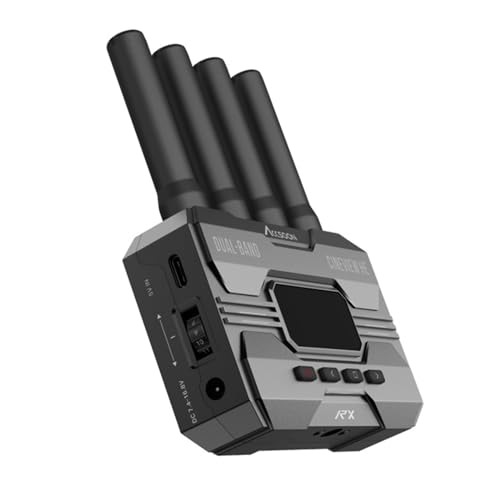
Best for Live Streaming – Accsoon CineView HE
For home studios that need dependable wireless video receivers for home studios, the Accsoon CineView HE stands out with dual-band transmission, very low latency, and a receiver with UVC output. It can send a camera feed to a computer for streaming without requiring a separate capture device.
Best For: Home-studio live streaming, multi-person monitoring, and longer HDMI camera runs.
Pros:
- 2.4GHz and 5GHz dual-band transmission supports stable video and audio over distances up to 1,200 feet in suitable conditions.
- Under 0.06-second latency is useful for real-time monitoring and production.
- UVC output lets the receiver connect to a computer for platforms such as OBS and YouTube.
- One transmitter can send to up to four receivers or supported mobile devices.
Cons:
- Battery and charging cables are not included.
- The system is centered on HDMI connections rather than SDI input.
Its combination of low latency, multi-device monitoring, and UVC streaming makes the CineView HE a particularly capable choice for creators building a connected home production setup.
Best for Multi-Screen Setups – Wireless HDMI 2-Receiver Kit
This wireless HDMI kit is a practical option for home studios and presentation spaces that need to distribute one source to several displays. Its dual-band connection, plug-and-play design, and support for up to six receivers make it useful when multiple TVs, monitors, or projectors need the same feed.
Best For: Multi-screen home studios, home theaters, classrooms, conference spaces, and venues.
Pros:
- Supports up to six receivers, with a range of up to 165 feet in open environments.
- 2.4GHz/5.8GHz dual-band transmission and dual antennas are designed to help maintain a stable signal.
- Works with laptops, cameras, game consoles, set-top boxes, TVs, projectors, and monitors.
- Includes USB-C, Micro HDMI, and Mini HDMI adapter accessories.
Cons:
- Range can drop to about 50 feet through walls.
- The system cannot transmit from one TV to another TV.
- Phone and tablet app control does not control a laptop transmitter.
Choose this model when distributing one HDMI source to several screens matters more than camera-focused production features or advanced monitoring controls.
Best for Long-Range HDMI – Vrriis WL082 Wireless System
The Vrriis WL082 is a flexible pick among wireless video receivers for home studios, combining 1080p60 transmission, a claimed 1,300-foot open-field range, and 0.05-second latency. Its loop-out, dual receiver outputs, and IR support make it suitable for monitoring a source locally while sending it to remote displays.
Best For: Long-distance HDMI monitoring, DSLR or laptop streaming, and setups requiring local and remote displays.
Pros:
- Supports up to 1080p at 60Hz with approximately 0.05-second latency.
- Transmitter HDMI loop-out allows a local monitor to remain connected.
- Receiver provides two HDMI outputs for connecting two screens simultaneously.
- Supports NP-F batteries, USB-C power, and adapters for different shooting environments.
Cons:
- The stated 1,300-foot range applies to open areas; walls and other obstacles can reduce coverage.
- Adding more receivers can reduce transmission distance.
- Batteries are not included.
With its combination of long-range claims, dual HDMI receiver outputs, and multiple power options, the WL082 fits studios that need flexible display placement around a production area.
Best Compact Creator System – Lemorele R5000
The Lemorele R5000 offers a straightforward wireless HDMI setup for creators who want a compact transmitter-and-receiver pair. It delivers 1080p60 video over 5GHz Wi-Fi, includes transmitter loop-out for local monitoring, and supports USB-C or NP-F battery power.
Best For: DSLR and camcorder monitoring, compact home studios, live events, and portable presentations.
Pros:
- Provides 1080p at 60Hz with approximately 50ms latency.
- 5GHz transmission supports a stated range of up to 656 feet in open, unobstructed spaces.
- Transmitter loop-out enables local viewing while sending the signal wirelessly.
- Supports up to four receivers and offers TUTUPlay app preview on iOS and Android devices.
Cons:
- The package includes one transmitter and one receiver; additional receivers are separate.
- Batteries are not included.
- Phones can preview footage through the app but cannot act as the signal transmitter source.
The R5000 is a sensible choice for creators who value a small, simple system with flexible power and local loop-out, provided its 50ms latency and 5GHz range meet the workflow requirements.
Best Plug-and-Play Pick – SoundBeast 4K Wireless Video System
For shoppers comparing wireless video receivers for home studios, the SoundBeast system is a straightforward option for sending a laptop or smartphone display to a TV, monitor, or projector. Its USB-C transmitter and HDMI receiver support true 4K or 1080p, while encrypted 5 GHz Wi-Fi and a button-based setup keep the workflow simple.
Best For: Home studios, presentations, screen mirroring, and users who want a no-app wireless setup.
Pros:
- Supports true 4K transmission and backward-compatible 1080p output.
- Plug-and-play operation without software, apps, or drivers.
- Up to 160 feet of range and encrypted 5 GHz Wi-Fi transmission.
- Includes a 3-year warranty and technical support.
Cons:
- The source device must have a USB-C port that supports DisplayPort video output.
- The kit includes one transmitter and one receiver, limiting it to a single source-to-display setup.
This is a practical choice when ease of installation matters more than advanced production features. Confirm that your laptop or smartphone supports USB-C video output before buying.
Best for Production Workflows – Accsoon CineView Master 4K Lite
Among wireless video receivers for home studios, the Accsoon CineView Master 4K Lite is the production-focused option. It handles HDMI up to 4K at 60 fps, supports 1080p through 3G-SDI or HDMI, and can distribute a feed to as many as five receiving devices for monitoring and live-production workflows.
Best For: Filmmakers, live streamers, camera operators, and multi-device monitoring.
Pros:
- Supports HDMI video up to 3840×2160 at 60 fps and 1080p through 3G-SDI or HDMI.
- Offers claimed latency below 35 ms at 1080p60 and below 65 ms at 4K60.
- Supports up to four wireless receivers plus one wired USB-C connection.
- Provides up to 1,200 feet of transmission range in unobstructed, interference-free conditions.
Cons:
- Maximum range depends on open, interference-free conditions.
- Some mobile-device and wired-output functions require specific devices, cables, or the Accsoon app.
- Camera-control compatibility is limited to listed camera models and supported connection modes.
This system is better suited to serious video production than casual presentation use. Its 4K support, low claimed latency, and multi-device distribution are useful when a home studio doubles as a filming or streaming space.
Best Budget 1080p Extender – Wireless HDMI 328ft/100m System
This wireless HDMI kit is a practical candidate for wireless video receivers for home studios when 1080p output is sufficient. It uses a dedicated transmitter and receiver rather than Wi-Fi, Bluetooth, or an app, and supports laptops, cameras, set-top boxes, projectors, monitors, and other HDMI-equipped devices.
Best For: Home presentations, basic studio monitoring, home theater, and cable-free HDMI connections.
Pros:
- Supports 1080p output at 60 Hz and 4K decoding.
- Plug-and-play operation without Wi-Fi, Bluetooth, or an app.
- Claims up to 165 feet indoors and 328 feet outdoors in open conditions.
- Includes Micro HDMI and Mini HDMI adapters for added source compatibility.
Cons:
- Output is limited to 1080p rather than native 4K.
- Both the transmitter and receiver must be connected to power.
- Walls and obstacles can reduce transmission distance and speed.
Choose this model if you want a simple point-to-point HDMI link and do not need native 4K output. Its broad device compatibility and included adapters make it flexible, while the 1080p ceiling keeps it best suited to everyday viewing and presentation tasks.
Best 4K Studio Upgrade – CineView SE 4K Wireless Video System
For home studios that need high-resolution monitoring, the ACCSOON CineView SE 4K is a capable choice among wireless video receivers for home studios. It supports end-to-end 4K30 transmission, dual-band connectivity, and multiple connection options for flexible camera-to-monitor workflows.
Best For: Home studios, small production sets, and creators who want 4K wireless monitoring with camera-control support.
Pros:
- Supports 4K30 transmission with H.265 encoding.
- Uses 2.4GHz and 5GHz dual-band transmission with RTMS 4.0 for improved stability.
- Includes USB-C video output and wireless camera control through the Accsoon SEE app.
- Supports one wired and up to four wireless connections.
Cons:
- Its advanced features may be more than a simple home display setup requires.
- The supplied details do not confirm software update support.
The CineView SE 4K stands out when image quality and connection flexibility matter most. It is a stronger fit for production-focused studios than for casual HDMI extension.
Best Plug-and-Play Extender – 360FT Wireless HDMI Kit
This wireless HDMI transmitter and receiver kit is a practical option for home studios seeking straightforward wireless video receivers for home studios. It decodes 4K input while outputting 1080p at 60Hz, with automatic pairing and support for mirrored or extended displays.
Best For: Home offices, classrooms, presentations, home theaters, and studios that prioritize simple HDMI distribution over 4K output.
Pros:
- Supports 4K decoding with 1080p@60Hz output.
- Offers claimed transmission up to 360 feet outdoors or 165 feet indoors, depending on obstacles.
- Uses 2.4GHz and 5.8GHz dual-band connectivity with automatic plug-and-play setup.
- Supports one receiver with up to eight transmitters and up to three sets in the same environment.
Cons:
- Output is limited to 1080p@60Hz rather than 4K.
- Walls and other obstacles can reduce transmission distance and speed.
- Its compatibility is centered on HDMI devices rather than a dedicated camera-production workflow.
Choose this kit for convenient screen extension and flexible multi-device use. It is less suitable when a studio requires native 4K output or specialized camera-control features.
Best for Streaming – CineView HE Wireless Receiver
The ACCSOON CineView HE is a receiver-focused option for creators comparing wireless video receivers for home studios. Its 1080p60 workflow combines dual-band transmission, low latency, and USB-C UVC output for direct streaming to platforms such as OBS or YouTube without a separate capture device.
Best For: Live streamers and small production teams that need wireless camera feeds delivered directly to a computer.
Pros:
- Provides 1080p at 60fps with latency of less than 0.06 seconds.
- Uses 2.4GHz and 5GHz dual-band transmission for stability and interference resistance.
- UVC output can send received footage to a computer over USB-C for streaming.
- One transmitter can send video and audio to up to four receivers or mobile devices.
Cons:
- This listing is for the receiver only, so a compatible transmitter is needed.
- Its listed workflow is 1080p rather than 4K.
- A USB-C cable for the UVC connection is user-provided.
The CineView HE is especially compelling for streaming-oriented studios. Its UVC feature simplifies the path from a wireless camera feed to streaming software, provided you already have the required transmitter and cable.
How We Picked the Best Wireless Video Receivers for Home Studios
We focused on features that matter in real home-studio workflows: video resolution, measured or advertised latency, wireless range, connection types, reliability, setup simplicity, and compatibility with cameras, computers, monitors, and streaming software. The selection includes basic transmitter-and-receiver kits as well as more advanced systems with HDMI loop-out, SDI support, UVC output, dual-band transmission, or multi-receiver capability.
Specifications can vary with walls, interference, antenna placement, source devices, and regional versions. Treat maximum range as an open-space estimate rather than a guaranteed indoor distance.
Quick Comparison
- Best for professional camera workflows: Accsoon CineView SE 4K and CineView 4K Lite systems, especially where HDMI, SDI, higher resolution, or stronger wireless flexibility is important.
- Best for live streaming: Accsoon CineView HE models with UVC output, which can connect directly to compatible computers and streaming applications.
- Best for basic HDMI extension: The plug-and-play 1080p kits, including long-range models with loop-out or LED status displays.
- Best for multi-screen distribution: Systems designed to support multiple receivers, provided the transmitter and receivers are configured as a compatible set.
- Best for presentations: The 4K presentation and broadcasting system with support for laptops and smartphones, subject to device and adapter compatibility.
Key Buying Factors for Wireless Video Receivers for Home Studios
Resolution and Frame Rate
Choose a system that matches the source and display. A 1080p receiver is generally sufficient for streaming, monitoring, and presentations, while 4K support is more useful for detailed previews, production cameras, and future upgrades. Check whether 4K is available at the desired frame rate or only decoded to a 1080p output.
Latency and Stability
Low latency matters for talking-head monitoring, camera operation, gaming, and live production. Look for clearly stated delay figures, but remember that wireless congestion and signal obstructions can affect real-world performance. Dual-band systems may offer more flexibility in busy environments.
Ports and Workflow Compatibility
Confirm whether you need HDMI, SDI, USB UVC output, loop-out, or a combination. UVC output is particularly useful when the receiver must appear as a camera source to a computer. Also verify connector versions, supported audio formats, power requirements, and whether batteries or adapters are included.
Range and Receiver Capacity
Longer advertised range is helpful, but indoor reliability depends on room layout and interference. If several monitors need the same feed, choose a system explicitly rated for multiple receivers rather than assuming any receiver can be added.
Who Should Buy Which Wireless Video Receivers for Home Studios?
Choose a basic 1080p HDMI kit if you want an affordable way to connect a camera, laptop, or media source to a nearby display without cable runs. Choose a loop-out model when you need to use a local monitor while also sending the feed wirelessly.
Choose an Accsoon CineView HE for streaming-oriented setups that benefit from UVC computer connectivity and low-latency monitoring. Choose CineView SE 4K or 4K Lite for more demanding film, camera, or hybrid HDMI/SDI workflows.
Choose the presentation-focused system for laptop and smartphone sharing, provided its input adapters and operating-system support match your devices. Before ordering, confirm the exact package contents, output resolution, power method, and whether the advertised range meets your room layout.