DisplayLink docking stations make it easier to connect laptops to multiple external monitors, even when a computer has limited native display outputs. They can also consolidate charging, USB accessories, Ethernet, audio, and card readers into one desk-friendly connection.
This roundup compares 10 docking stations with DisplayLink across dual- and triple-display support, resolution options, power delivery, port selection, operating-system compatibility, and setup requirements. Use the guide below to narrow your choice based on your monitors, laptop, and workflow.
Best 10 Docking Stations with Displaylink Picks for 2026
Compact Connectivity Pick

- Dual HDMI display extension
- Gigabit Ethernet and card readers
- Compact, but no laptop charging
Best For: Travelers and basic home-office setups
Mac Dual-Display Solution

- Dual 4K at 60Hz output
- Built for Mac display expansion
- 100W charging and lifetime support
Best For: MacBook productivity workstations
Flexible Three-Screen Workstation

- Three extended-display support
- 100W charging with 130W supply
- Six 10Gbps USB ports
Best For: Multi-monitor productivity offices
Enterprise Triple-Screen Hub
Plugable 13-in-1 DisplayLink Dock
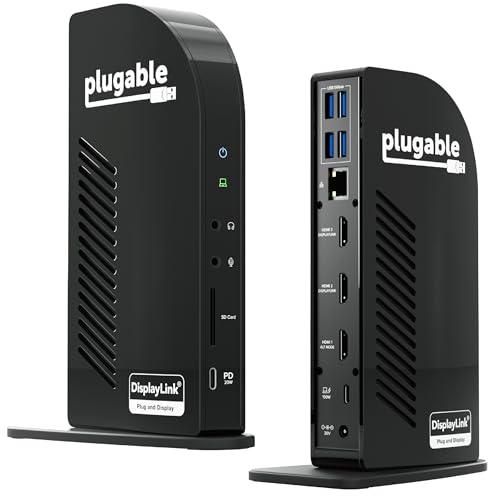
- Three HDMI outputs for up to three extended displays
- 100W laptop charging and 20W accessory charging
- 13 ports with Ethernet, SD, USB, and audio connectivity
Best For: Managed office and home-office triple-monitor setups
Flexible 15-Port Workstation
WAVLINK DisplayLink Triple-Monitor Dock

- 15 ports with HDMI, DisplayPort, USB, Ethernet, and card readers
- Up to 100W Power Delivery from the included 130W adapter
- Supports productivity-focused multi-monitor workflows
Best For: Office productivity and data-heavy three-monitor workstations
Dual-4K Compact Choice
UGREEN 9-in-1 DisplayLink Dock

- Supports dual extended 4K displays at 60Hz
- Four video outputs across HDMI and DisplayPort
- 10Gbps USB, Gigabit Ethernet, and 100W PD support
Best For: Compact dual-monitor MacBook and Windows workspaces
Best Enterprise Triple-Display Dock
Plugable 12-in-1 DisplayLink Dock

- Up to three HDMI displays
- 100W USB-C Power Delivery
- Designed for mixed-fleet office deployments
Best For: Hybrid offices and triple-monitor workstations
Best Dual-4K Flexibility
WAVLINK Dual 4K DisplayLink Dock

- Supports two 4K displays at 60Hz
- HDMI and DisplayPort combinations
- Six USB 3.0 ports plus Ethernet
Best For: Dual-monitor home offices and remote work
Best Budget HD Option

- Dual HDMI up to 1920×1200 at 60Hz
- Hybrid USB 3.0 and USB-C connection
- Ethernet, audio, and six USB ports
Best For: Basic office productivity with two HD monitors
Compact Connectivity Pick – Giq USB 3.0 Dual-HDMI Dock
For shoppers seeking docking stations with displaylink on a budget, this compact Giq hub combines dual-HDMI display extension with everyday connectivity. It adds USB 3.0 ports, Gigabit Ethernet, SD and microSD readers, and supports up to 4K at 30Hz or Full HD 1080p, though its USB-C port is for dock charging rather than laptop charging.
Best For: Home offices, travel, and users who need dual-display output plus basic peripherals in a small hub.
Pros:
- Dual-HDMI mirroring or extended-display support.
- Includes three USB 3.0 ports, Gigabit Ethernet, and card readers.
- Compact aluminum-and-plastic design weighing about 3.6 ounces.
Cons:
- USB-C port does not charge the laptop.
- HDMI output is limited to 4K at 30Hz.
- SD and microSD slots cannot be used simultaneously.
This is a practical entry-level option when space and port variety matter more than high-refresh 4K video or laptop power delivery. Check your computer’s operating-system and port compatibility before buying.
Premium Triple-Display Choice – Anker Prime DL7400 Dock
The Anker Prime DL7400 is a high-end choice among docking stations with displaylink, offering three simultaneous 4K displays for Windows 10/11 laptops. Its 14 ports include HDMI, DisplayPort, fast USB-C and USB-A connections, 2.5Gbps Ethernet, audio, and SD/TF readers, while DisplayLink driver installation is required.
Best For: Windows professionals building a powerful multi-monitor workstation with high-wattage charging and extensive connectivity.
Pros:
- Supports triple 4K displays using two HDMI ports and one DisplayPort.
- Up to 140W laptop power through the upstream USB-C port.
- 14 ports, 2.5Gbps Ethernet, smart display, and active cooling.
Cons:
- Requires the latest DisplayLink driver and is specified for Windows 10/11.
- Front USB-C ports do not support video output for USB-C or Thunderbolt monitors.
- DRM-protected streaming may show a black screen because of DisplayLink limitations.
With its charging capacity, monitoring screen, and triple-4K support, this dock is suited to demanding desk setups rather than casual travel. Use the included USB-C 3.2 Gen 2 cable as recommended for reliable operation.
Mac Dual-Display Solution – Plugable UD-6950PDH Dock
The Plugable UD-6950PDH is designed for Mac users who need docking stations with displaylink to overcome native external-monitor limits. It supports two 4K displays at 60Hz through HDMI and DisplayPort, provides up to 100W charging, and adds USB, Ethernet, audio, and SD/microSD connectivity.
Best For: M1–M5 and compatible MacBook users creating a dual-4K office or productivity workstation.
Pros:
- Enables two 4K 60Hz extended displays on supported Macs.
- Up to 100W laptop charging through the dock.
- Broad compatibility with macOS, Windows, and ChromeOS systems using supported USB-C, USB4, or Thunderbolt connections.
Cons:
- DisplayLink software installation is required for full functionality.
- HDCP is not supported.
- Requires a full-featured USB-C, USB4, or Thunderbolt connection.
This dock is particularly compelling for MacBook owners whose computers natively support only one external display. It combines useful office ports with 4K refresh performance, but buyers should plan for driver installation and the stated content-protection limitation.
Flexible Three-Screen Workstation – WAVLINK DisplayLink Dock
This WAVLINK model is a versatile option among docking stations with displaylink, supporting three extended displays across compatible Mac, Windows, and ChromeOS systems. It combines one 4K HDMI output with additional 2K HDMI or DisplayPort outputs, 100W charging, six 10Gbps USB ports, Gigabit Ethernet, and combination audio.
Best For: Productivity-focused home and office workstations that need three screens and multiple high-speed USB connections.
Pros:
- Supports three extended displays, including one 4K 60Hz output and two 2K 60Hz outputs.
- Provides up to 100W laptop charging with a 130W power supply.
- Includes six 10Gbps USB ports, Gigabit Ethernet, and audio.
Cons:
- Driver installation is required; it is not plug and play.
- Not recommended for gaming.
- Does not support HDCP, Linux, or encrypted/copy-protected playback.
The WAVLINK dock offers strong workstation flexibility for web and productivity applications, especially when three displays and fast peripherals are priorities. Confirm USB-C Alt Mode and Power Delivery support on the laptop before purchasing.
Enterprise Triple-Screen Hub – Plugable 13-in-1 DisplayLink Dock
For offices standardizing on docking stations with DisplayLink, this Plugable model combines three HDMI outputs with broad USB-C compatibility and centralized power delivery. It supports up to three extended displays, though macOS users must install DisplayLink Manager for multiple-monitor operation.
Best For: Enterprise, education, government, and home-office setups that need three monitors, 100W laptop charging, and deployment-friendly connectivity.
Pros:
- Three HDMI outputs support up to 4K 30Hz on HDMI 1 and up to 1920×1200 at 60Hz on HDMI 2 and 3.
- Provides up to 100W laptop charging plus 20W charging for phones and accessories.
- Includes 13 ports, Gigabit Ethernet, SD card support, four USB-A 5Gbps ports, and audio connections.
- Compatible with Windows, macOS, and ChromeOS systems using full-featured USB-C, USB4, or Thunderbolt ports.
Cons:
- DisplayLink Manager installation is required on macOS for multiple displays and for HDMI 2 and 3.
- Does not support protected-content playback such as Netflix or Hulu.
- Display resolutions vary by HDMI port, with the primary output limited to 4K at 30Hz.
This is a practical choice when fleet consistency, three-screen expansion, and included power delivery matter more than high-refresh-rate video. Its compliance features and lifetime North American support further suit managed deployments.
Flexible 15-Port Workstation – WAVLINK DisplayLink Triple-Monitor Dock
This WAVLINK dock is a flexible option among docking stations with DisplayLink, offering HDMI and DisplayPort combinations, fast USB connectivity, card readers, and up to 100W Power Delivery. It is aimed primarily at office productivity rather than gaming or professional video editing.
Best For: Data analysis, spreadsheets, dashboards, remote work, and other productivity-focused setups needing three-monitor expansion and extensive peripheral support.
Pros:
- 15-in-1 design includes three HDMI ports, two DisplayPort ports, USB-C and USB-A connections, Ethernet, SD/TF readers, and audio.
- DisplayLink-6350 supports expanded multi-display use with up to dual 2K at 60Hz through the Display 1/2 HDMI or DisplayPort channels.
- Offers up to 100W Power Delivery from its 130W power adapter for compatible laptops.
- Includes 10Gbps USB-C ports, 5Gbps USB-A ports, Gigabit Ethernet, and card-reader support up to 104MB/s.
Cons:
- DisplayLink drivers must be installed before use; it is not plug-and-play.
- HDMI and DisplayPort outputs on the same display channel cannot be used simultaneously.
- The notes position it for productivity rather than gaming or professional video editing.
Choose this model when port variety is as important as monitor expansion. Its broad operating-system compatibility is useful, but buyers should confirm the laptop has a full-function USB-C or Thunderbolt connection and plan for driver installation.
Dual-4K Compact Choice – UGREEN 9-in-1 DisplayLink Dock
For buyers comparing docking stations with DisplayLink for a dual-monitor desk, this compact UGREEN dock offers two HDMI and two DisplayPort outputs, 10Gbps USB ports, Gigabit Ethernet, and 100W PD passthrough. Display and network functions require driver installation.
Best For: MacBook and Windows users who want dual 4K monitor support, fast USB transfers, and a compact nine-port dock.
Pros:
- DisplayLink technology supports two extended 4K displays at 60Hz on macOS and Windows.
- Provides both two HDMI and two DisplayPort outputs for flexible monitor connections.
- Includes two USB-A 3.2 Gen 2 ports and one USB-C 3.2 Gen 2 port with speeds up to 10Gbps.
- Offers 100W PD 3.0 charging and Gigabit Ethernet in a compact 9-in-1 design.
Cons:
- Power adapter and HDMI cables are not included.
- Drivers are required for display and network functions.
- It provides dual-monitor expansion rather than the triple-monitor support offered by the other docks here.
This UGREEN model is a strong fit for a streamlined dual-screen workspace where fast peripheral connections matter. Budget separately for a compatible power adapter and display cables, and allow time for the required driver setup.
Best Enterprise Triple-Display Dock – Plugable 12-in-1 DisplayLink Dock
For teams building workstations around docking stations with DisplayLink, this Plugable model combines DisplayLink graphics with native USB-C video. It supports up to three HDMI monitors, including one 4K display and two 1080p displays, while also providing 100W USB-C Power Delivery, Gigabit Ethernet, six USB 3.0 ports, and audio.
Best For: Hybrid offices, managed deployments, and users who need triple-display support with laptop charging.
Pros:
- Supports up to three extended HDMI displays, including two through DisplayLink.
- 100W USB-C Power Delivery helps keep compatible laptops charged.
- Broad Windows, macOS, and ChromeOS compatibility, including Apple Silicon Macs.
- Strong connectivity for peripherals, networking, audio, and office hot-desking.
Cons:
- DisplayLink driver installation is required on macOS.
- Not compatible with Linux, and HDCP is not supported.
This is the most deployment-focused option in the group, especially for mixed laptop fleets and multi-monitor productivity. Confirm that your computer supports full-featured USB-C, USB4, or Thunderbolt and that its operating system meets the listed requirements.
Best Dual-4K Flexibility – WAVLINK Dual 4K DisplayLink Dock
This WAVLINK dock is a flexible choice among docking stations with DisplayLink for everyday multitasking. It can drive up to two 4K monitors at 60Hz through HDMI and DisplayPort combinations, and it adds six USB 3.0 ports, Gigabit Ethernet, and a 3.5mm audio jack.
Best For: Home offices and remote workers who want dual 4K display flexibility without laptop charging.
Pros:
- Supports up to two 4K monitors at 60Hz on compatible systems.
- Offers two HDMI and two DisplayPort outputs for flexible monitor combinations.
- Works with USB-A, USB-C, USB4, and Thunderbolt laptops.
- Includes six USB 3.0 ports, Gigabit Ethernet, and audio connectivity.
Cons:
- Does not charge the connected laptop.
- DisplayLink driver installation is required for video output.
- Not intended for gaming, high-frame-rate video editing, or DRM-protected streaming.
Its mix of HDMI and DisplayPort outputs makes monitor matching straightforward, while broad host compatibility suits shared home or work setups. Plan for driver installation and use it primarily for productivity rather than demanding visual workloads.
Best Budget HD Option – Plugable UD-3900 USB 3.0 Dock
The Plugable UD-3900 is a practical entry point for docking stations with DisplayLink when two HD monitors are enough. Its hybrid USB 3.0/USB-C connection provides dual HDMI output up to 1920×1200 at 60Hz, along with Gigabit Ethernet, audio, and six USB ports.
Best For: Office productivity users who need affordable dual-HD monitor support and extra connectivity.
Pros:
- Supports two HDMI displays up to 1920×1200 at 60Hz.
- Hybrid USB 3.0 and USB-C cable supports a range of host computers.
- Adds Gigabit Ethernet, audio, two USB 3.0 ports, and four USB 2.0 ports.
- Includes a two-year warranty and lifetime support.
Cons:
- Does not support 4K displays or DisplayPort connections.
- Does not charge the host laptop.
- Not compatible with Linux/Unix or HDCP-protected content.
This dock covers the essentials for documents, browser work, and general office software without paying for 4K output. Choose it when your monitors are HDMI-based and your priority is dependable expansion rather than gaming or protected streaming.
How We Picked These Docking Stations with Displaylink
We selected models that cover the most common laptop-docking needs: dual- and triple-monitor expansion, USB-C and USB-A host compatibility, charging, and a useful mix of modern and legacy ports. We also considered stated display resolutions, DisplayLink driver requirements, power-delivery ratings, Mac and Windows support, and whether a dock uses HDMI, DisplayPort, or both.
Because performance depends on the laptop, operating system, monitors, cables, and installed drivers, treat manufacturer specifications as the starting point. Confirm compatibility before buying, especially for Apple silicon Macs and computers that do not support USB-C video output directly.
Quick Comparison
| Best For | What to Prioritize |
|---|---|
| Basic dual-monitor desk | Reliable DisplayLink support, two HDMI outputs, and enough USB ports |
| Triple-monitor productivity | Three supported video outputs, current drivers, and adequate host bandwidth |
| High-resolution displays | 4K support at the desired refresh rate, plus compatible cables and monitors |
| One-cable laptop setup | USB-C power delivery, Ethernet, peripherals, and a matching charger |
| Older laptops | USB 3.0 or USB-A compatibility and a DisplayLink driver for the operating system |
Key Buying Factors for Docking Stations with Displaylink
Monitor Count and Resolution
Start with the number of screens and the resolution you actually need. Dual 1080p is less demanding than dual 4K, while triple-monitor configurations require closer attention to supported combinations. Check whether the dock can run each display independently and whether your preferred refresh rate is supported.
Host Connection and Drivers
DisplayLink typically requires software, so verify that the dock supports your version of Windows or macOS. USB-C does not automatically mean video support; DisplayLink can help in some cases, but the dock still needs the correct host connection and driver. USB-A docks may support displays through DisplayLink but generally cannot provide laptop charging.
Power Delivery and Port Selection
For a clean desk, choose a dock with enough USB-C power delivery for your laptop. A high wattage rating does not guarantee that the included charger provides that output. Also count the ports you use daily, including USB-A, USB-C, Ethernet, audio, SD or microSD, and additional video connectors.
Everyday Performance
DisplayLink is well suited to office work, web applications, documents, coding, and multitasking. It is less ideal for latency-sensitive gaming, professional color-critical video work, or high-frame-rate applications. Keep the dock firmware and DisplayLink software current, and use quality cables.
Who Should Buy Which Docking Stations with Displaylink?
Choose a basic dual-HDMI dock if you mainly need two office monitors and several USB accessories. A dual-4K model is a better fit for detailed spreadsheets, creative applications, or large high-resolution displays. Triple-monitor docks suit traders, developers, analysts, and anyone who benefits from a wide workspace, but they require more careful compatibility checks.
For a newer USB-C laptop, prioritize a dock with strong power delivery and the ports you use most. For an older USB-A computer, focus on universal compatibility and remember that charging will usually remain separate. MacBook owners should confirm the exact Apple silicon generation, supported monitor arrangement, and DisplayLink permissions before ordering.