If you need paper turned into searchable files fast, the right scanner can save hours every week. The best document scanners with cloud upload make it easy to scan, organize, and share without extra steps.
Below, we focus on speed, duplex scanning, wireless convenience, and cloud-ready workflows so you can choose a model that fits your office, filing habits, and budget.
Best 10 Document Scanners with Cloud Upload Picks for 2026
High-Output Wi-Fi Pick

- Up to 45 ppm duplex scanning
- 100-sheet ADF for larger jobs
- Touchscreen scan-to-email and cloud
Best For: Busy offices needing fast wireless cloud-ready scanning
Compact Mobile Scanner

- Compact design for home or travel
- Wi-Fi and USB-C connectivity
- Up to 30 ppm with duplex scanning
Best For: Users who want a small, flexible scanner for connected workflows
Simple USB Cloud Scanner
- Up to 45 ppm duplex scanning
- 60-sheet feeder for batch jobs
- CaptureOnTouch supports cloud scanning
Best For: Users who want fast USB scanning with easy cloud workflow support
Space-Saving Wi-Fi Choice

- Compact design saves desk space
- USB or Wi-Fi with cloud support
- Up to 30 ppm duplex scanning
Best For: Small desks and everyday cloud-connected scanning
Compact Cloud-Ready Desktop Scanner

- One-pass duplex scanning up to 18 ppm
- Touchscreen shortcuts for cloud destinations
- Handles receipts, photos, IDs, and documents
Best For: Small offices and home users needing easy cloud scanning
High-Speed Wireless Cloud Scanner

- 45 ppm duplex scanning with a 100-sheet feeder
- Wi-Fi 6, USB-C, and cloud service support
- Automatic file naming, sorting, and optimization
Best For: Heavy scanning workflows that need speed and cloud sharing
Portable Scan-to-Cloud Scanner

- USB-powered and lightweight for travel
- Scans a page in as little as 5.5 seconds
- Included software supports scan-to-cloud and OCR
Best For: Mobile users needing a compact scanner for occasional cloud uploads
AI-Ready Cloud Scan Receipts

- AI-ready receipt and document extraction
- Scan directly to cloud, email, or USB
- 45 ppm duplex speed with 100-sheet feeder
Best For: receipt-heavy users who want cloud-ready scanning and accounting-friendly organization
Wireless Cloud Sharing Workhorse

- Wireless scanning to cloud storage accounts
- 35 ppm duplex speed with 50-sheet ADF
- OCR and ScanSmart simplify file handling
Best For: home offices and small teams needing easy cloud uploads
Fast Cloud Workflow Scanner

- ScanSmart supports cloud upload and email
- 50-sheet ADF with duplex scanning
- OCR and TWAIN help with office workflows
Best For: desktop users who want fast USB scanning and easy cloud sharing
High-Output Wi-Fi Pick – Epson ES-590W
If you want document scanners with cloud upload for a busy desk, the Epson WorkForce ES-590W is built around speed, wireless convenience, and computer-free workflow. Its 4.3-inch touchscreen can send scans directly to email, cloud storage, or USB flash drives, while the 100-sheet feeder and duplex engine help it handle larger jobs without slowing down.
Best For: Office users who want a fast desktop scanner with wireless and direct-to-cloud scanning.
Pros:
- Up to 45 ppm with single-pass double-sided scanning
- Large 100-sheet automatic document feeder for bigger batches
- 4.3-inch touchscreen supports scan-to-email, cloud storage, and USB
- Built-in Wi-Fi for secure scanning from a computer or mobile device
Cons:
- Desk footprint is larger than compact portable-style scanners
- Windows minimum system requirement may matter for some setups
The ES-590W stands out when speed and direct cloud upload matter more than saving space. It is a strong fit for teams that scan often and want a more self-serve, wireless desktop workflow.
Compact Mobile Scanner – Brother ADS-1350W
For document scanners with cloud upload in a smaller form factor, the Brother ADS-1350W is designed to move easily between home, office, and travel setups. It scans over Wi-Fi or USB-C, works with the Brother Mobile Connect app, and includes a 20-page feeder plus single-pass duplex scanning for everyday document batches.
Best For: People who need a compact scanner that can connect wirelessly and support cloud-based organization.
Pros:
- Compact body fits well on crowded desks or in shared spaces
- Wi-Fi and USB-C connectivity add flexible placement options
- Up to 30 ppm with single-pass double-sided scanning
- Can handle cards, long pages, and standard multi-page documents
Cons:
- 20-page feeder is smaller than higher-capacity desktop models
- Best advanced workflow features depend on the included software and app
The ADS-1350W is a practical choice if you value portability and a smaller footprint over maximum throughput. It gives you a straightforward way to digitize documents and route them into a connected workflow.
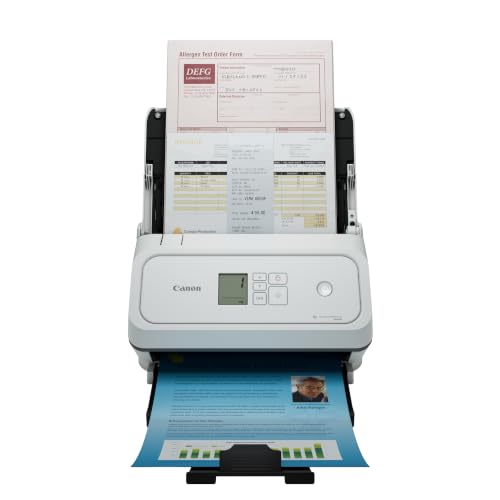
Simple USB Cloud Scanner – Canon R40II
The Canon imageFORMULA R40II is a straightforward option among document scanners with cloud upload if you prefer a wired USB setup and easy batch scanning. It supports duplex scanning up to 45 ppm, includes a 60-sheet feeder, and is designed to work with the bundled CaptureOnTouch software for simple scanning to cloud and other destinations.
Best For: Users who want a simple, fast USB scanner with software that supports cloud scanning.
Pros:
- Scans both sides at once at up to 45 ppm
- 60-sheet automatic feeder handles moderate workloads
- Works with Canon CaptureOnTouch for easy setup and scanning
- Handles receipts, business cards, long documents, and mixed document types
Cons:
- USB-only connection limits wireless placement options
- TWAIN and ISIS drivers are not supported
The R40II is best if your priority is reliable desktop scanning with minimal setup rather than wireless flexibility. It makes sense for users who want a fast feeder-based scanner and are comfortable staying within Canon’s software workflow.
Space-Saving Wi-Fi Choice – ScanSnap iX1300
If you are comparing document scanners with cloud upload for a tight workspace, the ScanSnap iX1300 is built to stay out of the way while still handling everyday scanning tasks. It connects by USB or Wi-Fi, can send scans to Mac, PC, mobile devices, and cloud services, and includes ScanSnap Home software for organizing documents, receipts, photos, and cards.
Best For: Small desks and users who want a compact scanner with cloud and mobile connectivity.
Pros:
- Space-saving design that works well in small areas
- USB and Wi-Fi connectivity for flexible scanning options
- Up to 30 ppm duplex scanning with automatic image cleanup features
- Can scan documents, photos, business cards, and plastic cards
Cons:
- 20-sheet capacity is modest for heavy batch scanning
- Designed for smaller jobs rather than high-volume office throughput
The iX1300 is a strong everyday scanner when desk space is limited and you still want cloud-ready convenience. Its value comes from easy placement, broad device support, and simple organization software.
Compact Cloud-Ready Desktop Scanner – Brother ADS1500W
Brother ADS1500W Compact Color Desktop Scanner with Duplex and Web Connectivity
Check Price On AmazonIf you want one of the more practical document scanners with cloud upload, the Brother ADS1500W is built for everyday office capture. It scans single- and double-sided pages in one pass, handles color or black-and-white jobs, and gives you direct destinations for cloud services from its touchscreen.
Best For: Small offices and home users who want a compact desktop scanner with one-touch cloud destinations and support for a wide mix of paperwork.
Pros:
- One-pass duplex scanning at up to 18 ppm
- 2.7-inch color touchscreen with customizable shortcuts
- Direct scan-to options for Google Drive, Dropbox, Box, Evernote, and more
- Can handle documents, receipts, photos, IDs, and embossed plastic cards
Cons:
- Slower than newer high-speed office scanners
- 20-page auto document feeder is modest for larger batches
- Cloud workflows rely on its built-in destination setup and software
The ADS1500W stands out for convenience rather than raw speed, but that is often exactly what matters in a cloud-first workflow. If you need a straightforward scanner that can send files to online services, email, FTP, or a USB drive without much hassle, this is a well-rounded pick.
High-Speed Wireless Cloud Scanner – ScanSnap iX2500
For buyers comparing document scanners with cloud upload, the ScanSnap iX2500 is aimed at speed, automation, and flexible sharing. It offers fast 45 ppm double-sided scanning, a 100-sheet feeder, and Wi-Fi or USB connectivity so you can send scans to PCs, Macs, mobile devices, and cloud services.
Best For: Busy users who want a fast, feature-rich scanner for large stacks of documents and cloud-based organization.
Pros:
- Fast 45 ppm double-sided scanning
- 100-sheet document feeder for bigger jobs
- Wi-Fi 6 plus USB-C for flexible connections
- Profiles, quick menus, and automatic optimizations help sort and name files
Cons:
- More scanner than casual users may need
- Higher-capacity features can make it less compact than mobile models
- Cloud and workflow features may take time to customize
The iX2500 is the most automation-heavy option here, which makes it appealing if you scan often and want files organized with minimal manual cleanup. It is a strong fit when speed, cloud access, and feeder capacity matter more than portability.
Portable Scan-to-Cloud Scanner – Epson WorkForce ES-50
If portability is the priority, this Epson model is a useful choice among document scanners with cloud upload. The WorkForce ES-50 is lightweight, USB-powered, and designed for quick single-sheet scanning, with included software that supports scan-to-cloud workflows.
Best For: Mobile workers and occasional scanners who need a compact, USB-powered way to digitize pages and send them to online storage.
Pros:
- Fast single-page scans in as little as 5.5 seconds
- Lightweight, USB-powered design with no batteries required
- Can scan documents up to 8.5 x 72 inches
- Included software supports cloud uploads, OCR, and searchable PDFs
Cons:
- Single-sheet-fed design is not built for large stacks
- Requires a computer connection for operation
- Best suited to lighter, on-the-go scanning rather than office batches
The ES-50 makes the most sense when you need something easy to carry and simple to set up. It is not the fastest path for big jobs, but for receipts, IDs, and occasional documents, it keeps cloud scanning straightforward.
AI-Ready Cloud Scan Receipts – Epson RapidReceipt RR-620W
If you want document scanners with cloud upload that also handle receipts intelligently, the Epson RapidReceipt RR-620W is built for fast, organized scanning. It combines a 100-sheet feeder, wireless connectivity, and AI-ready data extraction, so you can move paper into cloud storage or accounting workflows with less manual cleanup.
Best For: Users who scan receipts, invoices, and mixed documents and want direct cloud-ready output plus QuickBooks/TurboTax-friendly organization.
Pros:
- AI PRO Technology extracts and converts receipts and documents into smart, AI-ready data.
- ScanWay touchscreen scanning can send files directly to email, cloud storage, or USB flash drives without a computer.
- Up to 45 ppm double-sided scanning and a 100-sheet ADF support high-volume batches.
- Works with Wi-Fi and USB for flexible desktop setup.
Cons:
- At 8.2 pounds, it is less portable than compact scanners.
- Built primarily for Mac and PC desktop use rather than mobile-first workflows.
This is a strong pick if your priority is cloud upload plus smarter receipt handling, not just basic scan-and-save performance.
Wireless Cloud Sharing Workhorse – Epson Workforce ES-500W II
For buyers comparing document scanners with cloud upload, the Epson WorkForce ES-500W II stands out as a simple wireless desktop scanner for everyday office stacks. It scans up to 35 ppm, supports a 50-sheet feeder, and lets you upload to cloud storage from the desktop app or Epson Smart Panel mobile app.
Best For: Home offices and small teams that want straightforward wireless scanning to cloud services with solid speed and easy software.
Pros:
- Wireless scanning to smartphones, tablets, computers, and online cloud storage accounts.
- ScanSmart software supports preview, email, upload to the cloud, and automatic file naming.
- 50-sheet ADF and single-step duplex scanning help process batches quickly.
- OCR can create searchable PDFs and convert scans to editable Word or Excel files.
Cons:
- Top speed is 35 ppm, slower than Epson’s faster high-volume models.
- It uses a USB connection type in the specs despite wireless scanning support, which may be confusing for some buyers.
This model is a practical choice if you want reliable cloud upload features without stepping up to a more advanced or specialized scanner.
Fast Cloud Workflow Scanner – Epson Workforce ES-400 II
The Epson WorkForce ES-400 II is a straightforward option for document scanners with cloud upload if you want a fast, wired desktop setup. It uses Epson ScanSmart software to preview scans, email files, and upload to the cloud, while the 50-sheet ADF and duplex scanning keep stacks moving efficiently.
Best For: Users who want a speedy desktop scanner for office documents and easy cloud storage sharing through a USB-connected workflow.
Pros:
- Epson ScanSmart lets you preview, email, and upload scans to the cloud.
- 50-sheet ADF and duplex scanning support efficient batch processing.
- OCR creates searchable PDFs and can convert scans to editable Word or Excel files.
- TWAIN driver helps it fit into many document management software workflows.
Cons:
- It is USB-only, so it does not offer built-in Wi-Fi like some alternatives.
- Resolution is listed at 300 dpi, which may be less appealing for users focused on finer-detail capture.
If your priority is simple, fast desktop scanning with cloud upload support and reliable office integration, this is an easy model to consider.
How We Picked the Best Document Scanners with Cloud Upload
We prioritized practical office features that matter most in daily use: duplex scanning, reliable wireless or USB connectivity, strong document-feed performance, and straightforward cloud destination support. We also looked for models that suit different workloads, from mobile use to high-volume desktop scanning.
Quick Comparison
Some scanners are built for portability and occasional use, while others are designed for faster stacks of mixed paperwork. In general, compact models work well for small desks and lighter workloads, while higher-speed desktop scanners are better for shared offices, larger file backlogs, or anyone digitizing paper in batches.
Key Buying Factors for Document Scanners with Cloud Upload
Speed and Duty Cycle
Look at pages per minute and how much paper you scan in a typical day. Higher speeds help if you process contracts, forms, or archived files regularly. If you scan only a few pages at a time, a smaller model may be enough.
Duplex Scanning
Single-pass double-sided scanning is a major time saver. It reduces manual flipping and makes it easier to digitize multi-page packets quickly.
Cloud Workflow Support
Not all cloud-ready scanners handle destinations the same way. Check whether the scanner can send files directly to your preferred services or whether it uses companion software for upload and organization.
Connectivity and Compatibility
Wireless is convenient for shared spaces, while USB can be more stable for a dedicated workstation. Make sure the scanner supports your operating system and any document management tools you already use.
Paper Handling
Consider the types of documents you scan most often: receipts, IDs, thin paper, thick cards, or mixed stacks. A better feeder and image correction tools can reduce jams and cleanup.
Who Should Buy Which Document Scanners with Cloud Upload?
If you want the fastest path for busy office filing, choose a high-speed desktop model with duplex scanning and cloud support. If desk space is tight, a compact scanner is the smarter fit. Frequent travelers and remote workers should look at portable options, while receipt-heavy users may prefer a model tuned for both receipts and standard documents.
For most buyers, the best choice comes down to balancing speed, size, and how directly you want scans to reach the cloud. Pick the scanner that matches your volume today, with a little headroom for future use.