Choosing powered studio monitors is about more than wattage or brand names. The right pair should give you clear mids, controlled bass, and enough detail to make mixing decisions you can trust.
In this roundup, we focused on options that fit real-world setups, from small home studios to more serious production spaces, with a range of sizes and feature sets.
Best 10 Powered Studio Monitors Picks for 2026
Compact Desktop Reference
Yamaha HS4 Powered Studio Monitor Pair

- 4.5-inch woofer and 1-inch dome tweeter
- Room control and high trim settings
- XLR/TRS, RCA, and stereo mini inputs
Best For: Desktop creators who need a compact stereo monitor pair
Wide-Sweet-Spot Pair
JBL 305P MkII 5-Inch Powered Monitors

- Image Control Waveguide for precise imaging
- Dual 41W Class-D amps and Slip Stream port
- Boundary EQ and HF Trim for room tuning
Best For: Producers and podcasters who want precise imaging and room tuning
Classic Nearfield Choice
Yamaha HS5 Powered Studio Monitor Pair

- 5-inch woofer with 1-inch dome tweeter
- Bi-amplified 70W nearfield design
- XLR and TRS inputs for studio use
Best For: Engineers and musicians who want a straightforward nearfield pair
Budget-Friendly Flat Response
Edifier MR4 Powered Studio Monitors
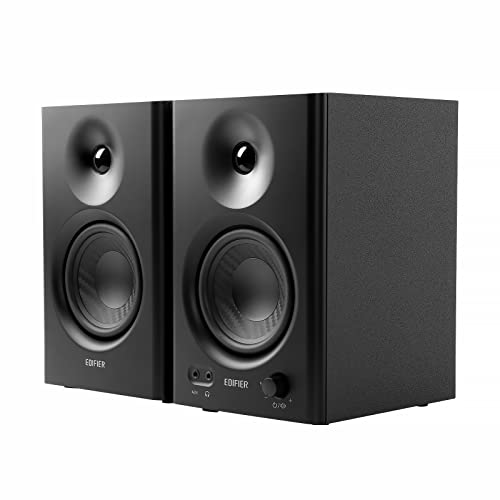
- Almost-flat tuning for studio work
- TRS, RCA, AUX, and headphone output
- High and low tone controls on the front
Best For: Budget-conscious creators who want flexible inputs and desktop use
Compact Desk Monitor
Mackie CR3.5 Studio Monitors (Pair)

- Sold as a pair with cables and isolation pads included.
- Tone knob and location switch help tailor the sound.
- RCA and TRS inputs suit common desktop gear.
Best For: Small desks, starter studios, and close-range listening.
Flexible Hi-Res Pick
Edifier MR3 Powered Studio Monitor

- Hi-Res Audio certified with flat-response tuning.
- Bluetooth plus TRS, RCA, AUX, and headphone output.
- App EQ and multiple sound modes add flexibility.
Best For: Creators who want tuning control and wireless convenience.
Budget All-Rounder
PreSonus Eris 3.5 Powered Studio Monitors

- Built-in 50W amplification for clean near-field sound.
- Room-tuning controls help tailor the output.
- TRS, RCA, aux, and headphone jack improve compatibility.
Best For: Budget-conscious users who need a compact all-in-one monitor pair.
Precision Pick
Kali Audio LP-6 V2 6.5" Powered Studio Monitor

- Flat-response DSP for detailed monitoring
- Front port and low-noise design reduce turbulence
- 80W bi-amped output with boundary EQ
Best For: Music production and home studio mixing
Wide-Sweet-Spot Choice
PreSonus Eris E7 XT Active Monitor

- EBM waveguide widens the listening sweet spot
- Room-tuning controls help tailor sound to your space
- 6.55-inch woofer and silk-dome tweeter for balanced detail
Best For: Mixing in rooms that need flexible acoustic tuning
Budget Versatility Pick
Ortizan C7 Powered Studio Monitors Pair

- Bluetooth 5.3 and multiple wired inputs
- Built-in 24-bit DAC over USB
- 3.5-inch woofer with balanced TRS support
Best For: Compact setups that need flexible connectivity
Compact Desktop Reference – Yamaha HS4 Powered Studio Monitor Pair
If you want powered studio monitors for a small desk setup, the Yamaha HS4 pair is built for practical nearfield work like music production and video editing. The 4.5-inch woofers, 1-inch dome tweeters, and room control/high trim options make them a straightforward choice when you want clean monitoring without a lot of fuss.
Best For: Desktop creators who need a compact stereo monitor pair for mixing, editing, and everyday DAW work.
Pros:
- Compact 2-way design with 4.5-inch woofer and 1-inch tweeter
- Room control and high trim help tailor the sound to the space
- Flexible XLR/TRS, RCA, and stereo mini inputs
- Includes speaker cable, mini-to-RCA cable, and anti-slip pads
Cons:
- 26W output is modest for larger rooms
- Small cabinet size limits deeper bass output
- Best suited to nearfield listening rather than filling a room
Overall, the HS4 is a sensible pick if you need a compact powered monitor pair with useful room tuning and broad connectivity. It focuses on desktop practicality and accurate everyday studio use.
Wide-Sweet-Spot Pair – JBL 305P MkII 5-Inch Powered Monitors
For powered studio monitors that prioritize imaging and mix detail, the JBL 305P MkII pair stands out with its Image Control Waveguide and dual 41-watt Class-D amplification. The 5-inch woofers, Slip Stream port, and room adjustment tools are aimed at producers who want accurate monitoring with a broad sweet spot.
Best For: Producers, podcasters, and creators who want precise stereo imaging and room-tuning flexibility.
Pros:
- Patented Image Control Waveguide for wide, immersive imaging
- Dual 41W Class-D amps with 5-inch woofer and Slip Stream port
- Boundary EQ and HF Trim help adapt the sound to the room
- XLR/TRS inputs and a tested MDF enclosure
Cons:
- Less compact than smaller 4-inch desktop options
- Designed for studio use, so not ideal if you want a casual all-purpose speaker
The 305P MkII is a strong fit if your priority is monitor accuracy, imaging, and flexible placement in a project studio. It has the technical features many buyers look for in a serious powered monitor pair.
Classic Nearfield Choice – Yamaha HS5 Powered Studio Monitor Pair
The Yamaha HS5 pair is a familiar option in powered studio monitors for users who want a nearfield monitor with a clear, uncolored presentation. With a 5-inch cone woofer, 1-inch dome tweeter, and bi-amplified 70-watt design, it’s aimed at studio monitoring and music production where sonic purity matters.
Best For: Engineers and musicians who want a straightforward nearfield monitor pair for studio work.
Pros:
- 5-inch woofer and 1-inch dome tweeter in a 2-way bass reflex design
- Bi-amplified 70W total output for nearfield monitoring
- Designed to emphasize sonic purity without added coloration
- XLR and TRS inputs accept balanced or unbalanced signals
Cons:
- 5-inch size may not deliver the deepest low end on its own
- Best suited to studio monitoring rather than general listening
If you want a traditional studio monitor approach, the HS5 remains a practical and focused choice. Its clean tuning and pro-style connectivity make it easy to drop into a recording or editing setup.
Budget-Friendly Flat Response – Edifier MR4 Powered Studio Monitors
The Edifier MR4 is a practical option in powered studio monitors if you want a more affordable desktop-friendly pair with a near-flat tuning. Its 4-inch woofer, 1-inch silk dome tweeter, and front controls make it easy to use for music production, recording, and general computer listening.
Best For: Budget-conscious creators who want flexible inputs and an easy desktop monitor setup.
Pros:
- Professionally tuned to an almost flat curve for studio use
- 1-inch silk dome tweeter and 4-inch composite woofer
- TRS, RCA, and AUX inputs plus a front headphone output
- Separate high/low controls and front volume/mode button
Cons:
- 4-inch driver size is more limited for bass-heavy monitoring
- Best for nearfield use on a desk rather than larger rooms
For a compact and versatile budget monitor, the MR4 covers the basics well. It offers the connectivity and tuning controls that matter most for everyday studio and PC use.
Compact Desk Monitor – Mackie CR3.5 Studio Monitors (Pair)
If you want powered studio monitors that fit a desk without sounding overly “polite,” the Mackie CR3.5 pair is built for simple near-field setups. The 3.5-inch woofers, tone knob, and location switch make it easy to match the speakers to your room and your listening preference.
Best For: Small studios, desktop setups, and casual mixing where space is limited.
Pros:
- Sold as a complete stereo pair with isolation pads and all needed cables included.
- Tone knob lets you adjust voicing directly from the desk without menus.
- Location switch helps correct bass when placed near a wall or in free space.
- RCA and TRS connectivity work with desktops, laptops, phones, and more.
Cons:
- 3.5-inch woofers are better suited to compact rooms than larger monitoring spaces.
- No wireless connectivity options are listed.
The CR3.5 is a practical pick if you need a straightforward powered studio monitor setup for close-up listening and desktop production. It focuses on flexibility and easy placement rather than extra features.
Flexible Hi-Res Pick – Edifier MR3 Powered Studio Monitor
The Edifier MR3 is a strong choice if you want powered studio monitors with more connectivity and tuning flexibility. With Hi-Res Audio certification, Bluetooth support, and app-based EQ controls, it covers monitoring, editing, and everyday listening in one compact package.
Best For: Home studios, content creators, and listeners who want adjustable sound with wireless convenience.
Pros:
- Hi-Res Audio certification and a flat response help support accurate monitoring.
- Balanced TRS, RCA, AUX, Bluetooth, and headphone output offer broad connection options.
- Music, Monitor, and Custom modes make it easy to match the speaker to the task.
- EDIFIER ConneX app adds detailed EQ control for further tuning.
Cons:
- Plastic enclosure is not as premium as MDF-heavy alternatives.
- Maximum output is modest compared with larger powered monitors.
Overall, the MR3 stands out for users who want a monitor that can move between studio work and casual use without much hassle. Its balance of wired inputs, Bluetooth, and app control makes it especially versatile for desk setups.
Budget All-Rounder – PreSonus Eris 3.5 Powered Studio Monitors
The PreSonus Eris 3.5 is a versatile option if you want powered studio monitors that can handle music production, gaming, and general desktop audio. With built-in amplification, room-tuning controls, and a compact stereo-pair design, it aims to deliver clean sound in tight spaces.
Best For: Desk-based creators and everyday users who want an affordable, feature-rich monitor pair.
Pros:
- 50 watts of built-in amplification provides clear output at low to moderate volumes.
- High- and low-frequency controls help adjust the sound for your room.
- Balanced TRS, RCA, front aux, and front headphone jack cover common desktop sources.
- Sold as a complete stereo pair with a compact footprint for desks and bookshelves.
Cons:
- 3.5-inch woofers are best for near-field use rather than bass-heavy monitoring.
- Maximum range and size make it less ideal for larger studio rooms.
If you need a practical entry-level monitor setup, the Eris 3.5 checks a lot of boxes without taking up much room. It’s especially appealing for users who want straightforward controls and broad compatibility from a small pair of powered speakers.
Precision Pick – Kali Audio LP-6 V2 6.5" Powered Studio Monitor
The Kali Audio LP-6 V2 is a practical choice if you want powered studio monitors that aim for a flat, revealing presentation. Its updated DSP, boundary EQ, and low-noise bi-amped design are built to help you hear mix details clearly whether the monitor is on a desk, a stand, or placed near a wall.
Best For: Music producers and home studio users who want accurate monitoring with flexible placement options.
Pros:
- 2nd-gen DSP is tuned for a more robust flat response.
- Front port and 12dB noise reduction help reduce chuffing and hissing.
- Boundary EQ is designed to sound consistent on stands, desks, or against walls.
- 80W bi-amped power, 115dB max SPL, and 47Hz-21kHz range give it solid output for the size.
Cons:
- Sold as a single monitor, so stereo listening requires a second unit.
- Focused on accuracy rather than adding extra color or enhancement.
Overall, the LP-6 V2 is a strong pick for buyers who value honest monitoring and adaptable placement in a compact setup.
Wide-Sweet-Spot Choice – PreSonus Eris E7 XT Active Monitor
PreSonus Eris E7 XT 2-Way Active Studio Monitor with EBM Waveguide (Pack of 1)
Check Price On AmazonThe PreSonus Eris E7 XT stands out among powered studio monitors for its EBM waveguide and tuning controls, which are meant to widen the sweet spot and help you adapt the sound to your room. With a 6.55-inch low-frequency driver, silk-dome tweeter, and multiple acoustic adjustments, it is built for practical mixing work in a real-world space.
Best For: Mixers and project studios that need wide imaging and room-tuning flexibility.
Pros:
- EBM waveguide provides a wide 100° x 60° sweet spot and solid imaging.
- Acoustic controls let you adjust level, HPF, LF trim, HF trim, and acoustic space.
- 6.55-inch woven composite woofer and 1.25-inch silk-dome tweeter support deep lows and smooth highs.
- Includes Studio One Prime and Studio Magic plug-in suite.
Cons:
- Sold as a single monitor, so you need two for a stereo pair.
- Best results depend on using the tuning controls for your room.
If you want a monitor that gives you room for adjustment and a broad listening sweet spot, the Eris E7 XT is a sensible studio-focused option.
Budget Versatility Pick – Ortizan C7 Powered Studio Monitors Pair
The Ortizan C7 is a flexible option if you want powered studio monitors that can do more than just desk monitoring. With Bluetooth 5.3, RCA, TRS, AUX, and USB input support, it is designed for easy switching between music playback, TV use, gaming, and compact content-creation setups.
Best For: Buyers who want an affordable all-in-one speaker pair for casual monitoring and everyday listening.
Pros:
- Bluetooth 5.3 plus RCA, AUX, TRS, and USB inputs add a lot of connection flexibility.
- Built-in 24-bit DAC is designed to minimize signal loss over USB.
- 3.5-inch carbon fiber woofer and 0.75-inch silk dome tweeter aim for clear mids, highs, and detail.
- Balanced TRS input and front headphone output support compact monitoring workflows.
Cons:
- 3.5-inch drivers are smaller than the other monitors here, so they are less suited to deeper low-end needs.
- Positioning and setup matter if you want the flattest response.
The C7 is a practical pick when you want broad connectivity and a monitor pair that can serve double duty in a smaller space.
How We Picked the Best Powered Studio Monitors
We prioritized Powered Studio Monitors that offer a practical mix of sound quality, connectivity, room-friendly sizing, and overall value. Because these speakers are often used for mixing, editing, and content creation, we gave extra weight to neutrality, low-noise performance, and ease of placement.
Quick Comparison
Smaller 3- to 4-inch models are best for compact desks, casual production, and nearfield listening. 5-inch monitors are the most versatile for many home studios, while 6.5-inch and larger options usually deliver fuller low end and more headroom for bigger rooms.
Key Buying Factors for Powered Studio Monitors
Driver Size and Room Size
Match the speaker to the room. Smaller drivers are easier to manage in tight spaces, while larger woofers can produce more bass but may overwhelm untreated rooms.
Sound Accuracy
For production work, look for a balanced response rather than hyped bass or exaggerated treble. Accurate Powered Studio Monitors help you make better EQ, compression, and balance decisions.
Inputs and Connectivity
Check whether you need balanced inputs, RCA, 3.5 mm, or wireless features. Balanced connections are usually preferable for cleaner signal paths in studio setups.
Controls and Placement
Rear or front EQ controls, volume knobs, and acoustic tuning options can make setup easier. Also consider isolation pads, stands, and how close the monitors will sit to walls.
Who Should Buy Which Powered Studio Monitors?
If you are building a small home studio or desktop setup, compact Powered Studio Monitors are usually the easiest fit. If you want more mix translation and stronger low-end extension, step up to a 5-inch or 6.5-inch model. Creators who mainly edit voice, stream, or listen casually may prefer smaller speakers with simple connectivity and a smaller footprint.
For the best results, choose the pair that matches your room, workflow, and listening distance rather than chasing the biggest spec sheet. The right monitors will sound honest, stay comfortable over long sessions, and support better decisions across every project.