Choosing the right security camera tester can make camera installation, commissioning, and fault-finding significantly faster. The best models combine display quality with practical tools such as PoE output, IP discovery, cable testing, PTZ control, and support for multiple video standards.
This roundup compares 10 testers for installers working with modern IP systems, legacy coaxial cameras, or both. Use the guide below to match screen size, power capability, connectivity, and diagnostic features to your daily workflow.
Best 10 Security Camera Testers for Installers Picks for 2026
High-Power IP Specialist

- Up to 90W PoE++ output for compatible PTZ cameras
- 4K/12MP IP camera testing with reporting tools
- SFP, Wi-Fi, power, and cable diagnostics included
Best For: High-power PoE/PTZ and fiber-network installations
Portable Coax Choice
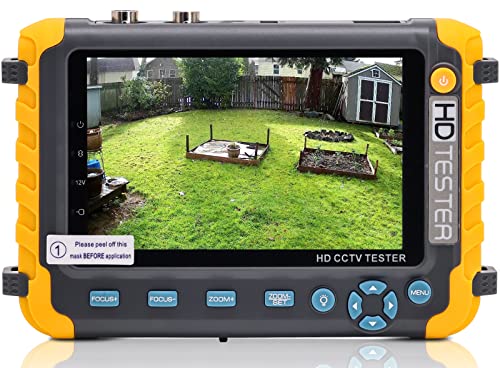
- Supports AHD, TVI, CVI, and CVBS cameras up to 8MP
- Adds PTZ, UTP, audio, VGA, and HDMI testing
- Battery is specified for up to 11 hours of operation
Best For: HD coax and analog CCTV service calls
All-System Workhorse

- 90W PoE output plus 4K/12MP IP camera support
- Tests IP, PTZ, analog, HDMI, and VGA sources
- Detailed RJ45 TDR and network troubleshooting tools
Best For: Multi-format installation and troubleshooting
Documentation-Focused Pro

- Supports IP, HD coax, and analog CCTV systems
- Powers cameras via PoE/PoE+ or 12V DC
- Creates transferable reports with screenshots
Best For: Professional commissioning and documented handoffs
Best Compact All-Rounder

- Tests IP, CVBS, AHD, TVI, and CVI cameras
- 30W PoE and DC12V power output
- RJ45 TDR, PTZ, and network tools
Best For: Compact mixed-camera installation and troubleshooting
Best Long-Running Workshop Tester

- Supports up to 8K IP and 8MP HD cameras
- 10-hour working time with a 5400mAh battery
- Includes TDR, multimeter, OPM, VFL, and HDMI
Best For: Extended service calls and broad diagnostic work
Best Advanced Fiber and PoE Tester

- Supports 8K/32MP IP and multiple analog formats
- 90W PoE++ output for high-power PTZ cameras
- Includes OPM, VFL, SFP, and extensive TDR tools
Best For: Advanced IP, PoE, fiber, and high-resolution installations
Feature-Rich Network Specialist

- Tests IP/PoE cameras up to 6K/32MP
- RJ45 TDR range reaches 195 meters
- CVBS only for analog cameras
Best For: IP/PoE installation and network diagnostics
Coaxial HD Value Pick

- Supports 4K/8MP TVI, AHD, and CVI
- Includes UTC and RS485 PTZ controls
- Does not test IP network cameras
Best For: Coaxial HD camera installation and maintenance
Compact All-Format Workhorse

- Tests 4K IP plus AHD, TVI, CVI, and CVBS
- Supplies 25.5W PoE and 12V power
- Includes scanning, TDR, and cable tools
Best For: Mixed-format installation and service calls
High-Power IP Specialist – 4K 90W CCTV Tester
For installers comparing security camera testers for installers, this 8-inch Rsrteng E88 is built for demanding IP-camera work. It combines 4K/12MP video testing with up to 90W PoE++ output, SFP fiber support, Wi-Fi analysis, cable testing, and power diagnostics.
Best For: Installers handling high-power PoE/PTZ cameras, gigabit networks, and fiber-linked systems.
Pros:
- Supports IEEE 802.3af/at/bt PoE and up to 90W output for compatible high-power PTZ cameras.
- Tests up to 4K/12MP IP cameras and includes camera discovery, activation, IP modification, and reporting tools.
- Includes a gigabit SFP slot, Wi-Fi analyzer, PoE detection, power management, and RJ45/TDR cable testing.
Cons:
- Its broad feature set may be more than needed for basic analog-camera service calls.
- Fiber testing requires a separately inserted compatible SFP module.
This is a feature-heavy choice for network-focused technicians who need one tester for camera commissioning, PoE troubleshooting, cable checks, and basic network diagnostics.
Portable Coax Choice – 4-in-1 Analog CCTV Tester
Among security camera testers for installers, the Anpviz IV8-GM is a straightforward option for coax-based systems. Its 5-inch display supports AHD, TVI, CVI, and CVBS testing, while built-in PTZ, UTP, audio, power, VGA, and HDMI functions broaden its service-call usefulness.
Best For: Technicians installing or troubleshooting HD coax and analog cameras rather than IP PoE cameras.
Pros:
- Supports TVI video up to 8MP, along with AHD, CVI, and CVBS camera formats.
- Includes PTZ control, UTP cable testing, audio testing, and power output.
- Built-in 2,600mAh battery is specified for up to 11 hours of working time after charging.
- VGA and HDMI input allow use with DVR/NVR recorders and as a display.
Cons:
- It does not support IP PoE cameras.
- The 5-inch, 800×480 screen is smaller and lower resolution than the larger IP testers in this roundup.
- The display is not touch-enabled.
This tester makes the most sense for legacy and hybrid service work where coax camera compatibility, PTZ control, and portability matter more than IP-network features.
All-System Workhorse – 4K 90W IP Camera Tester
The WANLUTECH E88 is a versatile pick among security camera testers for installers who work across IP, PoE, analog, and network infrastructure. It pairs a large touchscreen with 90W PoE output, SFP fiber testing, extensive cable diagnostics, camera configuration tools, and HDMI/VGA inputs.
Best For: Installers who need one field tester for IP, PTZ, analog, PoE, fiber, and structured-cabling tasks.
Pros:
- Provides up to 90W PoE output for compatible 802.3af/at/bt devices and high-power PTZ cameras.
- Supports 4K/12MP IP testing, camera discovery, batch activation, IP/password changes, and test reports.
- RJ45 TDR testing covers pair status, length, attenuation, impedance, skew, and fault location.
- Includes SFP, Wi-Fi analysis, PoE detection, HDMI/VGA input, and testing for analog camera formats.
Cons:
- The extensive feature set can mean a steeper learning curve than a basic coax tester.
- An SFP module is needed for optical-fiber testing.
With its broad format support and strong cable/network toolkit, this is a practical choice for contractors who regularly move between camera commissioning and infrastructure troubleshooting.
Documentation-Focused Pro – SecuriTEST IP Camera Tester
TREND Networks’ SecuriTEST IP is designed for installers who value repeatable commissioning and clear handoff documentation. It supports IP, HD coax, and analog CCTV systems, supplies PoE/PoE+ or 12V DC power, and creates reports with camera and video screenshots.
Best For: Professional integrators who need camera configuration, troubleshooting, and customer-ready installation reports.
Pros:
- Supports digital/IP, HD coax, and analog CCTV systems in one tester.
- Can power cameras through PoE/PoE+ or standard 12V DC using its internal Li-Ion battery.
- QuickIP and networking tools help identify cameras and troubleshoot connectivity.
- Creates reports with camera and video screenshots and supports email transfer.
Cons:
- The supplied notes do not specify a maximum IP-camera resolution or PoE wattage.
- Its feature set is aimed at professional installation workflows rather than basic visual checks.
This is a strong fit when documenting completed work and reducing troubleshooting callbacks is as important as powering and configuring the camera itself.
Best Compact All-Rounder – WANLUTECH IPC-1800ADH Plus
For installers comparing security camera testers for installers, the WANLUTECH IPC-1800ADH Plus is a compact option that combines IP, analog, cable, and basic network testing in one handheld unit. Its 4-inch touchscreen and support for cameras up to 8MP make it useful for routine commissioning and troubleshooting.
Best For: Installers who need a compact tester for mixed IP, coaxial, PTZ, and RJ45 jobs.
Pros:
- Tests IP cameras, CVBS, and up to 8MP AHD, TVI, and CVI cameras.
- Provides PoE output up to 30W and DC12V 3A output for temporarily powering devices.
- Includes PTZ control, RJ45 TDR testing, IP discovery, PING, port flashing, and report creation.
- Supports Hikvision and Dahua batch activation and IP or password changes.
Cons:
- The 4-inch display is smaller than the screens on the other testers in this roundup.
- The included 2400mAh battery is more modest than the higher-capacity alternatives.
This is a practical choice when portability matters more than a large viewing area or advanced fiber tools. It covers the core functions needed for mixed-camera installation work without adding unnecessary bulk.
Best Long-Running Workshop Tester – EVERSECU 7-Inch CCTV Tester
The EVERSECU is a versatile choice for installers shopping for security camera testers for installers, with a 7-inch IPS touchscreen, broad camera compatibility, and a stated working time of up to 10 hours. It adds measurement and media features that can make longer service calls more convenient.
Best For: Installers who want a large screen, extended battery life, and a broad set of camera, cable, and network tools.
Pros:
- Supports up to 8K IP video and 8MP HD, AHD, TVI, CVI, and CVBS cameras.
- Includes TDR, digital multimeter, optical power meter, VFL, HDMI input/output, and audio recording.
- Offers 24W PoE output, DC12V 2A output, and 10/100/1000M Ethernet testing.
- The 7-inch 1280×800 touchscreen and 5400mAh battery suit extended testing sessions.
Cons:
- At 4.58 pounds, it is less lightweight than a compact handheld tester.
- The PoE output is lower than the 90W capacity offered by the NOYAFA model.
The EVERSECU balances a large display and strong battery capacity with substantial diagnostic coverage. It is especially compelling for technicians who regularly move between camera commissioning, network checks, cable testing, and general signal measurements.
Best Advanced Fiber and PoE Tester – NOYAFA 8-Inch CCTV Tester
For demanding installation teams evaluating security camera testers for installers, the NOYAFA 8-inch tester stands out for its large display, 32MP IP support, fiber diagnostics, and high-power PoE++. It is designed for jobs that extend beyond standard camera viewing and basic cable checks.
Best For: Professional installers handling high-resolution cameras, high-power PTZ systems, and fiber-linked networks.
Pros:
- Supports true 8K/32MP IP viewing and automatically recognizes TVI, CVI, AHD, SDI, and CVBS cameras.
- Provides up to 90W IEEE 802.3af/at/bt PoE output for high-power PTZ cameras.
- Includes a seven-wavelength optical power meter, visual fault locator, and Gigabit SFP interface.
- Offers dual Gigabit Ethernet ports, Wi-Fi analysis, extensive TDR testing, HDMI, and network tools.
Cons:
- Its advanced feature set may be more than needed for basic residential camera installations.
- The supplied notes specify a built-in 18650mAh battery, so battery capacity is less generous on paper than the EVERSECU’s.
The NOYAFA is the most specialized option here, particularly for fiber, high-power PoE, and high-resolution IP work. Its larger screen and extensive interfaces make it a strong fit for technicians who need one tester to cover both camera and network infrastructure diagnostics.
Feature-Rich Network Specialist – 6K IP and CVBS Camera Tester
For installers seeking security camera testers for installers, this RAINLEOTI model is geared toward network-camera work while retaining basic CVBS support. It combines IP discovery, PoE testing, cable diagnostics, PTZ control, and a large touchscreen in one portable unit.
Best For: Installers who primarily test IP/PoE systems and occasionally service standard CVBS analog cameras.
Pros:
- Supports IP/PoE camera testing up to 6K/32MP, with IP discovery, RTSP playback, recording, and report generation.
- Includes PoE, UTP, and RJ45 TDR testing, with cable measurements up to 195 meters.
- Offers a 7-inch 1920×1200 IPS touchscreen, Wi-Fi, HDMI output, PTZ control, and multiple power outputs.
- The 7,000mAh battery supports extended field use.
Cons:
- The CVBS input does not support AHD, TVI, or CVI coaxial HD cameras.
- At about 1.98 pounds, it is less compact than smaller testers.
This is the most capable option here for network-focused troubleshooting and documentation. Verify the camera formats you service before buying, since its analog function is limited to standard CVBS.
Coaxial HD Value Pick – 4K TVI/AHD/CVI Camera Tester
Among security camera testers for installers, this coaxial-focused monitor is designed for HD analog systems rather than network cameras. Its automatic format recognition, UTC controls, PTZ support, and cable tester make it practical for servicing compatible coax installations.
Best For: Installers working mainly with TVI, AHD, CVI, or CVBS cameras and needing a straightforward field monitor.
Pros:
- Automatically recognizes TVI, AHD, and CVI cameras up to 4K/8MP, while also supporting CVBS.
- Supports UTC controls, OSD access, and RS485 PTZ control across more than 30 protocols.
- Includes RJ45 wiring and length tests, plus HD and VGA inputs for display use.
- The compact 5-inch unit weighs about 0.88 pounds and includes a 12V/1A camera power output.
Cons:
- It does not support IP network camera testing.
- The 800×480 screen is smaller and lower resolution than the display on the larger tester in this roundup.
If your installations are centered on coaxial HD cameras, this tester offers the right format coverage without paying for IP features you may not need. Choose another model for PoE or network-camera commissioning.
Compact All-Format Workhorse – 4K IP and Analog CCTV Tester
This EVERSECU model suits installers comparing security camera testers for installers who need one compact device for IP, analog, and HD coaxial cameras. It adds practical network utilities, PoE power, cable diagnostics, and PTZ compatibility without the larger footprint of a 7-inch tester.
Best For: Field installers who need broad camera-format coverage and network troubleshooting in a compact battery-powered unit.
Pros:
- Tests IP cameras up to 4K and supports AHD, TVI, CVI, CVBS, ONVIF PTZ, and analog PTZ cameras.
- Provides 25.5W/48V PoE output and 12V/3A power output for on-site testing.
- Includes IP scan, ping, bandwidth, DHCP, traceroute, UTP, and RJ45 TDR functions.
- The 4-inch touchscreen, 180-degree rotation, and roughly 1-pound weight support portable field work.
Cons:
- The 800×480 display is smaller than the 7-inch screen on the RAINLEOTI tester.
- Its stated IP support is up to 4K, below the higher-resolution capacity of the larger network-focused model.
This is a well-rounded choice when installers regularly move between IP and coaxial systems. Its compact design and broad diagnostic toolset make it especially useful for maintenance visits and constrained job sites.
How We Picked the Best Security Camera Testers for Installers
We compared these testers by the capabilities that matter during real installation and service calls: camera and resolution support, PoE output, analog compatibility, network discovery, cable diagnostics, display usability, portability, and accessory connections. Models supporting IP and coaxial formats generally offer more flexibility, while specialist tools may be preferable for installers who need deeper configuration or certification-oriented functions.
Resolution claims are not the only consideration. A tester must also provide suitable power, responsive controls, clear status information, and dependable connections at the job site. Features such as TDR cable testing, SFP support, Wi-Fi, HDMI or VGA output, and PTZ control can reduce the need to carry separate tools.
Quick Comparison
- Best for mixed systems: Choose a 4-in-1 or 5-in-1 tester supporting IP, TVI, CVI, AHD, and CVBS.
- Best for high-resolution IP work: Look for 4K, 8K, or higher megapixel support, plus strong PoE output and IP discovery.
- Best for network troubleshooting: Prioritize cable TDR, RJ45 testing, link information, ping or scan functions, and configurable network settings.
- Best for fiber-connected systems: Consider a tester with an SFP module or optical-fiber interface.
- Best for portability: Smaller four- or five-inch screens are easier to carry, while seven- and eight-inch displays improve menu navigation and image inspection.
Key Buying Factors for Security Camera Testers for Installers
Video and Camera Compatibility
Confirm that the tester supports the formats used by your customers. IP-only equipment may be efficient for new installations, but installers servicing older systems often need TVI, CVI, AHD, and CVBS compatibility. Check the maximum supported resolution and whether the tester can display the camera’s actual output rather than merely detecting it.
PoE Power and Network Functions
PoE output is valuable for testing cameras before connecting them to a switch. Verify the supported IEEE standards, total wattage, and whether the unit can handle higher-power devices. IP discovery, DHCP or static-IP configuration, ping, and link testing are useful when a camera is not appearing on the network.
Cable and Installation Diagnostics
An RJ45 wire map is useful for basic checks, while TDR testing can help estimate cable length and identify opens, shorts, or wiring problems. PTZ control, audio testing, and HDMI, VGA, or SFP connectivity can also improve commissioning efficiency, depending on the systems you install.
Screen, Battery, and Durability
A bright IPS touchscreen makes outdoor testing easier and helps with focus, exposure, and image-quality checks. Larger screens are more comfortable for detailed work, but add bulk. Also compare battery capacity, charging time, protective design, included leads, and the availability of replacement accessories.
Who Should Buy Which Security Camera Testers for Installers?
Independent installers and service technicians should favor a portable multi-format tester with PoE, IP discovery, and cable testing. Commercial CCTV teams may benefit from a larger high-resolution screen, stronger PoE output, fiber support, and broader network diagnostics. Analog-system specialists can save money with a compact coaxial tester that prioritizes TVI, CVI, AHD, and CVBS testing. Installers handling mixed estates should choose the broadest format coverage, even if it means a slightly larger unit.
Before buying, list the cameras and cabling you test most often, then confirm every required connector, video standard, power mode, and maximum resolution. The best Security Camera Testers for Installers are not necessarily the ones with the most headline features; they are the ones that shorten diagnosis time without adding unnecessary weight or complexity.