If you need to copy flash drives in bulk, the right duplicator can save hours and reduce errors. Our roundup focuses on speed, bay count, standalone operation, and erase features.
Whether you’re preparing training media, event giveaways, or IT deployment kits, these picks make it easier to clone drives consistently and efficiently.
Best 10 USB Duplicators Picks for 2026
Standalone Cloning and Erasing
StarTech 1:2 USB Flash Duplicator

- Copies one USB drive to two targets.
- Includes copy, compare, and erase modes.
- LCD interface helps monitor status and errors.
Best For: Small IT jobs that need cloning and secure USB wiping.
Multi-Port Batch Duplication

- Copies one source drive to seven targets.
- Standalone unit with synchronous and asynchronous modes.
- Up to 2GB per minute transfer rate.
Best For: High-volume USB cloning jobs that need many identical copies.
Portable Two-Drive Duplication
BestDuplicator UB300 1:2 USB Duplicator

- Standalone cloning to two target drives.
- Quick Copy and Whole Media Copy modes.
- Includes erase and media-test functions.
Best For: Mobile users who need a lightweight USB cloner with basic diagnostics.
High-Capacity Batch Copying

- Copies one source drive to 15 targets.
- Standalone with synchronous and asynchronous modes.
- Up to 2GB per minute transfer speed.
Best For: Large duplication runs that need many copies at once.
Portable Standalone Copier
EZ Dupe Mini USB Plus MK II 1-to-4
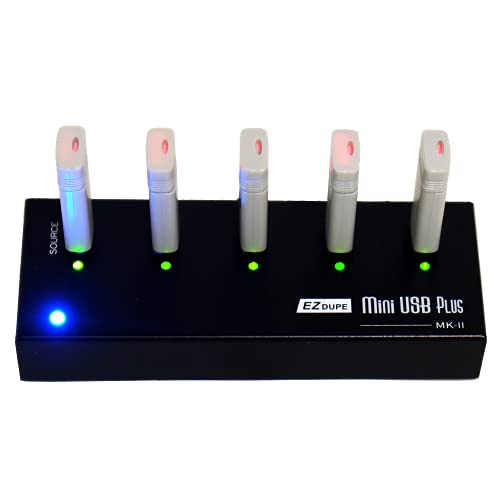
- Copies up to 4 drives at once
- Standalone, no computer required
- Updated version with faster copy speed
Best For: Small batch flash drive duplication on the move
Clone-and-Erase Workstation
StarTech 1:5 USB Flash Drive Duplicator Eraser

- Duplicates and erases USB drives
- LCD menu with drive checks and error scan
- Includes verify and overwrite erase modes
Best For: IT teams needing cloning plus secure drive wiping
High-Capacity PC-Connected Copier
DupliM Mini USB Duplicator 1-to-10

- Copies up to 10 drives at once
- Works with Windows and Mac
- Can clone from files, folders, or image files
Best For: Larger batch cloning with software control on PC or Mac
Top Pick for Large Batch Work
1:15 Standalone LCD USB Duplicator and Eraser

- Duplicates or erases up to 15 drives
- Standalone LCD menu with verify and error scan
- Supports multiple copy and wipe modes
Best For: Technicians and IT pros handling large USB batches
Best Compact Upgrade
Mini USB Plus MK III 1 to 7 Standalone Duplicator

- Copies up to 7 USB drives at once
- Faster than the original model at up to 2.5GB/min
- Standalone design with asynchronous copy mode
Best For: Portable small-to-mid batch USB duplication
Best Mid-Capacity Choice
MiniUSB Pro 1 to 9 Standalone USB Duplicator
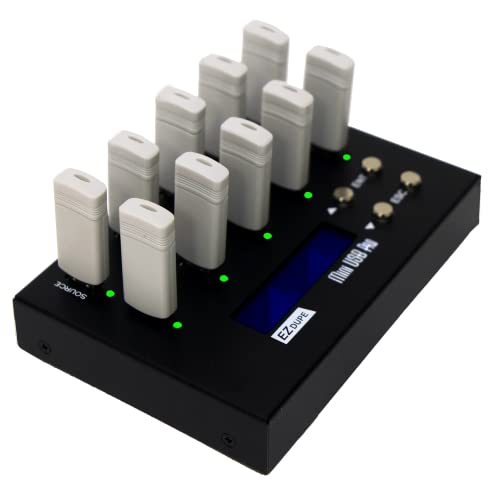
- Copies up to 9 drives simultaneously
- Offers quick copy, sector-by-sector copy, and erase modes
- Supports external USB powered hard drives up to 2TB
Best For: Mid-capacity standalone copying and sanitizing
Standalone Cloning and Erasing – StarTech 1:2 USB Flash Duplicator
If you need usb duplicators for small-batch cloning or secure drive wiping, this StarTech unit is built for straightforward standalone use. It copies one USB flash drive to two targets, supports verification, and includes erase modes for sanitizing drives without a computer.
Best For: Technicians and IT teams that need a compact 1-to-2 USB duplicator for copying, comparing, and erasing flash drives.
Pros:
- Standalone operation with no computer required.
- Supports copy, compare, quick erase, and 3-pass overwrite modes.
- LCD menu shows drive info, performance, and bad-sector scans.
- Asynchronous mode lets you swap finished drives while copying smaller source content.
Cons:
- Asynchronous copy is limited to source content under 64 MB.
- Targeted at 1-to-2 duplication rather than larger production runs.
- External USB devices may need their own power source.
This is a practical pick if you value verification and sanitizing tools as much as basic duplication. Its speed and formatting support make it a flexible fit for routine USB drive workflows.
Multi-Port Batch Duplication – Systor 1 to 7 USB Duplicator
For buyers comparing usb duplicators for higher-volume copying, the Systor SYS-USBD-7 stands out with seven target ports and standalone operation. It is designed for bit-by-bit duplication and includes synchronous and asynchronous copy modes, making it suited to repeatable flash-drive jobs without needing a computer.
Best For: Teams that need to clone multiple USB flash drives at once with a no-computer workflow.
Pros:
- Duplicates one source to up to seven targets at the same time.
- Standalone design requires no software or computer.
- Supports synchronous and asynchronous copy modes.
- Rated for up to 2GB per minute transfer speed.
Cons:
- Large desktop unit at about 10 pounds.
- Uses USB 1.1 interface language in the specs, which may not feel current.
- Best suited to flash drives rather than general storage tasks.
This model is a strong fit when throughput and port count matter more than portability. If you routinely prepare several identical USB drives, its seven-bay layout is the main advantage.
Portable Two-Drive Duplication – BestDuplicator UB300 1:2 USB Duplicator
If you want usb duplicators that stay simple and portable, the BestDuplicator UB300 focuses on one source drive copied to two targets without computer software. It supports quick data-only copying or whole-media cloning, and it also includes erase and media-check tools for basic flash-drive preparation.
Best For: Portable duplication work for IT staff, schools, and field users who need a lightweight 1-to-2 copier.
Pros:
- Standalone 1-to-2 duplication with no computer required.
- Quick Copy and Whole Media Copy modes.
- Includes capacity check, device info, speed test, and erase functions.
- Compact and lightweight for mobile use.
Cons:
- Limited to two target drives at a time.
- Best performance depends on using source and target media of similar capacity.
- Extra card-reader support requires a separate USB adapter.
This is a sensible choice when you need a small, self-contained duplicator for flash-drive workflows. Its mix of copying and maintenance features makes it more versatile than a basic cloner.
High-Capacity Batch Copying – Systor 1 to 15 USB Duplicator
When the job calls for usb duplicators that can scale, the Systor SYS-USBD-15 is built for larger batches and standalone operation. It copies one source drive to as many as 15 targets, supports synchronous and asynchronous modes, and is aimed at repetitive business or personal duplication tasks.
Best For: Users who need to produce many identical USB drives from a single source in one run.
Pros:
- Copies one source to up to 15 target drives.
- Standalone operation with no computer or software required.
- Supports synchronous and asynchronous copy modes.
- Rated for up to 2GB per minute transfer speed.
Cons:
- Bulkier desktop-style unit than smaller 1-to-2 duplicators.
- More capacity than many casual users will need.
- Spec details are focused on flash-drive duplication rather than broader storage uses.
This model makes sense when you care about port count and repeatable workflow over compact size. For organized batch production, it offers a straightforward path to a larger number of identical USB drives.
Portable Standalone Copier – EZ Dupe Mini USB Plus MK II 1-to-4
If you need usb duplicators for quick on-the-go cloning, the EZ Dupe Mini USB Plus MK II is built around a simple standalone workflow. It copies up to four USB flash drives at once, supports USB 1.0/2.0/3.0 media, and does not require a computer, making it a practical option for small batch jobs where portability matters.
Best For: Users who want a compact standalone duplicator for copying a few flash drives at a time.
Pros:
- Copies up to 4 USB flash drives simultaneously.
- Standalone operation means no computer is needed.
- Updated version claims faster copy speed and better USB flash compatibility.
- Supports asynchronous copying so finished drives can be swapped without restarting the whole set.
Cons:
- External USB storage must have its own power source.
- Maximum real-world speed still depends on the drives used.
Overall, this model is a straightforward fit for users who value portability and simple plug-and-use operation over advanced workflow features. The 1-to-4 layout keeps it focused on smaller duplication jobs while still offering decent compatibility and convenience.
Clone-and-Erase Workstation – StarTech 1:5 USB Flash Drive Duplicator Eraser
Among usb duplicators, this StarTech unit stands out for doing both duplication and secure erasing in one standalone box. It supports USB 3.0/2.0 flash drives and external USB storage, offers multiple copy and erase modes, and includes an LCD menu for checking drive info, performance, and errors.
Best For: Technicians and IT pros who need a standalone tool for cloning, wiping, and verifying USB drives.
Pros:
- Supports 1-to-5 duplication and erasing in the same device.
- Multiple erase options include Quick Erase, Single-Pass, and 3-Pass Overwrite.
- LCD interface helps monitor drives and scan for bad sectors.
- Copy & Compare verification is available for cloned drives.
Cons:
- Asynchronous copy mode is limited by the 64 MB internal memory and source size.
- External USB storage may need its own power source.
This is the most feature-rich option in the group if your priority is both cloning and sanitizing drives. The slower 1.5 GB/min rated speed is offset by the broader toolset, especially for managed IT workflows.
High-Capacity PC-Connected Copier – DupliM Mini USB Duplicator 1-to-10
If you want usb duplicators that can handle larger batches, the DupliM Mini USB Duplicator is designed for computer-connected cloning of up to 10 drives at once. It works with Windows and Mac, supports copying from image files, drives, or selected folders, and includes software plus a USB 3.0 cable for a more flexible workflow.
Best For: Users who need a batch-capable duplicator for Windows or Mac with software-based control.
Pros:
- Duplicates up to 10 USB 3.0/2.0 drives simultaneously.
- Works with both Windows and Mac OS.
- Can duplicate from image files, flash drives, or selected files and folders.
- Includes software suite, power adapter, and USB 3.0 cable.
Cons:
- Requires a connected computer to operate.
- Needs compatible system specs and software setup before use.
For larger USB duplication jobs, this model offers more batch capacity than the standalone units here. It is best suited to users who are comfortable working through software and want more source options than a basic drive-to-drive copier.
Top Pick for Large Batch Work – 1:15 Standalone LCD USB Duplicator and Eraser
If you need usb duplicators for IT workflows, the StarTech 1:15 is built for high-volume copying and sanitizing without a computer. It supports USB 3.0/2.0 flash media and external USB storage, and its standalone LCD interface makes it practical for technicians who want to monitor progress, scan for errors, and verify clones.
Best For: Technicians and IT pros who need a standalone duplicator/eraser for larger USB batches.
Pros:
- Copies or erases up to 15 USB drives at once
- Standalone operation with LCD menu, activity LEDs, and compare verification
- Supports system/file copy, sector-by-sector copy, and multiple erase modes
- Asynchronous copy mode helps keep work moving with less waiting
Cons:
- External USB storage may need its own power source
- Asynchronous mode is limited when source content exceeds 128 MB
- Bigger, heavier unit than mini-format duplicators
This is the most production-oriented option in the group, especially if you care about copy verification and erase standards. If your priority is managing lots of drives reliably in a standalone setup, it offers the broadest feature set.
Best Compact Upgrade – Mini USB Plus MK III 1 to 7 Standalone Duplicator
The EZ Dupe Mini USB Plus MK III is a compact choice if you want usb duplicators that are easy to move and quick to deploy. This standalone unit copies up to seven USB flash drives at once, includes asynchronous copying, and is rated for improved speed and broader flash compatibility than the earlier version.
Best For: Users who want a portable standalone duplicator for small to mid-size flash drive runs.
Pros:
- Copies up to 7 USB flash drives simultaneously
- 25% faster than the original version, up to 2.5GB/min
- Standalone plug-and-use operation with asynchronous copying
- Improved compatibility and support for above 2TB external USB storage
Cons:
- External USB devices still need their own power source
- Smaller capacity than 1:9 and 1:15 units
- Best speed depends on the source and target flash drive speeds
For smaller production runs, this model balances convenience, speed, and portability well. It is a smart middle-ground option when you do not need the largest bay count but still want a standalone copier.
Best Mid-Capacity Choice – MiniUSB Pro 1 to 9 Standalone USB Duplicator
If you need usb duplicators with a bit more capacity than a compact 7-bay unit, the EZ Dupe MiniUSB Pro raises the ceiling to nine drives. It offers standalone copying for USB flash media and USB devices, plus erase functions for basic sanitizing, making it a practical all-around tool for drive prep and duplication.
Best For: Teams that need a mid-capacity standalone copier with both duplication and erase functions.
Pros:
- Copies up to 9 USB flash media drives simultaneously
- Supports quick file copy and whole-media sector-by-sector copy
- Includes two erase functions for data sanitizing
- Supports external USB powered hard drives up to 2TB
Cons:
- External hard drives must have their own power source
- Copy speed is lower than the 1:15 StarTech and the updated 1:7 model
- Not as compact as a smaller 1:7 duplicator
This model fits well when you need a step up in capacity without jumping to a larger enterprise-style unit. It is a sensible choice for straightforward batch copying and sanitizing in a standalone format.
How We Picked These USB Duplicators
We prioritized models that balance copy speed, target-slot count, and ease of use. Standalone operation mattered most for simple workflows, while connected models earned consideration for flexibility. We also looked at LCD feedback, erase options, and support for both USB 2.0 and newer media where relevant.
Quick Comparison: What Matters Most
Higher-capacity USB Duplicators are best when you need to clone many drives at once, but smaller units can be faster to set up and easier to move between locations. If your workload is frequent and repetitive, a model with clear status indicators and dependable verification is usually worth more than extra features you won’t use.
Key Buying Factors for USB Duplicators
Copy Speed
Look at rated throughput, but remember real-world performance depends on the slowest drive in the batch. Faster units help most when you’re duplicating large files or running repeated production jobs.
Port Count and Workflow
Choose a bay count that matches your usual batch size. Smaller models are practical for occasional use, while 1:7, 1:9, or 1:15 setups are better for higher-volume runs.
Standalone Vs. Computer-Connected
Standalone USB Duplicators are the easiest choice for field work and office production because they don’t require a host PC. Computer-connected models can be useful when you want more control over source media management or mixed workflows.
Erase and Sanitization Options
If you reuse drives, eraser and sanitizing functions are valuable. They help simplify asset refreshes and data handling without adding separate steps.
Who Should Buy Which USB Duplicators?
If you only clone a few drives at a time, a 1:2 or 1:4 unit is usually enough. Small businesses and IT teams that produce media regularly may prefer mid-range options like 1:7 or 1:9. For larger deployments, training programs, and reseller operations, higher-port models such as 1:10 or 1:15 are the most efficient choice.
In short, the best choice depends on how often you duplicate, how many drives you need per run, and whether portability or volume matters more for your setup.