The best wireless inspection cameras make it easier to see inside walls, engines, ducts, drains, and other tight spaces without unnecessary disassembly. The right model can save time by combining a flexible camera cable, built-in lighting, and a phone or dedicated-screen display.
This roundup compares 10 options across image quality, lens design, cable reach, articulation, display style, and specialized features. Use the guide below to narrow your choice based on the spaces you inspect and how often you use a borescope.
Best 10 Wireless Inspection Cameras Picks for 2026
Best All-Around Wireless Inspection Camera

- 720p streaming with onboard 1080p recording
- Wi-Fi photo and video transfer to smart devices
- Waterproof, rechargeable, and multipurpose
Best For: Professional home, electrical, HVAC, chimney, and pest inspections
Best High-Resolution Wireless Inspection Camera

- 2560×1440 2K resolution
- Front and side lenses for 360° viewing
- 16.5-foot IP67 waterproof cable
Best For: Phone-based automotive, HVAC, plumbing, and mechanical inspections
Best Focus Control Wireless Inspection Camera

- App-controlled variable focus
- 720p Wi-Fi streaming with smooth zoom
- Waterproof and backed by a two-year warranty
Best For: Field inspectors and tradespeople needing adjustable close-up focus
Best Screen-Based Inspection Camera

- Built-in 4.3-inch LCD with no app required
- 1080p imaging and 16.5-foot semi-rigid cable
- IP67 waterproof probe with useful retrieval accessories
Best For: Phone-free automotive, plumbing, HVAC, and DIY inspections
Best Articulating Pick
Teslong Articulating Borescope

- Two-way 210° probe articulation
- 4.5-inch IPS screen; no app required
- 5-foot semi-rigid cable with IP67 probe
Best For: Mechanics and DIY users needing precise control in tight spaces
Best Long-Reach Pick
DEPSTECH Triple-Lens Endoscope

- Triple-lens switching for multi-angle views
- 16.5-foot semi-rigid inspection cable
- 5-inch IPS screen with IP67 probe
Best For: Deep plumbing, automotive, HVAC, and machinery inspections
Best Smartphone Connectivity
Klein Tools ET21 WiFi Borescope

- Wi-Fi video and image transmission up to 30 feet
- 5.5mm camera with five-foot IP67 snake
- iOS and Android app for saving and sharing
Best For: Phone-based inspections in narrow, damp, or dark spaces
Best Smartphone-Compatible Pick
Kinpthy 1920P 16.4ft Endoscope
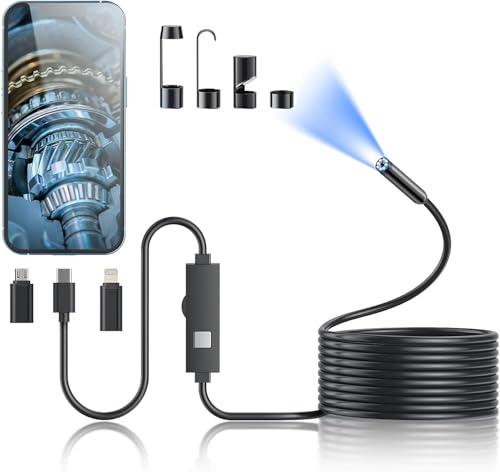
- 1920P imaging with adjustable LED lighting
- 16.4ft semi-rigid, IP67 waterproof probe
- Works with iOS and Android devices
Best For: Smartphone-based automotive, plumbing, and home inspections
Best Articulating Design
Acoath Dual-Lens 1080P Borescope

- 210° two-way articulation for angled access
- Dual front and side cameras
- 4.3-inch screen with 32GB card included
Best For: Complex automotive, HVAC, plumbing, and repair inspections
Best Long-Reach Standalone Option
TGJOR 16.4ft Dual-Lens Borescope

- 5-inch 1080P screen with 170° viewing angle
- 16.4ft waterproof semi-rigid probe
- Dual lenses and eight adjustable LEDs
Best For: Live plumbing, automotive, and HVAC inspections without recording
Best All-Around Wireless Inspection Camera – Ferret Plus
The Ferret Plus is a versatile choice among wireless inspection cameras for viewing enclosed spaces in electrical, HVAC, chimney, dryer-vent, pest-control, and home-inspection work. It streams at 720p, saves 1080p footage onboard, and sends photos and videos to a smart device over Wi-Fi.
Best For: Professionals who need a lightweight, rechargeable camera for documenting hard-to-reach inspections.
Pros:
- Streams 720p video and saves 1080p footage onboard.
- Wi-Fi connectivity allows photos and videos to be saved to a smart device.
- Waterproof design, manual focus, and a 6–15 cm macro focus range.
- Useful across electrical, HVAC, chimney, pest, and home-inspection tasks.
Cons:
- Rated battery life is about 1.5 hours.
- Requires a compatible smart device for viewing streamed footage.
Choose the Ferret Plus when flexible professional use and higher-resolution saved footage matter more than extended battery life. Its broad application range and reporting-friendly wireless workflow make it a practical inspection tool.
Best High-Resolution Wireless Inspection Camera – DEPSTECH 2K Dual Lens
The DEPSTECH 2K Endoscope is a strong option for shoppers prioritizing image detail in wireless inspection cameras. Its 2560×1440 resolution, dual front-and-side lenses, adjustable LEDs, and 16.5-foot semi-rigid cable support detailed inspections through narrow, curved spaces.
Best For: Phone users who want high-resolution viewing and dual-angle coverage for automotive, HVAC, plumbing, and mechanical inspections.
Pros:
- 2K resolution provides 3.69 million pixels for detailed phone viewing.
- Dual lenses offer front and side perspectives to reduce blind spots.
- IP67 waterproofing, 8+1 adjustable LEDs, and a 16.5-foot cable.
- Includes hook, magnet, and protective cap accessories.
Cons:
- Requires the DEPSTECHCAM app and a compatible phone or tablet.
- Android devices need OTG support with OTG enabled.
- Uses a phone connection rather than a built-in display.
This model stands out when clarity and viewing flexibility are key. Confirm your phone’s connector, operating system, and OTG compatibility before buying, then use the dual-lens design for broader inspection coverage.
Best Focus Control Wireless Inspection Camera – Ferret Pro
The Ferret Pro is designed for users who need wireless inspection cameras with app-controlled variable focus. It provides 720p streaming, Wi-Fi connectivity, smooth zoom, and a rechargeable waterproof design for electrical, HVAC, chimney, pest, and home-inspection applications.
Best For: Inspectors and tradespeople who want to adjust focus from the app while recording evidence on a smartphone, tablet, or laptop.
Pros:
- App-controlled variable focus supports close-up inspection work.
- Wi-Fi streaming works with smartphones, tablets, and laptops.
- Waterproof, lightweight, rechargeable design with smooth zoom.
- Backed by a two-year manufacturer’s replacement warranty.
Cons:
- Video capture is limited to 720p.
- Battery life is listed at about 1.5 hours.
- Requires a compatible device for viewing the wireless feed.
The Ferret Pro is a sensible pick when adjustable focus is more useful than maximum video resolution. It combines a compact design with wireless viewing and controls suited to field inspection work.
Best Screen-Based Inspection Camera – Daxiongmao 1080P Borescope
The Daxiongmao 1080P Borescope is a practical alternative to wireless inspection cameras when you prefer a dedicated screen and simple operation. Its 4.3-inch LCD provides real-time viewing without phone Wi-Fi or app setup, while the 16.5-foot semi-rigid cable and IP67 probe suit automotive, plumbing, HVAC, and DIY inspections.
Best For: Users who want an immediately usable inspection camera with a built-in display and no smartphone connection.
Pros:
- 4.3-inch LCD screen works without a smartphone or driver software.
- 1080p camera, eight adjustable LEDs, and a 16.5-foot semi-rigid cable.
- IP67 waterproof probe is suitable for wet environments, pools, plumbing, and rain.
- Includes hook, magnet, side mirror, and charging cable.
Cons:
- It cannot take pictures or record videos, according to the supplied notes.
- Charging requires a suitable 5V/1A household charger; fast charging is not supported.
- Includes a 180-day warranty, shorter than some alternatives listed here.
Choose this borescope for straightforward, screen-based inspections where recording is not required. Its dedicated display avoids app compatibility issues and keeps the camera ready for quick repair and maintenance checks.
Best Articulating Pick – Teslong Articulating Borescope
For wireless inspection cameras shoppers who want hands-on control without relying on an app, the Teslong articulating borescope combines a two-way articulating probe with a built-in 4.5-inch IPS display. Its semi-rigid cable and adjustable LEDs make it practical for automotive, HVAC, wall, and household inspections.
Best For: Mechanics and DIY users inspecting tight, complex spaces where precise probe positioning matters.
Pros:
- Two-way 210-degree articulation helps maneuver around obstacles.
- 4.5-inch IPS screen provides real-time viewing without an app.
- Five-foot semi-rigid cable, adjustable LED lighting, and IP67 waterproofing support varied inspection environments.
- Includes 32GB MicroSD storage and offers up to five hours of battery life.
Cons:
- Its five-foot cable is shorter than the reach offered by some competing inspection cameras.
- Still-photo resolution is listed at 2MP.
The articulating control and dedicated screen make this a strong choice when navigating is more important than smartphone connectivity. It is especially useful for detailed, close-range inspections that require one-handed operation.
Best Long-Reach Pick – DEPSTECH Triple-Lens Endoscope
Among wireless inspection cameras, the DEPSTECH DS620 stands out for long-distance and multi-angle work. Its triple-lens design lets you switch views with a button, while the 16.5-foot semi-rigid cable, 5-inch IPS screen, and waterproof probe support plumbing, automotive, HVAC, and machinery inspections.
Best For: Users who need extended reach and multiple viewing angles for pipes, drains, walls, or equipment.
Pros:
- Triple-lens system provides front and alternate-angle views without repeatedly repositioning the cable.
- 16.5-foot semi-rigid cable reaches deep or distant inspection areas.
- 5-inch IPS display delivers real-time viewing, while 10 adjustable LEDs help illuminate dark spaces.
- IP67 waterproof probe and included magnet and hook add versatility.
Cons:
- MicroSD card is required for saving photos and videos but is not included.
- Continuous operating time is listed at two to three hours.
This is a practical choice when reach and viewing flexibility are priorities. The large display and triple-camera arrangement can reduce the need to withdraw and reposition the probe during troubleshooting.
Best Smartphone Connectivity – Klein Tools ET21 WiFi Borescope
The Klein Tools ET21 is a compact option for wireless inspection cameras, sending live video and images to an iOS or Android smartphone over Wi-Fi. Its 5.5mm camera, five-foot waterproof snake, and adjustable LEDs are suited to confined spaces where a phone-based workflow is convenient.
Best For: Tradespeople and homeowners who want to view, save, and share inspection footage on a smartphone.
Pros:
- Wi-Fi transmits video and images to a smartphone from up to 30 feet.
- Compatible iOS and Android app supports viewing, saving, and sharing footage.
- Small 5.5mm camera reaches narrow spaces.
- Five-foot flexible IP67-rated waterproof snake and adjustable LEDs support dark or damp inspections.
Cons:
- Listed video resolution is 480p, lower than the 1080p resolution of the other models here.
- Requires the Klein Tools app and a compatible smartphone for its wireless viewing workflow.
The ET21 is best when smartphone access and easy sharing matter more than maximum image resolution or cable length. Its narrow camera and durable waterproof snake make it a focused tool for confined inspections.
Best Smartphone-Compatible Pick – Kinpthy 1920P 16.4ft Endoscope
For shoppers seeking wireless inspection cameras that work with a smartphone, the Kinpthy combines 1920P imaging, a long semi-rigid probe, and broad device compatibility. Its 7.9mm waterproof camera and adjustable LEDs are suited to close-range checks in dark, narrow spaces.
Best For: Smartphone-based automotive, plumbing, home, and wiring inspections.
Pros:
- 1920P photo and video resolution for detailed close-range viewing.
- 16.4ft semi-rigid cable offers useful reach while holding its shape.
- Includes Android, Lightning, and USB-C connectors plus hook, magnet, and mirror attachments.
- IP67 waterproof probe and adjustable lighting support inspections in wet or dark areas.
Cons:
- Requires a compatible smartphone or tablet and the SUP-ANESOK app.
- Fixed-focus design and 7.9mm probe may be less suitable for larger viewing areas.
The Kinpthy is a practical choice when you want high-resolution inspection images without carrying a dedicated display. Its long cable and included accessories add versatility, while phone dependence may be a drawback for users who prefer a standalone unit.
Best Articulating Design – Acoath Dual-Lens 1080P Borescope
Among wireless inspection cameras, the Acoath stands out for its built-in screen, dual-lens viewing, and two-way articulation. It is designed for navigating complex inspection paths without relying on an app, internet connection, or personal phone.
Best For: Mechanics, HVAC users, plumbers, and DIYers inspecting tight or angled spaces.
Pros:
- 210° articulation provides controlled positioning through difficult angles.
- Front and side cameras switch quickly for broader inspection coverage.
- 4.3-inch IPS screen and 1080P capture provide immediate on-device viewing.
- Includes a 32GB TF card, protective case, and useful inspection accessories.
Cons:
- The 5ft probe is considerably shorter than some long-reach inspection cameras.
- At 570g, it may feel heavier during extended handheld inspections.
The Acoath is a strong fit for users who value control and convenience over maximum cable length. Its articulating probe and dual-camera setup can simplify difficult inspections, while the standalone screen keeps personal devices out of the workflow.
Best Long-Reach Standalone Option – TGJOR 16.4ft Dual-Lens Borescope
This TGJOR model is one of the more straightforward wireless inspection cameras for users who want a standalone viewing system. It combines a 5-inch screen, dual-lens coverage, a 16.4ft semi-rigid probe, and IP67 waterproofing for plumbing, automotive, and HVAC work.
Best For: Long-reach visual inspections where recording is not required.
Pros:
- Large 5-inch screen with a 170° viewing angle for comfortable monitoring.
- Dual-lens design allows switching between front and side views.
- 16.4ft semi-rigid probe and eight adjustable LEDs support deep, dark spaces.
- Plug-and-play operation requires no app or Wi-Fi, with 3–4 hours of battery runtime.
Cons:
- It cannot take pictures or record videos.
- Its fixed-focus range is limited to approximately 1.2–4 inches.
The TGJOR is best viewed as a live-inspection tool rather than a documentation camera. Its long, waterproof probe and large display are useful for diagnosing drains, ducts, and engines, but the lack of photo and video capture limits its usefulness for sharing findings or keeping records.
How We Picked These Wireless Inspection Cameras
We focused on practical capabilities that affect real inspection work rather than headline resolution alone. The selected models represent several useful formats, including phone-connected cameras, dedicated-screen borescopes, dual- and triple-lens designs, articulating probes, and longer waterproof cables.
Our comparison criteria include image clarity, lighting control, probe diameter, cable length, flexibility, articulation, water resistance, display convenience, recording options, and suitability for automotive, HVAC, electrical, plumbing, home inspection, and general maintenance tasks. A higher-resolution camera can help reveal detail, but probe access and reliable positioning often matter just as much.
Quick Comparison
| Type | Best For | Main Advantage | Potential Limitation |
|---|---|---|---|
| Phone-connected wireless camera | General home and maintenance work | Uses a familiar phone display and app | Depends on phone compatibility and battery |
| Dedicated-screen borescope | Frequent or professional inspections | Ready-to-use display and controls | Usually bulkier than phone-based models |
| Dual- or triple-lens camera | Viewing forward and sideways | Reduces repositioning in confined spaces | More features can increase cost and complexity |
| Articulating borescope | Automotive, HVAC, and industrial work | Improves directional control at the tip | Requires practice and careful cable handling |
| Long waterproof probe | Drains, pipes, and deep cavities | Greater reach for difficult access points | Excess cable can be harder to manage |
Key Buying Factors for Wireless Inspection Cameras
Camera and Lighting Quality
Look for adjustable LEDs and a camera resolution suited to the task. Brightness control is important because reflective metal, dark cavities, and wet surfaces can all reduce visibility. Dual-lens systems are useful when you need both a forward view and a side view without repeatedly rotating the probe.
Probe Diameter, Length, and Flexibility
A narrow probe fits through smaller openings, while a longer cable reaches deeper spaces. Semi-rigid cables can hold a basic shape, making them easier to guide through insulation or engine compartments. For precise directional work, an articulating tip may be more useful than extra cable length.
Display and Wireless Connectivity
Phone-based Wireless Inspection Cameras are convenient and often easy to share or store. Dedicated IPS screens are preferable when you want a self-contained tool, need a larger live view, or work where using a phone is inconvenient. Check app support, operating-system compatibility, wireless range, and recording controls before buying.
Durability and Water Resistance
For plumbing, drains, and outdoor work, verify the probe’s stated water-resistance rating rather than assuming the entire device is waterproof. A protected cable, secure connectors, and a handle that can tolerate regular handling are also important for frequent use.
Who Should Buy Which Wireless Inspection Cameras?
Choose a phone-connected model if you want a compact tool for occasional home repairs, appliance checks, wall cavities, or dryer vents. It is typically the most convenient option for users who already carry a compatible smartphone.
A dedicated-screen model is a better fit for technicians, inspectors, and maintenance teams that use a borescope regularly or prefer not to rely on an app. Select a dual- or triple-lens design when viewing angle is a priority, especially in machinery, ducts, and enclosed compartments.
For automotive and HVAC work, an articulating probe can justify its higher cost by making it easier to steer around bends and inspect specific components. For drains, sewer lines, and deep openings, prioritize cable length, waterproofing, lighting, and stable image transmission over portability. Before ordering, confirm the probe diameter, included accessories, charging method, storage capacity, and compatibility with your intended inspection environment.