Wireless video receivers with SDI make it easier to move camera feeds to monitors, switchers, recorders, and streaming systems without running long cables across a set. The right model can simplify production while preserving the resolution, latency, and connection options your workflow requires.
We’ve selected 10 systems spanning professional 4K transmission, compact HDMI/SDI kits, app-assisted monitoring, and budget-friendly wireless links. Use the guide below to compare range, supported formats, latency, connectivity, and practical fit before you buy.
Best 10 Wireless Video Receivers with Sdi Picks for 2026
Best Multi-Receiver System

- HDMI and SDI input/output connectivity
- Up to 4K30 HDMI reception
- One transmitter can feed up to four receivers
Best For: Film crews and live-streaming teams needing shared monitoring
Best Complete Kit
JM400PRO Wireless SDI/HDMI Kit
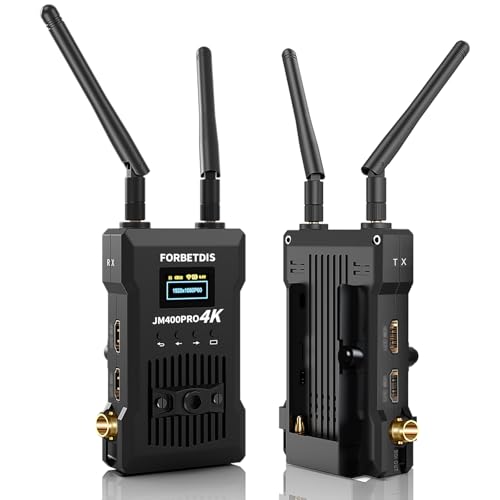
- Includes transmitter and receiver
- 4K30 transmission with about 0.06-second latency
- USB-C, DC, and L-series battery power options
Best For: Field production and events needing a flexible two-piece system
Best Long-Range 4K60 Option

- HDMI transmission up to 4K60
- Tri-band 2.4/5/6GHz wireless operation
- Supports up to four wireless monitoring destinations
Best For: Professional productions needing high-resolution, long-range monitoring
Best for Simple Setup
BovBox 4K Wireless SDI/HDMI System

- Plug-and-play HDMI and SDI operation
- 4K30 HDMI and 1080p60 SDI support
- Multiple power methods and 3.5mm audio output
Best For: Presentations, live streaming, and portable camera monitoring
Best 4K SDI-Ready Pick

- 3G-SDI supports 1080p; HDMI supports 4K30
- Up to 1312ft range with low latency
- Monitors up to five destinations
Best For: Professional teams combining SDI 1080p and HDMI 4K workflows
Best HDMI Alternative
Hollyland Pyro H Wireless HDMI System

- 4K30 wireless HDMI transmission
- 1300ft range and 60ms latency
- UVC output for computer streaming
Best For: HDMI workflows needing multi-user monitoring and live streaming
Best 1080p Streaming Option

- 1080p60 transmission below 0.06s latency
- Up to 1200ft range with dual-band wireless
- UVC output for streaming without a capture device
Best For: HDMI-based 1080p monitoring and computer live streaming
Top Pick for Multi-Receiver Monitoring

- HDMI and SDI support with 4K30 video
- Up to four receivers per transmitter
- 1,300-foot range and 50ms latency
Best For: Multi-camera productions, live events, and shared monitoring
Best for Intercom and Streaming

- 4K30 transmission with SDI and HDMI I/O
- Built-in intercom for crew communication
- UVC streaming without a capture card
Best For: Small crews combining monitoring, communication, and streaming
Best Compact 4K SDI Option

- 4K30 HDMI with professional SDI frame rates
- 450-foot rated range and 66ms latency
- LCD controls and flexible power options
Best For: Small crews and moderate-distance SDI monitoring
Best Multi-Receiver System – Hollyland Pyro S RX
For teams comparing wireless video receivers with SDI, the Hollyland Pyro S RX stands out as a receiver-only option with HDMI and SDI connectivity, 4K30 HDMI support, and up to four-receiver monitoring from one transmitter. Its auto dual-band hopping is designed to help maintain a stable connection during demanding shoots.
Best For: Film crews, live-streaming teams, and productions that need multi-user monitoring.
Pros:
- Supports HDMI and SDI input/output connections.
- Receives video at up to 4K30 via HDMI and supports multiple SDI frame rates.
- Supports up to four receivers from one transmitter.
- Includes app monitoring tools such as waveform, vectorscope, zebra, and false color.
Cons:
- This listing is for the receiver only.
- 4K30 support is specified through HDMI; SDI formats have separate frame-rate limitations.
- At 2.2 pounds, it may be less convenient for lightweight rigs.
The Pyro S RX is a strong fit when collaborative monitoring and flexible HDMI/SDI integration matter more than a minimal receiver footprint. Its UVC and RTMP capabilities also make it useful for streaming-oriented workflows.
Best Complete Kit – JM400PRO Wireless SDI/HDMI Kit
The JM400PRO is a two-piece transmitter-and-receiver kit for shoppers seeking wireless video receivers with SDI in a ready-to-use package. It supports 4K30 transmission, HDMI and SDI connections, app monitoring on up to four phones or tablets, and a claimed open-air range of up to 985 feet.
Best For: Videographers, event crews, and presenters who want flexible mounting and monitoring options.
Pros:
- Complete two-piece transmitter and receiver system.
- Supports up to 4K30 video with approximately 0.06-second latency.
- Offers HDMI and SDI connectivity, including receiver SDI output.
- Accepts USB-C, DC 9–16V, or L-series battery power.
Cons:
- Batteries are not included.
- The stated 985-foot range is an open-distance figure and can decrease with additional receivers.
- No warranty is listed in the supplied details.
With multiple power options and app monitoring for up to four mobile devices, the JM400PRO is versatile for field work. It is especially practical when a full transmitter/receiver pair is preferred over buying a receiver separately.
Best Long-Range 4K60 Option – Accsoon CineView Master 4K
The Accsoon CineView Master 4K targets professional workflows that need wireless video receivers with SDI, high-resolution HDMI transmission, and extended range. It supports HDMI video up to 4K60, 1080p through 3G-SDI/HDMI, tri-band wireless operation, and monitoring through receivers or compatible mobile devices.
Best For: Larger film sets, sports production, live events, and teams requiring long-range monitoring.
Pros:
- Supports HDMI formats up to 4K60.
- Provides 1080p monitoring through 3G-SDI and HDMI.
- Uses 2.4GHz, 5GHz, and 6GHz tri-band transmission.
- Can send video to up to four receivers or supported mobile devices.
Cons:
- The claimed 8,202-foot range applies to an unobstructed, interference-free environment.
- 4K60 latency is specified at under 35ms, while 1080p60 is under 25ms.
- Mobile monitoring depends on compatible devices and the Accsoon SEE app.
The CineView Master 4K is the most production-focused option here for crews prioritizing 4K60, long-range transmission, and advanced monitoring tools. Its broader feature set may be more than needed for simple point-to-point setups.
Best for Simple Setup – BovBox 4K Wireless SDI/HDMI System
The BovBox system is a straightforward choice among wireless video receivers with SDI, combining plug-and-play operation with HDMI and SDI input/output. It supports 4K30 over HDMI, up to 1080p60 through 3G-SDI, a claimed 1,000-foot line-of-sight range, and up to four receivers per transmitter.
Best For: Live streaming, presentations, camera monitoring, and users who want multiple power choices.
Pros:
- Plug-and-play setup with HDMI and SDI interfaces.
- Supports 4K30 HDMI and 1080p60 3G-SDI video.
- Allows one transmitter to connect with up to four receivers.
- Supports DC adapters, USB-C, power banks, and NP-F batteries.
Cons:
- Power banks and NP-F batteries are not included.
- The claimed 1,000-foot range can be reduced by walls, metal, glass, and other interference.
- Its stated latency is approximately 0.1 second, higher than some competing options.
The BovBox is appealing for practical installations and mobile production because it combines common video connections with flexible power and a carrying case. Consider it when ease of use and audio output are more important than the lowest possible latency.
Best 4K SDI-Ready Pick – Accsoon CineView SE 4K
For buyers comparing wireless video receivers with SDI, the Accsoon CineView SE 4K stands out as a complete transmitter-and-receiver system with 3G-SDI support for 1080p workflows and HDMI support for up to 4K30. Its long range, low latency, multi-device monitoring, and camera-control features make it suited to professional productions.
Best For: Filmmakers and production teams needing 4K HDMI transmission plus 1080p SDI connectivity and multi-person monitoring.
Pros:
- Supports 4K input/output through HDMI and 1080p through 3G SDI/HDMI.
- Offers up to 1312 feet of range and latency as low as 50ms at 1080p.
- Can connect to up to five monitoring destinations, including compatible mobile devices.
- Supports camera-control functions with select Sony and Canon cameras.
Cons:
- SDI operation is limited to 1080p, while 4K uses HDMI.
- USB-C video output is intended for mobile monitoring, not UVC computer capture.
- Some cables and compatible monitoring devices are sold separately.
The CineView SE 4K is the strongest fit here when SDI compatibility is important but your setup also needs 4K HDMI, extended range, and professional camera control. Verify camera and receiver compatibility before purchase.
Best HDMI Alternative – Hollyland Pyro H Wireless HDMI System
Although the Hollyland Pyro H is not an SDI receiver, it is a useful comparison for shoppers considering wireless video receivers with SDI alongside HDMI-focused systems. It transmits up to 4K30 over dual-band wireless, includes HDMI loop-out, and adds UVC support for direct computer streaming.
Best For: HDMI-based film crews, live-streamers, and teams that need multi-receiver monitoring without SDI inputs.
Pros:
- Supports up to 3840×2160 at 24/25/30fps through HDMI.
- Provides up to 1300 feet of range and 60ms latency.
- Can transmit to up to four receivers and supports Hollyview app monitoring.
- Includes UVC support for plug-and-play computer live streaming.
Cons:
- Connectivity is HDMI-only, with no SDI input or output listed.
- 4K transmission is limited to 30fps.
- Performance depends on wireless conditions despite smart channel scanning.
The Pyro H is a practical choice if your cameras and monitors are HDMI-based and direct streaming matters more than SDI compatibility. For an SDI-centered production, choose a system with native SDI connections instead.
Best 1080p Streaming Option – Accsoon CineView HE
The Accsoon CineView HE is another HDMI-focused option to consider when comparing wireless video receivers with SDI. It is designed for 1080p60 transmission, using dual-band wireless connectivity, a long operating range, and receiver-side UVC output for streaming to platforms such as OBS and YouTube.
Best For: HDMI camera users who prioritize reliable 1080p monitoring, long battery life, and straightforward computer streaming.
Pros:
- Supports 1080p60 transmission with latency below 0.06 seconds.
- Offers up to 1200 feet of transmission range in suitable conditions.
- Can send video to up to four receivers or mobile devices using a mix-and-match setup.
- Receiver UVC output can connect to a computer without an additional capture device.
Cons:
- Uses HDMI input and loop-out rather than SDI connections.
- Does not provide 4K transmission.
- Battery and charging cables are not included.
The CineView HE makes sense for 1080p productions, event coverage, and live streaming where HDMI compatibility and efficient power options are more important than 4K or SDI support. Its UVC feature is especially useful for computer-based streaming.
Top Pick for Multi-Receiver Monitoring – Hollyland Pyro S
For productions that need wireless video receivers with SDI plus flexible monitoring, the Hollyland Pyro S combines HDMI and SDI connectivity with 4K30 video, a rated 1,300-foot line-of-sight range, and 50ms latency. Its dual-band hopping and support for up to four receivers make it particularly adaptable for live events and multi-user shoots.
Best For: Film crews, live-streaming setups, and productions needing several monitoring stations.
Pros:
- Supports HDMI and SDI input/output, with HDMI video up to 4K30.
- Connects one transmitter to as many as four receivers.
- Offers 1,300-foot rated range, 50ms latency, and automatic 2.4GHz/5GHz hopping.
- Includes app monitoring tools plus UVC and RTMP streaming features.
Cons:
- The listed long-range performance is a line-of-sight rating.
- Advanced monitoring and streaming features may add setup complexity.
The Pyro S is the most expansive option here for teams that need SDI compatibility and multiple viewers. Its combination of range, low latency, and production-oriented tools makes it a strong choice when a basic point-to-point link is not enough.
Best for Intercom and Streaming – FEELWORLD WTRS
The FEELWORLD WTRS is a practical choice among wireless video receivers with SDI when a crew also needs HDMI flexibility, built-in communication, and computer streaming. It supports 4K30 transmission, provides SDI and HDMI outputs on the receiver, and is rated for more than 1,000 feet with 80ms latency.
Best For: Small production teams that need wireless monitoring, intercom, and UVC streaming in one system.
Pros:
- Receiver includes both SDI and HDMI outputs, while the transmitter has SDI input plus HDMI input/output.
- Built-in intercom supports direct crew communication without a separate system.
- UVC output enables computer streaming without a capture card or driver.
- Supports up to four receivers and includes smart channel scanning.
Cons:
- The rated transmission range is based on line-of-sight conditions.
- Some Android app features, including recording and waveform tools, are still in development.
- Its 80ms latency is higher than the Pyro S listed above.
WTRS stands out for workflow convenience rather than the lowest stated latency. The integrated intercom, UVC output, and flexible SDI/HDMI routing make it appealing for crews that want fewer separate accessories during shoots or streams.
Best Compact 4K SDI Option – Hollyland Mars 4K
The Hollyland Mars 4K is a straightforward wireless video system for buyers who want SDI and HDMI connectivity with 4K30 support. It delivers a rated 450-foot line-of-sight range and 66ms latency, while its LCD screen, joystick controls, and multiple power options help simplify on-set operation.
Best For: Camera operators and small crews using professional SDI equipment within moderate distances.
Pros:
- Supports 4K video through HDMI and professional 23.98/29.97/59.94 FPS SDI output.
- Provides HDMI and SDI input/output options for monitors, cameras, and switchers.
- Offers app monitoring for iOS and Android devices, with support for additional displays.
- Includes an LCD, joystick menu control, and 6–16V DC, NP-F, and USB-C power options.
Cons:
- Its 450-foot rated range is shorter than the other listed systems.
- QC/PD charging and 5V/2A charging are not supported.
- The stated 66ms latency is higher than the Pyro S rating.
The Mars 4K fits setups that value familiar SDI frame-rate support and hands-on controls over maximum range. It is a sensible choice for moderate-distance camera-to-monitor links, especially when flexible battery and DC powering matter.
How We Picked the Best Wireless Video Receivers with Sdi
We focused on systems that include SDI input, output, or both, while also supporting common HDMI production workflows. Our selections reflect the specifications that matter most in real use: resolution and frame-rate support, wireless range, latency, frequency-band flexibility, receiver capacity, power options, and compatibility with monitors, cameras, switchers, and mobile devices.
We also considered whether each system is best suited to professional cinema, live events, studio monitoring, education, or occasional content creation. Advertised range can vary significantly with walls, interference, antenna placement, and regional wireless restrictions, so treat it as a best-case figure rather than a guaranteed working distance.
Quick Comparison
| Priority | Look For | Best Fit |
|---|---|---|
| 4K production | 4K30 or 4K60 support, SDI, dependable format handling | Cinema, commercial, and studio crews |
| Long-distance monitoring | High advertised range, strong antennas, dual- or tri-band operation | Large sets and event venues |
| Low delay | Latency around 25–50ms | Focus pulling, live monitoring, and switching |
| Streaming | UVC output or app support | Creators, presenters, and mobile production teams |
| Simple deployment | Plug-and-play pairing and HDMI/SDI flexibility | Small crews and temporary installations |
Key Buying Factors for Wireless Video Receivers with Sdi
SDI and HDMI Compatibility
Check whether SDI is available on the transmitter, receiver, or both. SDI is valuable for longer cable runs and professional switchers, while HDMI remains common on cameras, displays, and consumer gear. Confirm connector type, signal direction, and whether conversion is required.
Resolution, Frame Rates, and Latency
4K30 is sufficient for many cinema and monitoring setups, while 4K60 is preferable when smooth high-resolution footage is essential. For interactive production, lower latency matters more than headline resolution. Also verify support for the exact frame rates your camera produces, including fractional rates such as 23.98, 29.97, and 59.94.
Range, Interference, and Receiver Count
Dual-band or tri-band systems can provide more flexibility in crowded wireless environments. A model that supports multiple receivers may be useful for sending one camera feed to a director’s monitor, client display, and focus station, but performance depends on the local spectrum and line of sight.
Power and Monitoring Workflow
Battery compatibility, USB-C power, mounting options, and app or UVC support can determine how convenient a system is on location. Make sure the receiver works with your existing batteries, displays, capture devices, and production accessories.
Who Should Buy Which Wireless Video Receivers with Sdi?
Choose a professional 4K SDI-capable system if you work on narrative, commercial, or multicamera productions and need reliable monitoring with flexible outputs. Choose a compact HDMI/SDI kit for occasional shoots, classrooms, presentations, or small live events. If mobile streaming is central to your workflow, prioritize UVC output and app support. For large venues or crews monitoring one source in several locations, prioritize long range, interference management, and multi-receiver support over maximum resolution alone.