The right capture card can make streaming console gameplay, camera video, and high-refresh PC content much simpler. The best choice depends on your resolution, frame-rate, connectivity, and passthrough needs.
We compare 10 capture cards for streaming across budget-friendly USB 3.0 models, camera-focused devices, and advanced HDMI 2.1 options for 4K gaming.
Best 10 Capture Card for Streaming Picks for 2026
Best Value HDMI Capture
1080p 60FPS Streaming Capture Card

- 1080p capture with 4K input support
- HDMI loop-out for low-delay play
- Plug-and-play with microphone input
Best For: Budget streaming and console capture
Best for Camera Streaming

- Captures up to 4K60 from compatible cameras
- Ultra-low latency for synced audio and video
- Works with PCs, Macs, iPads, and streaming apps
Best For: Camera-based streaming and video calls
Best High-Refresh Capture

- 4K60 capture with high-refresh passthrough
- Supports HDR and VRR
- Works with Windows, macOS, and Linux
Best For: High-refresh competitive gaming streams
Best Audio-Friendly Budget Pick

- 1080p60 capture with 4K30 input
- Dedicated microphone and headphone ports
- Plug-and-play support for major operating systems
Best For: Commentary-focused budget streaming
Premium 4K Choice

- 4K144 capture and passthrough
- HDMI 2.1 with VRR support
- Ultra-low-latency USB 3.2 Gen 2
Best For: High-refresh PS5, Xbox Series X, and PC streaming
Easy-Setup Value

- 4K input with 1080p60 output
- Built-in mic input for commentary
- Plug-and-play with USB-A and USB-C
Best For: Beginners and versatile console or camera streaming
Creator-Friendly Pick

- 1080p60 capture over USB 3.0
- 4K30 HDMI loop-out
- Headset, line-in, and RGB lighting
Best For: Console and PC creators wanting flexible audio and monitoring
Flexible 4K Passthrough

- 4K60 HDMI input and loop-out
- Captures 1080p60 or 1440p30
- USB-A/USB-C and mic-in support
Best For: Console streaming with smooth capture and passthrough
Portable Plug-and-Play Pick
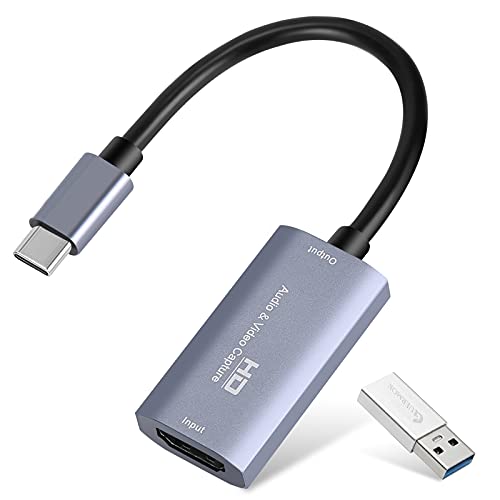
- 1080p60 or 2K30 output
- No drivers or external power needed
- Compact design with USB-C support
Best For: Simple, portable streaming and recording setups
High-Frame-Rate Choice

- Captures and passes through 4K60
- Supports 1080p120 recording
- Includes 3.5mm audio input and mic output
Best For: High-refresh gaming and demanding streaming workflows
Best Value HDMI Capture – 1080p 60FPS Streaming Capture Card
This affordable capture card for streaming is a practical choice for recording HDMI video at up to 1080p. It supports 4K input, HDMI loop-out, USB 3.0 connectivity, and microphone commentary, making it suitable for consoles, cameras, and common streaming software.
Best For: Budget-conscious gamers and creators who need plug-and-play 1080p streaming with HDMI pass-through.
Pros:
- Captures video at up to 1080p and accepts 4K30/60Hz input.
- HDMI loop-out is designed for low-delay gameplay.
- Plug-and-play operation works with Windows and Mac OS without external power.
- Includes a 3.5mm microphone input for game commentary.
Cons:
- Output is limited to up to 2K30Hz.
- Microphone input accepts only a 3.5mm TRS standard microphone headset.
- Does not support 4K120Hz or 4K144Hz input.
Its combination of simple setup, pass-through, and audio support makes it a well-rounded entry-level option. Just confirm that its resolution limits match your console and monitor setup.
Best for Camera Streaming – Elgato Cam Link 4K
The Elgato Cam Link 4K is a camera-focused capture card for streaming that turns a compatible DSLR, mirrorless camera, camcorder, action camera, or iPhone into a computer video source. It supports 1080p60 and up to 4K60 capture with ultra-low latency.
Best For: Creators who want to use a compatible camera for high-quality live streams, calls, or recordings.
Pros:
- Supports 1080p60 and up to 4K60 capture with compatible equipment.
- Works with DSLR, mirrorless, camcorder, action cam, and iPhone sources.
- Ultra-low latency helps keep video and audio in sync.
- Compatible with PC, Mac, iPad, OBS, Zoom, and Discord.
Cons:
- Requires a compatible camera and appropriate HDMI setup.
- Its feature set is focused on camera input rather than console pass-through.
- Specifications list operating-system compatibility inconsistently, so verify compatibility before purchase.
For camera-based production, this is the most purpose-built option in the group. Its compact design and broad device support make it especially useful for upgrading webcam quality.
Best High-Refresh Capture – PORTTA DX20R 4K60
The PORTTA DX20R is a performance-oriented capture card for streaming, supporting 4K60 capture plus high-refresh passthrough modes such as 1080p at 240Hz and 2K at 120Hz. VRR, HDR, and optional control software give it more flexibility than basic capture devices.
Best For: Competitive gamers and advanced streamers using high-refresh monitors, HDR, or VRR-enabled systems.
Pros:
- Captures 4K at 60Hz and supports 2K144Hz and 1080p240Hz modes.
- Supports VRR and HDR for smoother, more vivid gameplay.
- Works with Windows, macOS, and Linux without required driver installation.
- CapHub software enables audio mixing, firmware updates, and EDID/VRR management.
Cons:
- Advanced settings may be more than casual streamers need.
- Utility software must be downloaded separately for enhanced controls.
- Its feature set is best matched with compatible high-refresh hardware.
This is the strongest choice for demanding gaming setups where passthrough refresh rate matters as much as capture quality. It costs complexity in exchange for more control over modern display features.
Best Audio-Friendly Budget Pick – 1080p 60FPS Capture Card
This compact capture card for streaming combines 1080p60 capture with 4K30 input support, HDMI loop-out, and dedicated 3.5mm microphone and headphone connections. It is designed for plug-and-play use with consoles, cameras, computers, and popular streaming software.
Best For: Streamers who want straightforward 1080p capture with convenient microphone and headphone connections.
Pros:
- Captures Full HD video at 1080p60 and accepts up to 4K30 input.
- Provides 1080p60 HDMI loop-out with low-latency technology.
- Includes separate 3.5mm microphone input and headphone output.
- Supports Windows, Linux, and macOS without drivers or external power.
Cons:
- Maximum output is 1080p60.
- Requires a direct USB 3.0 connection; hubs and extension cables are not recommended.
- The supplied notes do not specify a brand name.
Its audio ports make it a convenient choice for commentary-heavy streams, while the 1080p60 limit keeps expectations clear. It is a sensible basic setup for console broadcasting and recording.
Premium 4K Choice – Elgato 4K X
If you want a capture card for streaming that can keep up with high-refresh gaming, the Elgato 4K X combines HDMI 2.1 connectivity, 4K144 capture and passthrough, and ultra-low-latency USB 3.2 Gen 2 performance. It works with popular apps including OBS, Streamlabs, Twitch Studio, Zoom, and Teams.
Best For: Gamers and creators using PS5, Xbox Series X, PC, or Mac who want high-resolution, high-frame-rate capture and VRR passthrough.
Pros:
- Captures up to 4K at 144 frames per second.
- HDMI 2.1 supports high frame rates up to 1080p at 240fps.
- VRR passthrough helps reduce screen tearing during gameplay.
- Compatible with Windows, macOS, iPadOS, and major streaming platforms.
Cons:
- Its advanced features require compatible HDMI 2.1 equipment and a USB 3.2 Gen 2 port.
- USB 3.2 Gen 1 works with reduced capture resolution.
The Elgato 4K X is the strongest fit for demanding gaming setups where refresh rate, HDR10, VRR, and minimal latency matter. It is more than most basic streamers need, but its specifications leave room for high-end console and PC upgrades.
Easy-Setup Value – Acer USB 3.0 Capture Card
For shoppers seeking a practical capture card for streaming, this Acer model offers 4K input, 1080p at 60Hz output, plug-and-play setup, and both USB Type-A and Type-C connectivity. Its built-in mic input also makes voice commentary convenient for gaming, classes, calls, and recordings.
Best For: Beginners, mobile creators, and streamers who need a compact card for consoles, cameras, PCs, or video calls.
Pros:
- Accepts 4K input and provides 1080p at 60Hz output.
- Includes a 3.5mm mic input for direct commentary.
- Plug-and-play design requires no extra drivers or external power.
- Supports Windows, Linux, macOS, Android, OBS, XSplit, VLC, and common consoles.
Cons:
- Capture resolution is limited to 1080p or 720p rather than 4K capture.
- USB 3.0 is required for USB 3.0 operation.
This Acer capture card emphasizes convenience and broad compatibility rather than advanced high-refresh features. Its mic input and compact plug-and-play design make it a flexible choice for straightforward streaming, teaching, conferencing, and recording.
Creator-Friendly Pick – Fifine AmpliGame V3
The Fifine AmpliGame V3 is a capture card for streaming built around smooth 1080p at 60fps capture and 4K at 30fps HDMI loop-out. With headset and line-in ports, included cables, plug-and-play operation, and adjustable RGB lighting, it is designed to cover both gameplay and creator-focused desk setups.
Best For: Console and PC streamers who want 1080p60 capture, monitor passthrough, direct audio connections, and customizable RGB lighting.
Pros:
- Captures 1080p video at 60fps for smooth broadcasts.
- Provides 4K at 30fps HDMI loop-out for low-latency monitoring.
- Includes HDMI output, line-in, and headset ports for flexible audio setups.
- Offers nine RGB lighting modes and works with OBS, YouTube, Discord, and Twitch.
Cons:
- Capture resolution is 1080p rather than 4K.
- 4K loop-out is limited to 30fps.
- The product notes recommend using the original USB cable for best performance.
The AmpliGame V3 balances dependable 1080p60 capture with useful audio controls and a decorative RGB feature. It is a sensible middle ground for streamers who want more setup flexibility than a basic capture dongle without needing 4K recording.
Flexible 4K Passthrough – 2K30/1080p60 HDMI Capture
If you need a versatile capture card for streaming, this XIIXMASK model combines 4K60 HDMI passthrough with capture up to 2K30 or 1080p60. Its USB-A/USB-C connectivity, broad device support, and microphone input make it practical for gaming, recording, meetings, and live broadcasts.
Best For: Streamers who want 4K passthrough, smooth 1080p60 capture, and flexible computer connectivity.
Pros:
- Supports 4K60 input and 4K60 HDMI loop-out for real-time monitoring.
- Captures up to 1080p at 60 fps or 1440p at 30 fps.
- Includes USB-A/USB-C support and a 3.5mm mic-in for commentary.
- Works with Windows, macOS, Linux, Android, iPadOS 17+, OBS, Twitch, YouTube, and more.
Cons:
- The listed capture modes do not include 4K recording.
- The mic input does not record party chat.
- OBS may need to be restarted after audio setup.
This is a well-rounded choice when passthrough quality and connection flexibility matter more than native 4K recording. It is especially appealing for console streamers who want 1080p60 output with an easy way to add commentary.
Portable Plug-and-Play Pick – 1080p60 USB Capture
For a straightforward capture card for streaming, the Guermok model offers 1080p60 or 2K30 output from a 4K30 HDMI input. It requires no extra drivers or power, includes USB-C and USB connectivity, and has a compact aluminum design suited to travel or temporary setups.
Best For: Beginners, mobile streamers, and users who need an easy USB capture solution for gaming or meetings.
Pros:
- Supports up to 1080p60 or 2K30 capture through USB 3.0.
- Plug-and-play operation without additional drivers or external power.
- Compact, lightweight aluminum construction is convenient for travel.
- Compatible with major operating systems, consoles, cameras, OBS, Zoom, and streaming platforms.
Cons:
- It is designed for capture only, not direct screen casting to a monitor or TV.
- USB 3.0 is recommended; an adapter may be recognized as USB 2.0.
- It uses one-way HDMI-to-USB-C transmission.
The Guermok is a practical entry-level option for users who value simple setup and portability. Just plan to use capture software and a suitable USB 3.0 connection for the advertised resolutions.
High-Frame-Rate Choice – 4K60 Capture and Passthrough
This XIIXMASK is the most performance-focused capture card for streaming in the group, supporting 4K60 capture and passthrough plus 1080p120 recording. It also adds 3.5mm audio input and mic output, making it suited to demanding gameplay, high-refresh monitoring, and more involved streaming setups.
Best For: Advanced gamers and creators who want 4K60 capture, high-frame-rate 1080p recording, and external audio connections.
Pros:
- Supports 4K60 capture and 4K HDMI passthrough.
- Handles 1080p120 input and recording for high-frame-rate gameplay.
- Supports MJPEG, YUY2, NV12, and XRGB formats.
- Includes USB-A/USB-C connectivity, HDMI cable, and 3.5mm audio ports.
Cons:
- Requires a USB 3.0 port and compatible operating system.
- Higher-end capture modes may demand more from the connected computer and software.
- The supplied notes do not list a specific minimum computer specification.
If your priority is high-resolution or high-frame-rate gameplay, this model offers the strongest feature set here. Its 4K60 capture and 1080p120 support provide more headroom than typical 1080p60 cards, while the audio ports simplify commentary integration.
How We Picked the Best Capture Card for Streaming
We focused on the specifications that affect real-world streaming: supported input and capture resolutions, frame rates, passthrough performance, connection type, latency, compatibility, and ease of setup. The lineup includes models for basic 1080p broadcasts, camera capture, high-refresh gaming, and 4K workflows.
We also considered whether each device is suitable for popular streaming software and operating systems, although buyers should confirm current driver and software support before purchasing. A card’s advertised passthrough resolution may be higher than its actual USB capture output, so those figures should be checked separately.
Quick Comparison
| Best For | Look For |
|---|---|
| Budget 1080p streaming | USB 3.0, 1080p at 60 fps, HDMI passthrough |
| Camera streaming | Clean HDMI output and reliable compatibility with DSLR or mirrorless cameras |
| 4K gaming | 4K capture support, low latency, and suitable HDMI bandwidth |
| High-refresh gameplay | HDMI 2.1 or passthrough supporting 144Hz and above |
| Portable setups | Compact USB design, bus power, and USB-C compatibility |
Key Buying Factors for a Capture Card for Streaming
Capture Resolution and Frame Rate
Choose based on what your audience will watch and what your source device outputs. 1080p at 60 fps remains a practical standard for many streams, while 4K capture is useful for recording, premium broadcasts, and future-proofing. Confirm whether 4K refers to capture, passthrough, or both.
Passthrough and Latency
Passthrough sends the source signal to a monitor or TV while the computer records it. For responsive gaming, prioritize ultra-low latency and passthrough that matches your display. A card may capture at 60 fps while passing through 120Hz, 144Hz, or higher.
Ports and Compatibility
USB 3.0 is generally preferable to USB 2.0 for high-quality video. Check the connector on your computer, required HDMI version, supported operating systems, and compatibility with OBS Studio or your preferred broadcasting application. Cameras may also require clean HDMI and a way to prevent sleep or on-screen overlays.
Audio and Setup Requirements
Decide whether audio will travel through HDMI, enter through a separate microphone input, or be managed by an audio interface. Simple plug-and-play hardware can reduce troubleshooting, but professional setups may benefit from independent audio controls.
Who Should Buy Which Capture Card for Streaming?
Choose a Basic 1080p Model
Entry-level USB 3.0 cards are a sensible choice for occasional streamers, console broadcasts, online teaching, and anyone who does not need 4K capture or high-refresh passthrough.
Choose a Camera-Focused Capture Card
A camera-specific option is best for creators using a DSLR, mirrorless camera, camcorder, or action camera as a webcam. Verify clean HDMI output and continuous-power requirements before buying.
Choose a 4K or HDMI 2.1 Model
Serious gamers and creators recording 4K footage should consider a higher-bandwidth model. These cards cost more, but they are better suited to modern consoles, 4K displays, and high-refresh gaming when the entire setup supports the required HDMI standard.