The best condenser microphones for voiceover capture clear, detailed speech while helping your recordings sound polished and consistent. The right choice depends on your room, recording interface, computer setup, and budget.
We’ve gathered 10 strong options across USB and XLR formats, including beginner-friendly microphones, podcasting models, and studio-focused picks. Use the guide below to narrow the list by sound, connectivity, features, and value.
Best 10 Condenser Microphones for Voiceover Picks for 2026
Studio Vocalist

- Very low 4.5 dBA self-noise
- XLR large-diaphragm condenser
- Shock mount, pop filter, and cable included
Best For: XLR home-studio voiceover and vocal recording
USB Voiceover Pick

- Direct USB computer connectivity
- 24-bit/96 kHz recording
- Headphone monitoring and mute button
Best For: Plug-and-play podcasting and voiceover
Budget XLR Workhorse

- Cardioid XLR condenser design
- 20 Hz–20 kHz frequency response
- Shock mount, adapter, and case included
Best For: Affordable home-studio voiceover with phantom power
Creator Control Center

- USB-C plug-and-play setup
- Clipguard 2.0 and Auto Gain
- Wave Link routing and onboard effects
Best For: Streaming, content creation, and processed voiceover
Balanced Studio Detail

- Large-diaphragm cardioid condenser with smooth, natural sound
- 80 Hz high-pass filter and 10 dB pad support varied sources
- Includes a custom shock mount for improved isolation
Best For: Studio voiceover, podcasting, and users with XLR equipment
Affordable XLR Starter

- Large-diaphragm condenser for vocals and instruments
- Cardioid pickup helps reduce ambient sound
- Shock mount and XLR cable are included
Best For: Budget-conscious home studios and beginner voiceover setups
Flexible USB/XLR Kit

- USB and XLR connections support computer or interface recording
- USB mode includes 192 kHz/24-bit audio and software controls
- Kit includes arm stand, shock mount, pop filter, and windscreen
Best For: Flexible home voiceover, podcasting, and streaming setups
Versatile XLR Value

- Cardioid condenser with clear vocal detail
- Handles SPLs up to 150 dB
- Includes pad, bass-cut filter, and stand adapter
Best For: Affordable interface-based voiceover setups
Plug-and-Play Starter Kit

- Direct USB connection to PC and laptop
- Includes boom arm, shock mount, and double pop filter
- Cardioid capsule suits speech and voiceover
Best For: Beginner desktop voiceover and podcast recording
Warm Studio Detail
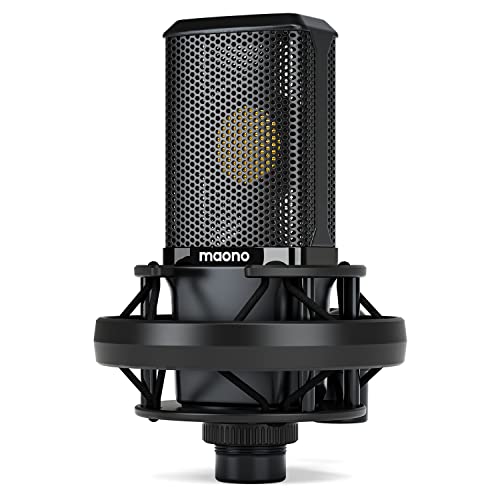
- 34 mm large-diaphragm condenser capsule
- Cardioid design with warm, detailed vocal sound
- Includes pop filter, shock mount, stand, and XLR cable
Best For: Interface-based voiceover and podcast studios
Studio Vocalist – RØDE NT1 Signature
The RØDE NT1 Signature is a strong choice among condenser microphones for voiceover if you want a traditional XLR studio setup and a quiet recording signal. Its large-diaphragm capsule, cardioid pattern, and included pop-filter-equipped shock mount make it ready to pair with an audio interface.
Best For: Voiceover artists, vocalists, and streamers building an XLR-based home studio.
Pros:
- Includes an SM6 shock mount with pop filter and a 6-meter XLR cable.
- Very low 4.5 dBA self-noise helps preserve quiet vocal takes.
- Cardioid pickup focuses on the speaker and rejects sound from the room.
Cons:
- Requires an audio interface or other compatible XLR preamp.
- Does not offer direct USB connectivity.
The NT1 Signature is especially practical when you want a complete vocal microphone package and plan to grow into a dedicated recording chain. Its included accessories reduce setup costs, while the low self-noise suits detailed voice work.
USB Voiceover Pick – Audio-Technica AT2020USB-X
The Audio-Technica AT2020USB-X simplifies voiceover recording with direct USB connectivity, so you can connect it to a computer without a separate audio interface. It combines a cardioid condenser design with 24-bit/96 kHz conversion, headphone monitoring, and a convenient mute control.
Best For: Podcasters, voiceover beginners, and creators who want a plug-and-play computer setup.
Pros:
- USB connection works directly with a personal computer.
- 24-bit/96 kHz conversion supports clear, natural-sounding recordings.
- Built-in headphone jack enables direct monitoring from the microphone.
- Includes a custom desk stand and USB-C-to-USB-A cable with adapter.
Cons:
- USB-only connectivity offers less traditional studio-routing flexibility than XLR.
- Its desk-stand setup may require additional support for more controlled positioning.
For straightforward computer-based voiceover, the AT2020USB-X keeps the signal path easy to manage while adding useful controls at the microphone. It is a practical option when fast setup and direct monitoring matter more than an expandable XLR rig.
Budget XLR Workhorse – MXL 990 Condenser Microphone
The MXL 990 is a versatile entry point among condenser microphones for voiceover, with an XLR output, cardioid pickup, and a frequency response suited to both male and female voices. It requires +48V phantom power, so plan to use an audio interface or microphone preamp with that capability.
Best For: Home-studio users seeking a detailed XLR microphone for voiceover, podcasting, and vocals.
Pros:
- Cardioid pattern helps reduce sound arriving from the sides and rear.
- 20 Hz to 20 kHz response supports a broad range of voices.
- Includes a custom shock mount, stand adapter, and carrying case.
- FET preamp and balanced output are designed for digital or analog recording.
Cons:
- Requires +48V phantom power and an appropriate XLR setup.
- Accessories do not include a pop filter or XLR cable in the supplied notes.
The MXL 990 offers a useful combination of vocal versatility and included mounting accessories. It makes the most sense for buyers who already have, or are prepared to add, phantom-powered recording hardware.
Creator Control Center – Elgato Wave:3 MK.2
The Elgato Wave:3 MK.2 is aimed at creators who want condenser microphones for voiceover with integrated digital controls. Its USB-C connection, Clipguard 2.0 protection, Auto Gain, headphone output, and Wave Link software make it particularly suited to computer-based recording and streaming.
Best For: Streamers, content creators, and voiceover users who want software routing and onboard processing.
Pros:
- USB-C setup works directly with PC or Mac.
- Clipguard 2.0 helps prevent clipping, while Auto Gain assists level setup.
- Wave FX supports voice enhancer, compressor, EQ, and VST plugin routing.
- Offers a multifunction dial, tap-to-mute control, and direct headphone monitoring.
Cons:
- USB connectivity is less suited to a conventional analog XLR studio chain.
- Its advanced controls and Wave Link software may be more than a simple voiceover setup requires.
The Wave:3 MK.2 stands out when workflow and processing convenience are priorities. It gives creators fast level management and flexible software control, while its anti-distortion features add protection during unpredictable speaking or streaming sessions.
Balanced Studio Detail – AT2035
For anyone comparing condenser microphones for voiceover, the Audio-Technica AT2035 is a strong XLR option for a studio or carefully treated home setup. Its large diaphragm, cardioid pickup, low-noise design, and included shock mount are aimed at clean, detailed vocal recording.
Best For: Voiceover artists, podcasters, and studio users who already have an audio interface or mixer.
Pros:
- Cardioid pattern helps reduce sound from the sides and rear.
- Large diaphragm delivers smooth, natural sound with low noise.
- High SPL handling, wide dynamic range, switchable 80 Hz high-pass filter, and 10 dB pad add flexibility.
- Custom shock mount improves isolation from vibration.
Cons:
- Uses an XLR connection rather than direct USB plug-and-play.
- Requires compatible equipment such as an audio mixer or interface.
The AT2035 is a versatile choice when vocal detail and recording control matter more than simple computer connectivity. Its filtering and pad make it useful beyond basic voiceover work.
Affordable XLR Starter – Mackie EM-91C
The Mackie EM-91C keeps the setup straightforward for shoppers seeking condenser microphones for voiceover at an affordable professional-quality level. This large-diaphragm XLR microphone uses a cardioid pattern and includes both a shock mount and XLR cable.
Best For: Home studios, beginner voiceover setups, and vocal or instrument recording with an audio mixer or interface.
Pros:
- Affordable professional-quality condenser design.
- Large-diaphragm capsule is suited to studio-based vocals and instruments.
- Cardioid pattern helps reduce ambient sound.
- Includes a shock mount and XLR cable.
Cons:
- Requires XLR-compatible recording equipment.
- Provides fewer stated control features than microphones with onboard filtering or pads.
The EM-91C is a practical entry point for an XLR voiceover chain. Its included accessories reduce the number of separate purchases, while the rugged construction suits regular home-studio use.
Flexible USB/XLR Kit – MAONO A04 Gen2
The MAONO A04 Gen2 stands out among condenser microphones for voiceover when you want both computer-friendly USB and traditional XLR connectivity. It combines a 192 kHz/24-bit USB mode with software controls, a cardioid capsule, and a complete arm-mounting kit.
Best For: Voiceover creators, podcasters, streamers, and users moving between USB recording and an XLR interface.
Pros:
- Dual USB and XLR connections support plug-and-play or interface-based recording.
- USB mode offers up to 192 kHz/24-bit sampling and MAONO Link controls.
- Cardioid pickup, pop filter, foam windscreen, and software noise reduction help manage unwanted noise.
- Includes shock mount, adjustable arm stand, base, and USB cable.
Cons:
- Software controls and noise reduction are available only in USB mode.
- XLR mode requires phantom power, and an XLR cable is not included.
- Not compatible with Xbox.
The A04 Gen2 is the most adaptable option here for creators who may start with a computer and later add an interface. Its included accessories make it particularly convenient for a ready-to-use desktop voiceover setup.
Versatile XLR Value – AKG P120
The AKG P120 is a practical choice for shoppers comparing condenser microphones for voiceover, especially if you already use an audio interface or mixer. Its cardioid pattern, 20 Hz–20 kHz response, and low-mass diaphragm are designed to deliver clear speech and vocal detail in home or project studios.
Best For: Voiceover creators who want an affordable XLR microphone with flexible studio and instrument-recording capability.
Pros:
- Cardioid pickup helps focus on sound from the front.
- Low-mass diaphragm supports clear, detailed speech and vocals.
- Handles sound levels up to 150 dB and includes a -20 dB pad.
- Includes a stand adapter and official warranty when purchased from an authorized AKG North American dealer.
Cons:
- Requires an XLR connection and phantom power, so it needs compatible recording hardware.
- Does not include a complete USB or boom-arm setup.
The P120 makes sense for voiceover users building around an interface and wanting a straightforward, durable condenser mic. Its pad and bass-cut filter also provide useful flexibility beyond spoken-word recording.
Plug-and-Play Starter Kit – FIFINE T669 USB Microphone
The FIFINE T669 is one of the more convenient condenser microphones for voiceover because it connects directly to a computer through USB. The kit combines a cardioid microphone with a boom arm, shock mount, double pop filter, and USB cable, reducing the extra equipment needed to begin recording.
Best For: Beginners recording voiceovers, podcasts, video narration, and online content directly to a PC or laptop.
Pros:
- USB plug-and-play connection works with PCs and laptops without additional drivers.
- Cardioid capsule is intended to capture front-facing speech while reducing ambient sound.
- Includes an adjustable boom arm, shock mount, double pop filter, and 8.2-foot cable.
- Gain control and a sturdy clamp-based arm support practical desk recording.
Cons:
- Not compatible with Xbox according to the supplied notes.
- USB connectivity is less suited to users who specifically want an XLR studio signal chain.
For a simple computer-based voiceover station, the T669 offers strong convenience because its core accessories are included. It is a sensible starter option for creators who want to avoid buying an interface separately.
Warm Studio Detail – MAONO PM500 XLR Microphone
The MAONO PM500 is a large-diaphragm XLR option for shoppers seeking condenser microphones for voiceover with a fuller studio presentation. Its 34 mm gold condenser capsule, cardioid pattern, and stated 20 Hz–20 kHz range are paired with a shock mount, metal pop filter, desktop stand, and XLR cable.
Best For: Voiceover artists, podcasters, and vocalists with an interface or mixer that supplies 48V phantom power.
Pros:
- 34 mm large diaphragm is designed for detailed, full, and warm vocal sound.
- Cardioid pickup helps suppress sound arriving from the sides and rear.
- Includes a metal pop filter, shock mount, desktop stand, and XLR cable.
- High SPL handling and low-noise circuit design support vocals and other recording sources.
Cons:
- Requires 48V phantom power and compatible XLR equipment.
- Its desktop stand may be less flexible than a full boom-arm arrangement.
The PM500 is a well-equipped choice when you want to start with an XLR workflow and prefer a warm, detailed vocal character. Confirm that your interface, mixer, or sound card provides 48V phantom power before buying.
How We Picked the Best Condenser Microphones for Voiceover
We focused on microphones suited to spoken-word recording, including narration, podcasts, video voiceovers, streaming, and home studios. Our selection covers both USB models for simple computer recording and XLR microphones for users who want an audio interface and more upgrade flexibility.
We also considered pickup pattern, diaphragm design, included accessories, monitoring features, compatibility, reputation, and overall value. Because room acoustics strongly affect condenser microphone recordings, no single model is ideal for every voice or recording space.
Quick Comparison
| Best For | Recommended Options | Connection |
|---|---|---|
| Simple USB recording | Audio-Technica AT2020USB-X, Elgato Wave:3 MK.2, FIFINE T669 | USB |
| Flexible USB/XLR setup | MAONO A04 Gen2 | USB/XLR |
| Studio-quality voiceover | RØDE NT1 Signature Series, Audio-Technica AT2035 | XLR |
| Affordable XLR recording | MXL 990, Mackie EM-91C, AKG P120, MAONO PM500 | XLR |
Key Buying Factors for Condenser Microphones for Voiceover
USB or XLR Connectivity
USB microphones connect directly to a computer and typically include a built-in analog-to-digital converter, making them convenient for beginners and mobile recording setups. XLR microphones require an audio interface, mixer, or compatible recorder, but they offer greater control and an easier upgrade path.
Pickup Pattern and Room Noise
Most microphones here use a cardioid pattern, which emphasizes sound from the front and reduces some rear-facing noise. Condenser microphones are sensitive, so fans, traffic, hard walls, and keyboard sounds may still be captured. A quiet room and basic acoustic treatment can matter as much as the microphone.
Sound Character and Sensitivity
For narration, look for clear midrange detail and controlled high frequencies. A brighter microphone can add presence, while a smoother model may be more forgiving with sibilant voices. If you record loud sources or have a naturally strong voice, check whether the microphone includes a pad or offers enough headroom.
Accessories and Monitoring
A shock mount, pop filter, stand, and headphone output can reduce setup costs and make recording easier. USB models with direct monitoring are especially useful when you need to hear your voice without noticeable latency.
Who Should Buy Which Condenser Microphones for Voiceover?
Choose the RØDE NT1 Signature Series or Audio-Technica AT2035 if you want a serious XLR microphone for narration and plan to use an interface. Choose the AT2020USB-X or Elgato Wave:3 MK.2 for straightforward computer recording, streaming, and easy monitoring.
Choose the MAONO A04 Gen2 if you want USB convenience now with XLR flexibility later. Choose the MXL 990, Mackie EM-91C, AKG P120, or MAONO PM500 for a budget-conscious interface-based setup. Choose the FIFINE T669 if you want an inexpensive, ready-to-use USB option for entry-level voiceover and podcasting.