Looking for a reliable way to run three external displays from one laptop? The right dock can simplify your desk, reduce adapter clutter, and keep your workflow moving.
Below, we focus on docking stations for three monitors that balance display support, charging power, port selection, and compatibility for modern work setups.
Best 10 Docking Stations for Three Monitors Picks for 2026
Universal Workhorse Dock

- Connects via USB-C or USB-A
- Supports up to three 4K displays
- Works with common home or office peripherals
Best For: Users who need broad laptop compatibility
Budget Multi-Display Adapter Dock
HoDo 8-in-1 USB-C Docking Station

- HDMI, DisplayPort, and VGA outputs in one compact dock
- Supports dual or triple displays with compatible laptops
- Includes 3 USB 2.0 ports and 100W PD charging
Best For: Compact setups that need multiple display outputs
Enterprise Triple Display Dock
Plugable USB C Triple Display Docking Station

- Triple HDMI support with 1× 4K and 2× 1080p outputs
- 100W USB-C Power Delivery for laptop charging
- 6 USB ports plus Gigabit Ethernet and audio
Best For: Hybrid teams and office setups needing dependable triple-monitor expansion
High-Port Office Dock
TobenONE 18 in 1 Laptop Docking Station
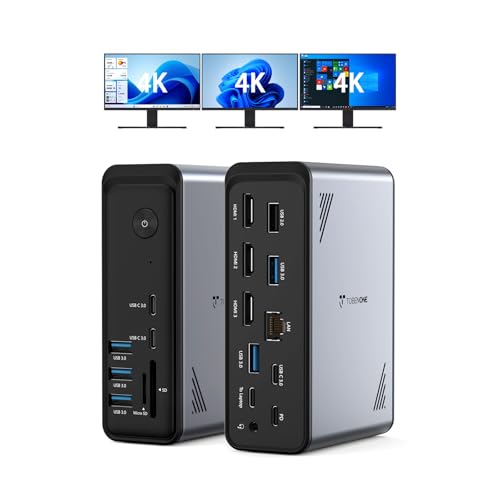
- Triple 4K HDMI support for dual or triple displays
- 18-in-1 expansion with 9 USB ports and card readers
- 100W PD charging for compatible laptops
Best For: Windows and ChromeOS users who need a high-port triple-monitor dock
Triple 4K Workstation Dock
Plugable 13-in-1 USB C Docking Station
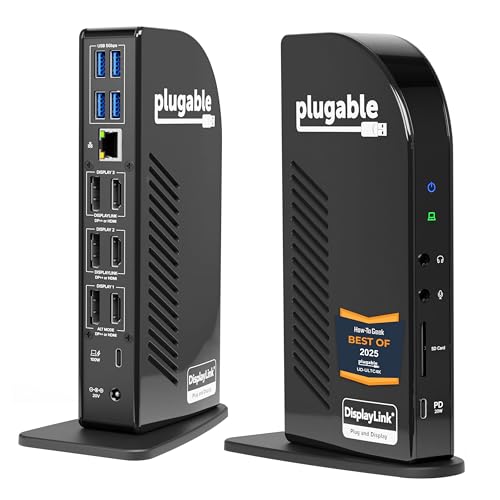
- Up to three 4K 60Hz monitors with HDMI and DisplayPort
- 100W USB-C charging for supported laptops
- 13-in-1 design with Ethernet, USB, audio, and SD support
Best For: Power users and IT teams needing flexible triple-monitor workstation support
Triple-HDMI Windows Dock

- 3 HDMI ports for triple monitor use on Windows
- 10Gbps USB-A/USB-C ports plus card reader
- 100W PD charging with Gigabit Ethernet
Best For: Windows laptop users building a no-driver triple-monitor desk setup
Mac-Friendly Triple Dock
Plugable 13-in-1 DisplayLink Dock
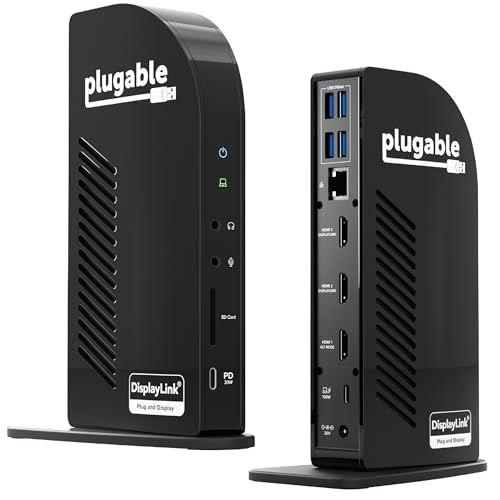
- Triple extended HDMI display support
- 100W laptop charging plus 20W device charging
- 3 HDMI, Ethernet, SD, audio, and 4 USB-A ports
Best For: Business users who want triple-screen support on Mac, Windows, or ChromeOS
Smart Triple-Display Dock – Selore 17-in-1 USB-C Docking Station
If you’re comparing docking stations for three monitors, the Selore is built for users who want a full desktop setup from one USB-C connection. It supports triple extended displays on Windows with up to 4K@60Hz output across its five video ports, while also adding fast USB, Ethernet, card readers, and a smart LCD that shows weather and charging status.
Best For: Windows laptop users who want a feature-packed triple-monitor dock with extra convenience tools.
Pros:
- Supports three independent external displays on Windows through MST.
- Offers 17-in-1 expansion with 10Gbps USB-C/USB-A, Ethernet, and SD/microSD.
- Includes a smart LCD with weather and charging info.
- 100W PD input with about 85W output to the laptop.
Cons:
- macOS is limited to mirror mode or a single extended display.
- Requires an 87W-or-higher charger for full functionality; charger is not included.
As a practical three-monitor dock, this one stands out for desktop convenience as much as display support. It makes the most sense for users who want a centralized hub with strong connectivity, not just extra monitor ports.
Universal Workhorse Dock – Dell D6000S Universal Dock
For buyers comparing docking stations for three monitors, the Dell D6000S keeps the focus on broad compatibility and straightforward expansion. It connects through USB-C or USB-A and is designed to attach a laptop to displays, keyboard and mouse, and audio devices in home or office setups.
Best For: People who want a simple universal dock that works with USB-C or USB-A laptops.
Pros:
- Supports up to three 4K displays.
- Works with laptops that have USB-C or USB-A.
- Built for connecting common peripherals and audio devices.
- Suitable for home or office use.
Cons:
- Product details here provide fewer specs than more feature-rich rivals.
- No built-in extras like smart display or high-speed card readers are noted.
This is the kind of dock that makes sense when compatibility matters more than bells and whistles. If you want a clean way to run three monitors without overcomplicating the setup, it’s an easy option to consider.
Power User Triple-Display Dock – Anker Prime DL7400 Triple 4K Dock
Among docking stations for three monitors, the Anker Prime DL7400 is aimed at Windows users who want serious connectivity and current-status feedback in one unit. It supports triple 4K@60Hz display output with DisplayLink, while also packing in 14 ports, 2.5Gbps Ethernet, SD/TF slots, and a smart display that shows charging and cooling information.
Best For: Windows laptop users who want a high-power dock with triple 4K displays and advanced status monitoring.
Pros:
- Drives three external 4K@60Hz displays with DisplayLink.
- Offers 140W upstream charging and multiple 100W USB-C ports.
- Includes 2.5Gbps Ethernet, SD/TF card slots, and a headphone/mic jack.
- Smart display and fan system help monitor performance and cooling.
Cons:
- Requires the latest DisplayLink driver.
- Windows 10/11 only, according to the product notes.
- Streaming services with DRM may show a black screen.
This dock is best when your desk setup needs both bandwidth and control. It’s especially compelling for power users who want a triple-monitor workstation and don’t mind the DisplayLink software requirement.
Budget Multi-Display Adapter Dock – HoDo 8-in-1 USB-C Docking Station
If you’re shopping docking stations for three monitors and want a compact adapter-style option, the HoDo dock covers a lot of bases in a small footprint. It offers HDMI, DisplayPort, and VGA video outputs plus USB ports and 100W PD charging, making it a practical choice for lighter multi-display setups.
Best For: Users who want a compact USB-C dock with multiple display outputs and basic USB expansion.
Pros:
- Provides 2 HDMI, 1 DisplayPort, and 1 VGA video outputs.
- Supports dual or triple display output depending on laptop capability.
- Includes 3 USB 2.0 ports for keyboard, mouse, and accessories.
- Offers up to 100W PD input with 87W safe output.
Cons:
- Using the VGA port reduces overall resolution to 1080P.
- Needs a full-featured USB-C port with DisplayPort Alt Mode.
- MacOS external screens mirror each other per the notes.
This is a sensible pick if you want flexible video outputs without moving up to a larger docking station. It’s most appealing for users who need a straightforward way to add monitors, keyboard, mouse, and charging from one connection.
Enterprise Triple Display Dock – Plugable USB C Triple Display Docking Station
If you want docking stations for three monitors that are built for mixed-fleet offices, this Plugable model is a practical pick. It combines triple HDMI output, 100W laptop charging, and a wide set of USB ports in one USB-C dock, making it easier to build a tidy multi-monitor workspace for work, meetings, and everyday productivity.
Best For: Hybrid teams and office users who need reliable triple-display support, strong device compatibility, and simple laptop charging.
Pros:
- Supports up to three HDMI displays with 1× 4K at 30Hz and 2× 1080p at 60Hz.
- Includes 100W USB-C Power Delivery for charging while you work.
- Offers 6 USB 3.0 ports plus Gigabit Ethernet and audio for a full workstation setup.
- Compatible with Windows, macOS, and ChromeOS on full-featured USB-C, USB4, and Thunderbolt systems.
Cons:
- Not compatible with Linux.
- HDCP is not supported.
- macOS requires driver installation for full DisplayLink support.
This is a strong fit if your priority is dependable three-monitor expansion with enterprise-friendly support and broad laptop compatibility. The mix of native USB-C video and DisplayLink makes it especially useful for productivity-focused desks.
High-Port Office Dock – TobenONE 18 in 1 Laptop Docking Station
For shoppers comparing docking stations for three monitors, this TobenONE unit stands out for sheer port count and office-focused display support. It offers triple 4K HDMI connectivity, 100W charging capability, and a broad mix of USB, card, Ethernet, and audio connections, making it a capable all-in-one dock for a busy desk.
Best For: Windows and ChromeOS laptop users who want a feature-rich triple-monitor dock with lots of USB connectivity.
Pros:
- Triple HDMI support with up to 4K at 60Hz for dual or triple displays.
- 18-in-1 layout includes 9 USB ports, Ethernet, SD/microSD, and audio.
- Supports 100W PD charging to keep a compatible laptop powered.
- Designed for Windows and ChromeOS laptops with full-featured USB-C, USB4, or Thunderbolt.
Cons:
- No power adapter is included.
- Needs an additional power supply rated over 65W for stable operation.
- Not recommended for Mac users based on the compatibility notes.
This dock makes sense if you want a dense, desk-friendly hub that can handle multiple monitors and a large peripheral load. Its value is strongest in Windows and ChromeOS environments where all-in-one expansion matters more than compact size.
Triple 4K Workstation Dock – Plugable 13-in-1 USB C Docking Station
If you need docking stations for three monitors with more display flexibility, this Plugable model is designed for serious workstation use. It supports up to three 4K monitors, offers both HDMI and DisplayPort outputs, and adds 100W laptop charging plus the desktop essentials needed for hybrid work or an IT-managed setup.
Best For: Power users, IT deployments, and professionals who want triple 4K monitor support with flexible display connections.
Pros:
- Drives up to three 4K 60Hz monitors.
- Includes 3 HDMI and 3 DisplayPort outputs for flexible display hookups.
- Provides up to 100W USB-C laptop charging through the rear host connection.
- Adds USB expansion, Ethernet, audio, and SD card support in a 13-in-1 design.
Cons:
- DisplayLink drivers are required on macOS.
- Screen Recording permission is required by the driver on Mac.
- HDCP is not supported.
This is the most workstation-oriented option in the group, especially if you want true flexibility across HDMI and DisplayPort monitors. It is a strong match for users who value multi-display performance, reliable charging, and broad dock functionality in one unit.
Triple-HDMI Windows Dock – Selore 13-in-1 USB-C Dock
If you want docking stations for three monitors and you’re on a Windows laptop, this Selore model is built around a true triple-display setup. It combines three HDMI outputs with 10Gbps USB ports, Ethernet, SD/microSD, and 100W pass-through charging, so it works as a compact desk hub rather than just a video adapter.
Best For: Windows users who need a plug-and-play triple HDMI dock with fast charging and basic expansion.
Pros:
- Three HDMI ports support triple monitor use on Windows with MST/DisplayPort Alt Mode support.
- 10Gbps USB-C and USB-A ports help move files quickly from drives and accessories.
- 100W PD charging keeps your laptop powered while the dock is in use.
- Includes Gigabit Ethernet and SD/microSD card slots for a fuller workstation setup.
Cons:
- Triple extended display is not supported on macOS.
- Your laptop must support DisplayPort Alt Mode or Thunderbolt 3/4 over USB-C.
Overall, this is a straightforward choice if your priority is a triple-monitor Windows workspace with no-driver setup and a practical mix of ports. It’s best suited to buyers who know their USB-C port supports video output and want a simple, all-in-one dock.
DisplayLink 3-4 Screen Dock – TobenONE 18-Port DisplayLink Dock
Among docking stations for three monitors, this TobenONE stands out if you need maximum display flexibility across Mac and Windows systems. Its DisplayLink design lets you drive triple or quad 4K@60Hz displays with a wide mix of HDMI and DisplayPort options, while also adding 10Gbps USB connectivity and a 120W power adapter.
Best For: Users who want a DisplayLink dock for multi-monitor productivity on Mac or Windows.
Pros:
- Supports triple or quad display setups with 3x HDMI and 3x DisplayPort outputs.
- Can run up to 4 monitors on supported Windows setups and up to 3 on macOS.
- Includes a 120W power adapter and can deliver up to 100W to the laptop.
- Offers 18 ports total, including 10Gbps USB-C and USB-A connections.
Cons:
- Requires DisplayLink driver installation before use.
- Not compatible with Linux/Unix systems.
- Protected streaming content such as Netflix is not supported.
This is a strong fit for users who want the widest possible monitor configuration and don’t mind installing software to unlock it. It’s especially practical for trading, content creation, development, and other workflows that benefit from lots of screen real estate.
Mac-Friendly Triple Dock – Plugable 13-in-1 DisplayLink Dock
If you need docking stations for three monitors and you use a Mac, this Plugable dock is designed to extend beyond the usual single-screen limit with DisplayLink. It offers three HDMI outputs, 100W laptop charging, and a solid set of office ports, making it a practical desk dock for business and productivity use.
Best For: Mac, Windows, and ChromeOS users who want triple-monitor expansion with DisplayLink.
Pros:
- Supports up to three extended HDMI displays through DisplayLink.
- Delivers up to 100W charging for the laptop plus 20W on the front USB-C port.
- Includes 3 HDMI ports, Gigabit Ethernet, SD card reader, audio I/O, and 4 USB-A ports.
- Compatible with macOS, Windows 10+, and ChromeOS when using the required DisplayLink software on Mac.
Cons:
- DisplayLink driver installation is required for Mac use.
- HDCP-protected streaming services such as Netflix and Hulu are not supported.
- Primary display resolution is lower than the secondary outputs at up to 4K 30Hz.
This dock makes sense if your main goal is dependable triple-screen productivity on a mixed OS setup. It is especially appealing for teams, offices, and users who want a business-ready dock with standardized charging and broad port coverage.
How We Picked the Best Docking Stations for Three Monitors
We prioritized Docking Stations for Three Monitors that offer stable multi-display output, practical charging, and enough ports for everyday peripherals. We also looked at platform support, because Windows, macOS, and ChromeOS can differ in how triple displays are handled.
Preference went to models with clear display specifications, dependable power delivery, and useful extras such as Ethernet, fast USB ports, and simple setup.
Quick Comparison
In this category, the biggest differences are display method, monitor resolution support, and host compatibility. Some docks are better for Windows-based triple-monitor productivity, while others are designed around DisplayLink for broader cross-platform support, including certain Mac setups.
If you want the easiest path to three screens, match the dock’s video outputs and software requirements to your laptop before buying.
Key Buying Factors for Docking Stations for Three Monitors
Display Output and Resolution
Check whether the dock supports triple 1080p, mixed resolutions, or true triple 4K output. Some models only reach 4K on one display, while others support 4K across all three with the right hardware and software.
Compatibility and Driver Support
Not all laptops handle three displays natively over USB-C. DisplayLink-based docks can expand compatibility, but they usually require driver installation. If you use a Mac, confirm whether your model and chip support the display layout you want.
Power Delivery
For a cleaner setup, look for at least 100W charging if you use a productivity laptop. That helps power the notebook and reduce the need for a separate charger, though high-performance systems may still need more.
Ports and Expansion
Beyond video, the best docks include fast USB-A and USB-C ports, Ethernet, and audio. These extras matter if you connect storage, webcams, keyboards, or wired networking every day.
Who Should Buy Which Docking Stations for Three Monitors?
If you mainly work in Windows and want the broadest triple-monitor flexibility, choose a DisplayLink dock with strong port variety. If you need a simpler office dock, pick a model with straightforward HDMI or DisplayPort output and strong charging support.
Mac users should be especially careful to verify compatibility before buying, since some laptops support multiple external displays differently depending on the chip and dock architecture. Heavy multitaskers, creators, and remote workers will usually benefit most from Docking Stations for Three Monitors that combine reliable video output with one-cable charging and Ethernet.