Choosing the right encoder can make a multi-camera production more reliable, easier to manage, and better suited to your streaming workflow. The best option depends on your cameras, switching needs, output platforms, network, and whether you need recording or remote-production features.
We compared 10 streaming encoders for multi-camera setups across input formats, resolution, supported protocols, monitoring, portability, and production flexibility. Use the guide below to narrow the field before choosing a system for events, classrooms, houses of worship, studios, or professional live production.
Best 10 Streaming Encoders for Multi Camera Setups Picks for 2026
Best All-in-One Switcher

- Four HDMI inputs and dual HDMI outputs
- Streams to three platforms or via USB to OBS/vMix
- Integrated audio, recording, playback, and overlays
Best For: Hands-on HDMI productions with integrated switching and audio
Best 4K SDI Encoder
Blackmagic Streaming Encoder 4K
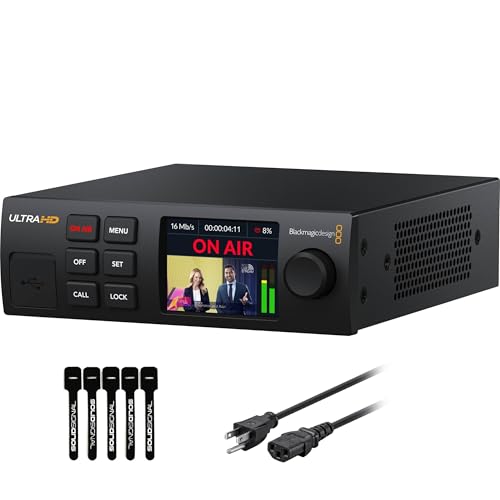
- 12G-SDI input supports DCI 4K60
- H.264/H.265 streaming over SRT or RTMP
- Ethernet and USB-C mobile auto-failover
Best For: Professional SDI workflows requiring 4K and resilient streaming
Best High-Input Multicam System

- Eight HDMI inputs with 4K60 scaling
- ISO records individual camera inputs
- NDI HX, instant replay, and 10-hour battery
Best For: Large HDMI productions, sports, and event streaming
Best Multi-Protocol Encoder
ORIVISION 4-Channel 4K H.265 Encoder

- Supports four HDMI channels and up to 16 feeds
- Handles H.265, H.264, and MJPEG
- Broad RTMP, SRT, HLS, UDP, and RTP support
Best For: IPTV and multi-platform distribution with flexible protocols
Best Hybrid 4K Pick

- Combines HDMI and SDI inputs
- Supports 4K H.264/HEVC encoding
- Streams to six destinations while recording
Best For: Multi-camera HDMI/SDI productions needing onboard mixing
Best Budget 1080p Option

- Encodes 1080p at up to 60fps
- Outputs up to four protocol streams
- Adds captions, logos, and timestamps
Best For: Single-HDMI-source streaming and IP distribution
Best HDMI Workflow Pick
Magewell Ultra Encode HDMI Plus

- Provides 4K HDMI encoding with loop-through
- Supports NDI|HX and multiple protocols
- Includes 128GB storage for recording
Best For: HDMI productions needing monitoring and IP workflow support
All-in-One Production Kit

- Eight-channel switching with SDI, HDMI, USB, NDI, SRT, and RTMP sources
- ISO recording, built-in monitor, media players, and layered video effects
- Portable power options and two XLR microphone inputs
Best For: Full-service mobile multi-camera productions
4K Network Encoder
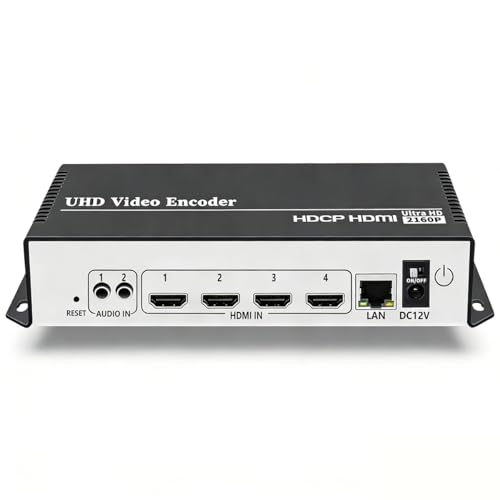
- Encodes 4K HDMI video using H.264 or H.265
- Outputs up to four streams with different protocols
- Adds captions, logos, timestamps, and adjustable video settings
Best For: 4K HDMI streaming to multiple platforms
Compact HD Stream Encoder

- Compact 1080p HDMI-to-IP encoding for live broadcasts
- Creates two streams per HDMI input with separate protocol choices
- Supports overlays, image adjustments, and developer controls
Best For: Compact HD distribution from an existing switcher
Best All-in-One Switcher – Osee GoStream Deck HDMI Pro
For creators comparing streaming encoders for multi camera setups, the Osee GoStream Deck is a practical choice when switching, audio control, recording, and streaming need to happen in one compact unit. It accepts four HDMI sources and supports direct streaming, USB output, and portrait or landscape production.
Best For: Podcasts, conferences, worship services, weddings, and panel productions needing hands-on switching and overlays.
Pros:
- Four HDMI inputs with two HDMI outputs for sources, MultiView, and monitoring.
- Streams to up to three platforms through Ethernet and can also work with OBS or vMix over USB.
- Built-in audio controls, recording to SD or USB SSD, playback, macros, and keying effects.
Cons:
- Its HDMI-focused design may be less suitable for productions built around SDI cameras.
- Advanced graphics and control features may require time to configure.
The GoStream Deck stands out as a self-contained production hub rather than a simple encoder. Choose it when tactile controls, integrated audio, and live overlays matter as much as basic streaming.
Best 4K SDI Encoder – Blackmagic Streaming Encoder 4K
Among streaming encoders for multi camera setups, the Blackmagic Streaming Encoder 4K is aimed at SDI-based workflows that need high-resolution delivery and dependable connectivity. It encodes H.264 or H.265 video up to 2160p60 and can stream directly without a separate encoding computer.
Best For: Broadcast-style productions using 12G-SDI cameras, remote control, and professional monitoring.
Pros:
- Supports 12G-SDI input up to DCI 4K60 with automatic standards conversion.
- Offers H.264 and H.265 streaming over SRT or RTMP to many major platforms.
- Includes Ethernet, USB-C mobile failover, SDI and HDMI monitoring, captions, timecode, and REST API control.
Cons:
- It has one SDI input, so multi-camera switching must be handled elsewhere.
- Its professional SDI feature set may be more than a basic HDMI streaming setup requires.
This is best viewed as a dedicated network encoder for an existing production chain. It is a strong fit when 4K60 SDI support, standards conversion, and connection redundancy are priorities.
Best High-Input Multicam System – YoloBox Extreme
The YoloBox Extreme is designed for demanding streaming encoders for multi camera setups where many sources, touchscreen control, and recording flexibility are important. It combines eight HDMI inputs, assignable outputs, NDI HX support, direct streaming, and ISO recording in a portable all-in-one system.
Best For: Sports, events, and larger productions that need numerous HDMI sources, instant replay, and isolated recordings.
Pros:
- Connects up to eight HDMI sources with built-in 4K60 scaling and two assignable HDMI outputs.
- Records individual inputs in up to 4K30 or 1080p60, depending on the number of inputs used.
- Supports up to six NDI HX inputs, multicamera replay at 1080p60, and up to 10 hours of battery life.
Cons:
- Its extensive feature set and large touchscreen may be excessive for small two-camera streams.
- ISO recording resolution varies with the number of inputs in use.
With its unusually high HDMI capacity and integrated NDI support, the YoloBox Extreme is built for scaling beyond a basic mobile switcher. It is especially compelling when post-production recordings and live replay are part of the plan.
Best Multi-Protocol Encoder – ORIVISION 4-Channel 4K H.265 Encoder
For buyers seeking streaming encoders for multi camera setups with broad network compatibility, the ORIVISION four-channel encoder emphasizes simultaneous outputs and protocol support. It accepts multiple HDMI feeds, provides an LCD status screen, and can send streams to as many as 16 destinations under the stated channel and protocol limits.
Best For: IPTV, broadcast distribution, and multi-platform streaming workflows that need RTMP, RTMPS, SRT, HLS, UDP, or RTP options.
Pros:
- Handles up to two 4Kp30 and two 1080p60 HDMI inputs and outputs.
- Can distribute four channels to up to four platforms each, for a stated maximum of 16 feeds.
- Supports H.265, H.264, and MJPEG plus multiple streaming protocols, OSD, and image flipping.
Cons:
- It provides one Ethernet output port and does not include a power plug.
- The maximum 16-feed configuration depends on the selected resolutions, protocols, and network setup.
This encoder is less about hands-on live switching and more about dense, flexible signal distribution. Choose it when protocol variety and simultaneous channel delivery outweigh the need for an integrated touchscreen production interface.
Best Hybrid 4K Pick – Magewell Ultra Encode AIO
For streaming encoders for multi camera setups, the Magewell Ultra Encode AIO is a flexible choice when your production uses both HDMI and SDI sources. It supports 4K encoding, picture-in-picture or side-by-side layouts, multiple streaming protocols, and simultaneous recording.
Best For: Multi-camera productions that need HDMI and SDI compatibility, built-in mixing, and multi-destination streaming.
Pros:
- Accepts HDMI and SDI inputs, with picture-in-picture and side-by-side mixing.
- Supports up to 4K encoding with H.264 or HEVC compression.
- Streams to up to six destinations and records simultaneously to SD, USB, or network storage.
- Includes overlays, PoE, Wi-Fi, 4G modem support, web control, and API control.
Cons:
- Its broader feature set may be more than needed for a simple single-camera HDMI workflow.
- SDI 4K input support is listed up to 4096×2160p30, while HDMI supports up to 4096×2160p60.
The Ultra Encode AIO stands out when source flexibility and onboard production tools matter more than keeping the setup minimal. It is a strong fit for studios, events, and mobile productions that want streaming, recording, and basic layout composition in one unit.
Best Budget 1080p Option – URayCoder HDMI IP Encoder
For streaming encoders for multi camera setups built around HDMI sources, the URayCoder HDMI IP Encoder offers a compact 1080p solution with H.264 and H.265 encoding. Its multi-protocol output and configurable overlays make it practical for distributing one camera feed across several platforms.
Best For: HDMI-based 1080p streaming where multiple protocol outputs, basic branding, and straightforward network management are priorities.
Pros:
- Supports 1920×1080 output at up to 60fps with H.264 or H.265 encoding.
- Can output up to four video streams using different protocols.
- Works with RTMP(S), SRT, HLS, RTSP, UDP/RTP, ONVIF, and other listed formats.
- Provides text, scrolling captions, logos, timestamps, cropping, and audio-input options.
Cons:
- It is limited to a single HDMI video input and 1080p resolution.
- It does not provide the HDMI/SDI input flexibility or onboard multi-camera mixing of the Magewell AIO.
This encoder is best viewed as a compact network bridge for an HDMI camera or source rather than a full production switcher. It makes sense when your cameras or switcher already handle the multi-camera work and you need flexible IP delivery.
Best HDMI Workflow Pick – Magewell Ultra Encode HDMI Plus
For streaming encoders for multi camera setups that rely on HDMI cameras, switchers, or other AV sources, the Magewell Ultra Encode HDMI Plus combines 4K encoding with loop-through monitoring. It also supports multi-destination streaming, NDI|HX, onboard recording, and network control.
Best For: HDMI-focused live productions that need local pass-through, 4K support, NDI|HX integration, and recording during a stream.
Pros:
- Encodes HDMI video up to 4096×2160p30 and provides HDMI loop-through for monitoring or pass-through.
- Supports RTMP(S), SRT, NDI|HX, HLS, and TS over UDP/RTP.
- Records while streaming to its 128GB internal storage, USB storage, or network locations.
- Offers PoE, Gigabit Ethernet, Wi-Fi, 4G/5G modem support, overlays, web UI, and API control.
Cons:
- It is designed for HDMI workflows and does not list an SDI input.
- 4K HDMI encoding is specified up to 30fps.
- 4G/5G USB modems are supported but not supplied.
The HDMI Plus is a well-rounded option when a camera or switcher feed needs to remain visible on a local display while also being encoded and distributed online. Its internal storage and NDI|HX support add useful flexibility for event, education, and corporate production systems.
All-in-One Production Kit – GoStream Duet 8 ISO
For creators comparing streaming encoders for multi camera setups, the Osee GoStream Duet 8 ISO Kit is a complete mobile production solution. It combines an eight-channel switcher, ISO recording, a built-in 14-inch monitor, multiple input types, audio support, and flexible power options in one portable package.
Best For: Multi-camera podcasts, conferences, worship services, education, weddings, and live events that need switching and recording in one system.
Pros:
- Supports 4 SDI, 4K HDMI, USB webcams, NDI-HX, SRT, RTMP, and media-player sources.
- Offers ISO recording, two built-in MP4 players, and up to 11 video layers with chroma and picture-in-picture tools.
- Includes a built-in monitor, two XLR microphone inputs, and AC, V-mount DC, or USB power-bank operation.
Cons:
- At 16.5 pounds, it is less convenient to transport than a compact encoder-only unit.
- Its broad feature set may require more setup and learning than a straightforward HDMI-to-IP encoder.
This is the most production-focused option in the group. Choose it when you want a self-contained switcher, recorder, monitor, and streaming hub rather than only an encoding device.
4K Network Encoder – URayCoder UHE265-4-4K
The URayCoder UHE265-4-4K is a practical choice when your multi-camera workflow already uses HDMI switching or source distribution and needs network streaming. It accepts 4K HDMI video, supports H.264 and H.265 encoding, and can output multiple streams using a wide range of protocols.
Best For: 4K HDMI sources, multi-platform streaming, IPTV, and installations managed through a computer or mobile device.
Pros:
- Supports 4K input and output at up to 30 fps, with up to 120 fps at 2K and lower resolutions.
- Can output four video streams using different protocols, including RTMP(S), SRT, HLS, WebRTC, UDP, and RTSP.
- Provides text, logo, timestamp, audio, cropping, rotation, and bitrate controls.
- Includes lifetime technical support and a lifetime free warranty according to the supplied product information.
Cons:
- It has one HDMI port, so it is not a multi-input camera switcher by itself.
- It does not provide the integrated monitor, physical switching controls, or ISO workflow of the Osee kit.
For multi-camera setups, pair this encoder with a switcher or HDMI distribution system. Its main advantage is flexible 4K network delivery and simultaneous protocol output in a compact chassis.
Compact HD Stream Encoder – URayCoder UHE265-8
The URayCoder UHE265-8 is a compact HDMI-to-IP encoder for workflows that need flexible online delivery without a full production switcher. For streaming encoders for multi camera setups, it can fit downstream of a camera switcher and create multiple stream outputs for different servers or platforms.
Best For: 1080p live broadcasting, IPTV, NVR workflows, and users who need simultaneous stream destinations from HDMI video.
Pros:
- Supports H.264 and H.265 encoding with RTMPS, RTSP, SRT, HLS, UDP, MP4, FLV, WebRTC, and other protocols.
- Provides two simultaneous video streams for each HDMI input, with separate protocol choices.
- Allows custom text, scrolling text, logos, timestamps, cropping, mirroring, and adjustable audio settings.
- Offers free lifetime technical support and warranty, plus SDK, API, and CGI documentation for development.
Cons:
- It is an HDMI encoder rather than a multi-camera switcher, so cameras need to be switched before the input.
- The supplied information describes 1080p operation, not 4K output.
This is a space-saving option for established multi-camera rigs that already produce a single HDMI program feed. Its dual-stream output and extensive protocol support make it useful when one program needs to reach different destinations.
How We Picked the Best Streaming Encoders for Multi Camera Setups
We focused on the features that have the greatest impact on real-world multi-camera streaming: video inputs, maximum resolution, codec support, simultaneous outputs, audio handling, recording, network connectivity, and ease of operation. We also considered whether each device is a dedicated encoder, an all-in-one switcher, or a more flexible network-video appliance.
Because these products serve different production styles, the list includes compact HDMI encoders, SDI-capable systems, standalone 4K units, multi-channel network encoders, and integrated switcher/recorder platforms. Compatibility with protocols such as RTMP, RTMPS, SRT, RTSP, HLS, UDP, and NDI can be especially important when connecting to multiple destinations or production tools.
Quick Comparison
- Best for integrated production: All-in-one switchers such as the YoloBox Extreme and Osee GoStream models combine camera switching with streaming and, in some cases, recording.
- Best for dedicated encoding: Magewell and Blackmagic options are better suited to established workflows that already use a separate switcher or production system.
- Best for high channel counts: Multi-channel HDMI-to-IP encoders can handle several feeds, but require more careful configuration and network planning.
- Best for portability: Compact HDMI encoders are easier to deploy for presentations, small events, and mobile productions.
Key Buying Factors for Streaming Encoders for Multi-Camera Setups
Inputs and Camera Compatibility
Check whether your cameras use HDMI, SDI, or both. HDMI is common in consumer and mirrorless cameras, while SDI is preferred for longer cable runs and professional installations. Also verify the supported signal resolution and frame rate for every camera.
Switching Versus Encoding
A dedicated encoder sends a finished feed to a platform; it does not necessarily switch between cameras. If you need transitions, layouts, picture-in-picture, or graphics, choose an integrated switcher or retain a separate video mixer.
Resolution, Codecs, and Bandwidth
4K support provides more detail and cropping flexibility, but it requires compatible cameras, displays, platforms, and substantially more bandwidth. H.265 can reduce bitrate compared with H.264, although H.264 remains more broadly compatible.
Protocols and Network Reliability
RTMPS is useful for common streaming platforms, while SRT is valuable when the connection is unpredictable. Ethernet is generally more stable than Wi-Fi. For critical events, consider redundant connectivity, local recording, and loop-through monitoring.
Audio, Recording, and Expansion
Look for the audio inputs you actually need, including embedded HDMI or SDI audio, line input, and microphone support. ISO recording, USB output, NDI, PoE, and multiple simultaneous destinations can justify a higher price if they fit your workflow.
Who Should Buy Which Streaming Encoders for Multi Camera Setups?
Choose an all-in-one switcher if you want the simplest path from several cameras to a finished live stream. These systems suit solo operators, educators, churches, event teams, and small studios.
Choose a dedicated 4K encoder if you already have a switcher or vision mixer and need dependable delivery to streaming platforms, production networks, or remote collaborators.
Choose a multi-channel network encoder if your priority is distributing several camera feeds over an IP network rather than manually switching a single program output. Budget time for configuration, bandwidth testing, and protocol management.
Before buying, map the entire signal chain—from camera outputs and cables to the switcher, encoder, network, streaming destination, monitors, and recording backup. The best encoder is the one that supports every critical connection without adding unnecessary complexity.